Tag: Canada

  • Word Wednesday – Para what?

    Word Wednesday – Para what?

    As I wrote in an August Word Wednesday Post, I love the Olympic and Paralympic games. I love the way entire countries rise up behind their athletes and how small acts of kindness between athletes make you realize that even in the heat of competition, people are inclined to help one another. One of the things that drives me absolutely crazy about the Paralympic games though is the way they’re treated in the media and by the general public. During the Olympics, I couldn’t log on to Twitter, Instagram, or Facebook without seeing #Olympics or #Canada or one of the Olympic filters on a profile picture. During the Paralympics, however, I have had to actively look to find people mentioning the games. I understand that there is some degree of “sports fatigue” – in that a lot of people who aren’t necessarily into sports watch the Olympics but aren’t actually all that interested beyond their favourite sports.  The 2 week wait between the Olympics end and the Paralympics begin also plays a role in diminished media attention and public appetite.  What I vehemently disagree with is that the Paralympic games are in any way or shape less important than the Olympic games. Paralympians are elite athletes – period. If you think that just because someone is physically disabled, they aren’t training just as hard or just as athletically gifted as an able bodied athlete, I challenge you to go to the Canadian Paralympic Team’s Paratough website and try one of the Paralympian workouts. I tried the swimming core workout 4 days ago, and my abs haven’t forgiven me yet!

    Before I get too far into  this, I should address the question I’ve been asked quite a few times on social media – why aren’t there athletes with autism or other intellectual disabilities in the Paralympics? There’s no really quick answer, but the best I can come up with is this: They were part of the Paralympics in 1996, 1998, and 2000, which is when the wheels came off. Several athletes who competed in the intellectually disabled categories during the Sydney Paralympics were proven to have cheated the classification system and were not actually intellectually disabled at all – the International Sports Federation for Persons with Intellectual Disability, which had been formed to represent elite athletes with intellectual disabilities hadn’t been doing the background checks and documentation checks on all of the athletes which created a loophole that was exploited by dishonest paralympic committees. After the scandal in 2000, the Intellectual Disabled category was removed from all Paralympic competition with some integration brought back with very tight oversight for the 2008 Summer Paralympic games in Beijing China and there are ID (intellectually disabled) classes in several Paralympic sports.  Still, the majority of intellectually disabled athletes compete in the Special Olympics World Games which happen in offset years to the Olympic and Paralympic games. The Special Olympics World Games are recognized by the International Olympic Committee as are the Deaflympics – which are actually older than the Paralympics and are exclusively for athletes with hearing impairments. The Deaflympics are distinct from the Paralympics and any other Para-sport organization because only members of the hearing impaired community can serve on the board for the The International Committee of Sports for the Deaf – who run the Deaflympics.

    So, the Paralympics are primarily for athletes with physical disabilities including visual impairments. The visually impaired categories in para-sport are determined by degree of vision loss and in some disciplines the need for a guide, with one sport – goalball – being exclusively for visually impaired athletes. If you haven’t seen goalball you should try to watch one of the matches via the CBC Sports website – it’s really cool. The game is played in total silence so that the bells inside the ball can be heard by the players. Athletes with partial vision compete with completely blind athletes because all players wear eyeshades that block out vision. The court has tactile markings to help players orient themselves – the lines on the court are marked by lengths of twine that are then taped over. A goal is scored by throwing the ball using a bowling motion into the opposing net – while the opposing team attempts to block it of course.  Goalball and Boccia are the two sports in the Paralympics that don’t have a Olympic counterpart. Boccia is a sport open to only physically disabled athletes with 4 classifications – 3 of which are for athletes with Cerebral Palsy. In Boccia, athletes throw coloured leather balls towards a white target ball (called a jack) on a long, narrow field of play that looks almost like a patch of grass but is smooth. The object is to be the closest to the jack after all 12 balls (6 per player or team) have been thrown. Boccia has been deemed to be similar to lawn bowling but I see it as more like lawn curling. I had a chance to try Boccia at a Para-sport day hosted by some local service organizations when I was younger. It was much harder than it looked, and I lost pretty soundly.
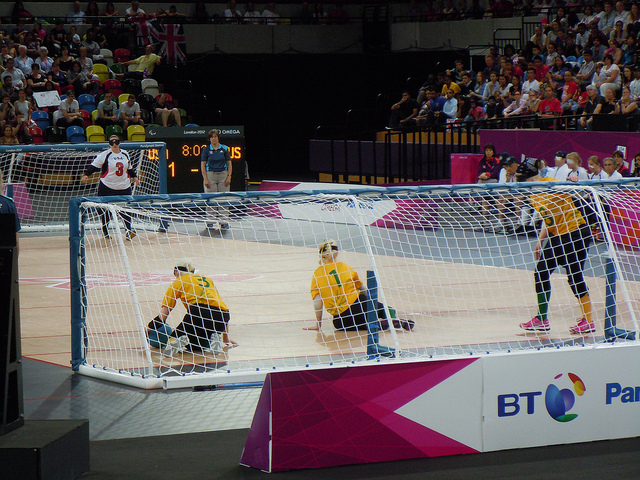
    Goalball at the London Paralympic games. There are 3 people in yellow 2 are sitting one is standing, all in front of a net. Across the court there is one person in white visible in front of their net.
    Goalball at the London Paralympic games.

    This week there has been a lot of media attention focused on the fact that the top 4 runners in the Men’s T13 1500m final all posted faster times than the Olympic Gold Medalist at that distance. The T13 classification is the highest level of functionality of visually impaired athletes so there were no prosthetic limbs or blades involved in the times.  This was the one time I saw quite a few posts about the Paralympics, usually full of shock that Paralympians could run that fast. I replied to every comment with the same question – why should a visual impairment make an athlete run slower? I wasn’t surprised that these men ran faster than the Olympians – they are still elite athletes after all. I think Wendy-Ann Clarke of CBC hit the nail on the head when she reminded everyone that every race at the Olympics and Paralympics is different, especially at a distance like 1500m where strategy plays a big role in race management. The goal at the Olympics and Paralympics is to get a medal – records are secondary. So the athletes are going as fast as they need to to win, but not necessarily as fast as they possibly can.  The gold medal winner at the Olympics, Matthew Centrowitz, controlled the race pace to one that gave him the biggest advantage – which was a slow first 2 laps and then a faster final lap – a tactic that would have forced his opponents to expend a lot of energy to try to pass him earlier in the race which would have drained their resources for later in the race when they needed to push. The T13 1500m final on the other hand had a racer, Bilel Hammami get off to a really fast start and the rest of the runners pushed to try to match it, resulting in a faster race overall.  The assumption that para-athletes are somehow inferior to able bodied athletes has been bothering me for the past few days and is ultimately what inspired this post. Paralympians and Olympians are the top athletes in their sports; of course some amazing times will be posted during the Paralympic games, but the focus should be on the performance in and of itself. Comparing Paralympic times to Olympic times makes it seem like the Olympics are somehow better than the Paralympics when they’re not. The Olympics, Paralympics, Special Olympics World Games, and the Deaflympics are all the preeminent sporting events for the athletes competing. The difference is merely in who competes not in the athletic ability of the competitors.

    %{include image.html url=“/wp-content/uploads/2016/09/Paralympic-or-Olympic.png” alt=“a gold, silver, and bronze medal with the text Paralympic or Olympic an equal accomplishment” description=“A gold medal is a gold medal”}

    All of this got me curious about the origin of the word Paralympic. The games were first contested in 1948 as the Stoke Mandeville Games named after the London treatment centre for spinal injuries. They were not officially named the Paralympics until 1988, but from 1960 on were informally called the Paralympics while formally known as the International Stoke Mandeville Games. The first games in 1948 were only for wheelchair athletes – and early literature refers to the games as the Paraplegic Olympics or Paralympics.  As more categories of physical disabilities were added, the Para in Paralympics was assumed to be the Greek prefix meaning beside. So the Paralympics  run alongside the Olympics. Now, the word Paralympics is recognized as a word in its own right, not as a portmanteau. 

    Paralympics ( Para·lym·pics)  Plural Noun

    1. An international competition for physically disabled athletes, associated with and held following the Summer and Winter Olympic games. 
  • Word Wednesday – New Beginnings

    Word Wednesday – New Beginnings

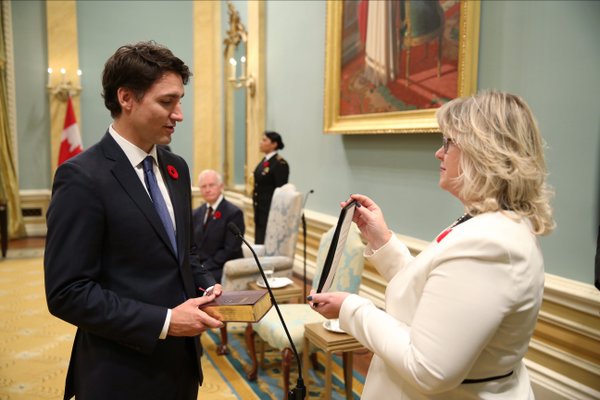
    Canada got a new Prime Minister today. Just 16 days after Canadians voted decisively for real change, Justin Trudeau was sworn in as Canada’s 23rd Prime Minister at Rideau Hall this morning.  While not everyone is happy about this (but honestly no government will ever please everyone), I am excited for the change. I think that the gender equal cabinet (there are 15 female cabinet ministers – the largest percentage of women ever) that is also the most diverse cabinet ever is going to ultimately be a good thing. It’s not like cabinets in recent memory have ever been about putting only the most qualified people into the portfolio that most suited them. There has always been an element of regional parity in cabinet making which already hampers the “best person for every position” philosophy, and I don’t think that any of the 14 women chosen weren’t qualified for their portfolio (besides, the only portfolio that you really need prior qualifications for is Finance IMHO).

    It has been said that Canadians don’t vote a government in, they vote one out – which I think is true. We’re a multiparty country that vacillates between two governing parties in cycles ranging between 8-12 years. Part of me, the political idealist who is mostly hidden, wants to think that this election wasn’t just about voting out a leader who had overstayed his welcome, it was about something much bigger – possibility.

    Justin Trudeau holds a book and swears an oath in front of a female Justice
    The new Prime Minister being sworn in. Photo from @JustinTrudeau on Twitter

    The possibility of a different direction for the country. One open and honest and accessible to everyone. My amazing friend, (I still can’t believe I’m her friend… I feel like she’s going to wake up and realize I’m nowhere near cool enough to be her friend) Amanda, wrote a heartwrenchingly honest letter to our new Prime Minister asking him to keep his promise to make transgender rights a priority. I feel like if anyone is going to be able to help Alexis grow up in a country that affords her the protection and respect she deserves, it is Mr. Trudeau. And if he doesn’t follow through on this promise, I will be right there with Amanda and all the other allies protesting and holding him accountable.

    Already there has been change. Today’s swearing in ceremony was different from any other one in Canadian history – with the public being invited to the grounds of Rideau Hall and with Mr. Trudeau going out and mingling with the crowd. Another amazing woman I know, Amy Boughner, was fortunate enough to be able to go and she got to meet the new Prime Minister and get this picture of him when he was out meeting with the people who came out to witness this historic event.

    Justin Trudeau speaks with a reporter in front of a crowd. He is smiling and wearing a poppy
    Photo Courtesy of Amy Boughner

    I was trying to decide what my Word Wednesday word was going to be, and flipped on the television coverage of the ceremonies, and the words “hope”, “change”, and “new beginning” kept coming up. I think the perfect word to encapsulate the feeling from today is possibility. So that’s my choice for Word Wednesday on this gorgeous November day. Possibility. It’s a word that has positive connotations, and I think it’s a great thing to have positive thoughts at the swearing-in of a new cabinet.

    Stylized text of the word possibility
    Possibility

    Possibility is another word with Latin roots (I always come back to the Latin roots), coming from Latin to French to English – a fairly straightforward etymological progression. The Latin root word is possibilis meaning “able to be done”, which inspired the Old French word possibilite, from whence (yes, I’m aware that “from whence” is redundant, and I’m going with it anyway because it’s less awkward and Shakespeare used it) we get the English word possibility. Possibility – it even sounds positive, and full of hope and opportunity.

    Possibility (pos·si·bil·i·ty ) noun

    1. A thing that may happen or be the case.
    2. The state or fact of being likely or possible; likelihood.
    3. A thing that may be chosen or done out of several possible alternatives
    4. Unspecified qualities of a promising nature; potential.

    So there’s a definite possibility that next week’s Word Wednesday post will have something to do with the word whence, because it’s awesome and makes me happy, and there’s an air of possibility in the new government that took office today.

  • Word Wednesday – Election 42 Edition

    Word Wednesday – Election 42 Edition

    Unless you’ve been living under a rock (or aren’t Canadian), you will have heard that a general election has been called for October 19th 2015. The election period is an unusually long 12 weeks (most are considerably shorter) and I’m already sick of the rhetoric. It’s like the old joke – how can you tell when a politician is lying? His (or her) lips are moving. I will vote come election day, because I was raised to believe that they who do not vote have no right to complain about the government.  Since I happen to quite enjoy complaining about the government, I have to vote. I’m fully prepared to pay more attention to the election – once the summer is over. I have a limited attention span for political doublespeak and it’s definitely not 12 weeks long!

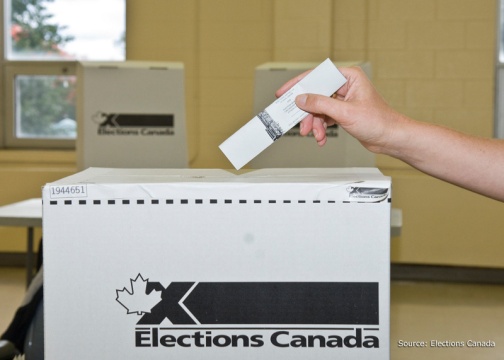
    I’ve worked the last few elections as a poll clerk. I haven’t decided if I want to work this one. For one thing, it’s the day after a big conference I’m really looking forward to attending. For another it’s a really long day and if you don’t have a good partner, it can really suck. The pay is decent though, and it is fun to be a part of the democratic process.

    A hand drops a paper ballet into an Elections Canada ballot box
    Courtesy of Elections Canada

    That said, you’d have to have been under a rock to not have heard something about the first leader’s debate. I chose not to watch it on television or stream it, but instead kept track of who was saying what about whom via Twitter. I noticed, that as politicians are wont to do, there was a lot of prevarication going on. Which gave me the idea for today’s Word Wednesday post. So some good came out of it at least.

    Some of the politically savvy readers may know that as a matter of parliamentary procedure, one member cannot call another a straight out liar in the House of Commons. It has consistently been ruled as “Unparliamentary language” and there’s a partial list of all the words deemed unacceptable here. I’m not sure what the rule on thesaurus use is, because I would like to point out that almost every member is guilty of prevarication on occasion.

    %{include image.html url=“/wp-content/uploads/2015/08/coollogo_com-195076142.png” alt=“Stylized word Prevarication” description=“Prevarication”}

    Prevarication (pre·var’i·ca’tion** ) noun

    1. a false or deliberate misstatement; a lie

    2) the act of deviating from the truth

    Maybe calling someone a liar would be better if we used a fancier word? Don’t accuse your opponent of lying – say they’re prevaricating. By the time they look up the meaning, you’ll be long gone. At least the first time.

    Prevarication has a pretty interesting etymology. it comes from the Latin word praevaricatus, past participle of praevaricari, meaning to act in collusion – or literally to straddle.  The meaning comes from the second half of the word, which has its roots in the word  varus, meaning bowlegged.

    So the next time you think a politician is straddling the truth, don’t accuse them of lying – accuse them of prevarication instead. You’ll say the same thing, but it sounds better.


  • Word Wednesday Part IV

    Word Wednesday Part IV

    So I’m feeling a bit of pressure here. I’m told that the fourth installment of a series should be the best. Many of my geeky friends argue that the fourth Star Wars (Episode IV: A New Hope, which was actually the first one released… so now I’m not sure if it fits my point) is the best one[Yes, I know, some of you beg to differ]. The fourth Harry Potter book (Goblet of Fire for those keeping track at home) was a change of pace from the first three, marking not only the era of longer books but also a darker tone to the series, and is definitely a favourite of mine.  If something is going to continue on, the fourth installment needs to be great. Plus, having missed last week due to some website moving /hosting issues and a few life events, the fourth installment falls on Canada Day. Well let’s hope I hit it out of the ballpark with this week’s word.

    I mentioned this word on my Facebook page last week and one of my friends, Laureen (who, incidentally, has a great blog over at Tempered With Kindness) was very much in support of me using this word for my Word Wednesday post. Even though it’s technically 2 years too early. On the other hand. it’s good to know about this nice and early-like so we can all be prepared when the event happens right? Yep. That’s what I’m going to go with. In 2017, Canada will be celebrating it’s sesquicentennial, meaning the country will be turning 150 years old; so today’s Word Wednesday is sesquicentennial.


    Stylized word sesquicentennial
    The word just rolls off the tongue

    Sesquicentennial – I love the way the word sounds. Six syllable words have a way of rolling off the tongue that makes them amongst my favourite words to say (see also the word amongst which, despite what WordPress seems to think, is a legitimate word). The ‘squ’ trigraph (a phoneme with 3 letters that make a single sound) is one of the word sounds I find really easy on the ears. So any word that has 6 syllables and the ‘squ’ trigraph is doubly awesome.

    As a note, sesquicentennial is relatively young as a word – though the components are old. The word comes from combining the Latin words sesqui, which means one and a half times, and centennial, which comes from the the Latin word for 100 (centum). Putting them together we get sesquicentennial meaning the 150th anniversary of an event. According to the Mirriam-Webster dictionary, the first known use of sesquicentennial was in 1880 for the city of Baltimore’s 150th anniversary.

    Canada’s sesquicentennial  celebration is going to be awesome, with lots of events already being planned. I remember the celebrations for the 125th anniversary of the creation of Canada, and the sesquicentennial  celebrations promise to be bigger. Maybe not as big as the centennial in 1967, because there’s no Expo ’67 like event going on and I’m not sure if the provinces are going to create ear-worm like songs (Ontari-ari- ario anyone?) for the sesquicentennial but it’s going to be a great party.

    Sesquicentennial (ses-kwi-sen-ten-ee-uh l) Noun  – A 150th anniversary or its celebration.

    I’d be remiss if I didn’t include a few quintessentially Canadian pictures in honour of the day.


    The CN Tower lit up in our National colours red and white
    The CN Tower lit up in our National colours
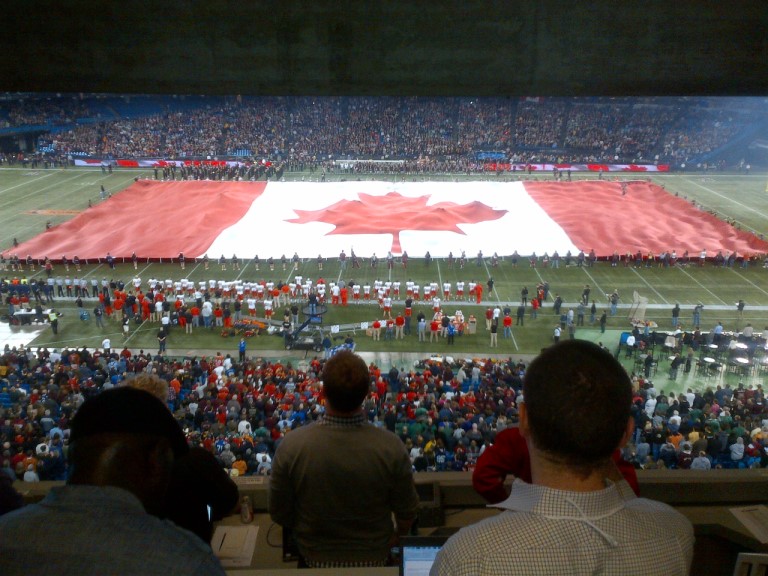
    A giant Canadian flag that takes up most of a football field.
    The giant Canadian flag that was unfurled on the field at the 100th Grey Cup game in Toronto.
    A loon swimming on the lake
    A loon swimming on the lake


  • Science really does Rock!

    Science really does Rock!

    As a kid, one of my favourite places to go in Toronto was the Ontario Science Centre. Between the bouncy bridge, the electrostatic ball that made my hair stand up (mine went straight up and out to both sides), making paper, and the machine that said “coffee” in different pitches, it was a great place to spend a day. I went with school, with my parents, and with Girl Guides – usually at least a couple of times every year. Then when I was a teenager, I didn’t go as often – and when I did go I was helping out with younger cousins or my Brownie unit. As an adult, my experience with the Science Centre has been as a leader with Girl Guides (which includes 2 “Sleepovers” with my Brownie unit which mainly consisted of me chasing down 7 year olds who didn’t want to sleep at 3 am and trying / failing to convince them to go back to their sleeping bags) and taking my friends’ kids around the exhibits. While I won’t do another sleepover soon (my Pathfinders prefer to camp and are too old for the official “Sleepover at the Science Centre” program), I have quite enjoyed taking my friends’ kids to the Science Centre. The one problem I’ve had is that the while the Ontario Science Centre has a lot of exhibits that are of interest to adults, it can be hard to see them and almost impossible to interact with them when there are kids around. I mean I’m not going to push a little kid out of the way so that I can play with a fun exhibit – that’s a jerk move if ever there was one. Besides, it’s hard to enjoy the exhibit when you’re also watching to make sure that little Janey doesn’t disappear again or that little Johnny isn’t punching the kid behind him in line. [Please tell me I’m not the only one this happens to out in public]

    All of this is why, whenI heard about ScienceRocks! at the Ontario Science Centre I knew I had to go check it out. ScienceRocks! is a chance for adults (19 + as there is alcohol available for sale) to explore the amazing Science of Rock and Roll exhibit without any children present. I got a couple of girlfriends together and we met up at the Science Centre not sure what to expect but hoping for a fun girls night out at the very least. We were clearly not the only ones with this idea, and a number of couples seemed to have chosen the event as a great place for date night. If you have only been to the Science Centre with kids in tow, you need to come and see it after dark.  There is something about walking through the Science Centre sipping on a gin and tonic that makes you feel like a rebel.

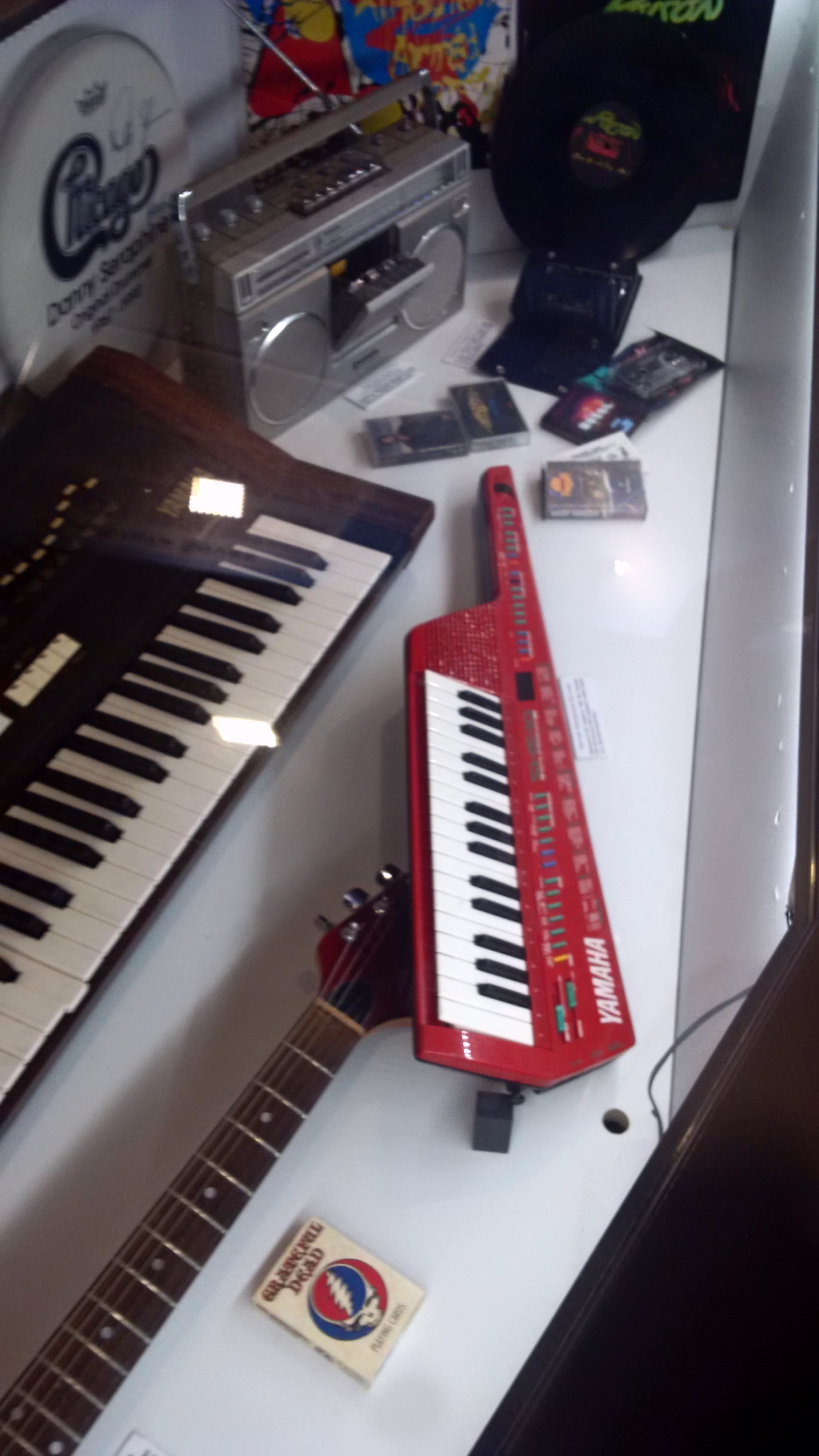
    A collection of instruments and music memorabelia in a display case including a red keyboard with a guitar neck and a strap, a boom box portable stereo, cassette tapes, and an electronic keyboard.
    The Keytar is from the 1980s time capsule.

    There were so many things to do that I stayed for the whole event (which runs from 7pm-midnight).  I didn’t get a chance to see the IMAX movie about the Rolling Stones (but am aiming for it this time).  I did, get a rock and roll makeover courtesy of The Beauty Team. It was amazing.  I sat in the audience and listened to League of Rock do a few numbers (though if you’re more ambitious than I am, you can actually play with them).  I watched and participated in a presentation on neuroscience and music where we had to clap out different rhythms at different tempos. I ate some of the Fleetwood Mac n’ Cheese (topped with pulled pork – it was amazing).  Then, after taking in all of the various attractions, I headed into the main exhibit.  The Science of Rock and Roll exhibit has something for everyone!  I loved the history exhibits with artifacts from different decades in rock history.  The reactables were a lot of fun to play with and distort all the music and see what effect changing the balance or the instrumentation has on a piece of music. The hands on demo with the different instruments that make up a typical rock band was a ton of fun – I especially enjoyed the left handed bass guitar.  All the adults lined up nicely to take turns and nobody felt bad about trying things out because we weren’t taking time away from a kid who wanted a turn.

    All in all it was one of the most fun nights out I’ve had in a long time. Sorry you missed it?  Don’t be – there is still one more ScienceRocks! Adults Only night left – Thursday September 18th!  The event on the 18th features all of the fun of the earlier dates plus a ukulele choir (I have to admit, this intrigues me).   There is a hands on session where you can make your own cigar box guitar to take home which looks pretty awesome. The headliners for the evening are Steve Cropper and Jonny Rosch.   I’m looking forward to finding out what Johann Sebastian Joust is all about.  It sounds fun.

    Tickets are $15 in advance or $18 at the door for non members and $12 in advance or $14.40 at the door for members.  Parking is free.

    For more information and to purchase tickets, head to the Ontario Science Centre website.


  • Remember

    Remember

    Remember   verb ri-ˈmem-bər

    1. To retain in the memory; keep in mind; remain aware of.

    2. To recall to the mind by an act or effort of memory; think of again.

    (Source: Dictionary.com)

    Today is the last Friday in October, which means that it’s the start of Poppy Campaign by the local branches of the Royal Canadian Legion.  I have worn the same poppy for the past three years but I always make a donation into the box whenever I see a volunteer giving out poppies.   It’s a common misconception that poppies are for sale.  Poppies are not for sale, rather they are freely given away.  You can choose to make a donation but it is not mandatory.  According to the website of the Royal Canadian Legion, “During the Poppy Campaign some 18 million poppies and 70,000 wreaths, crosses and sprays are distributed across Canada and overseas annually”.  18 million poppies.  The number is staggering.  When you make a donation to the Legion through the annual Poppy Campaign, the money is used to help veterans and the families of veterans.  The main purpose of the Poppy Campaign, though, isn’t to raise money but to remind Canadians of the sacrifices made by over 117,000 Canadians who died in service to their country.

    With the Canadian involvement in Afghanistan in recent years, Canadians have begun to think more about military service and what it entails.  Canada is very fortunate.  2012 marks the 200th anniversary of the war of 1812, the last war fought on Canadian soil.  As a nation, we do not know first hand the horrors of war.  Our military, however, is full of brave men and women willing to forgo the safety and comfort of their home and native land and serve in countries such as Afghanistan, the Democratic Republic of Congo, Egypt, Kosovo, Cyprus, Sudan, and Libya as well as protecting Canadians here at home.   All veterans, regardless of whether they were involved in military action overseas or remained in Canada are eligible for membership in the Royal Canadian Legion.  Regardless of military service, all Canadians are eligible to become members of their local legion branch.  Like donating to the Poppy Campaign, Legion Membership is another way to help support the terrific programs and services that the Legion provides.

    A red lapel poppy with a black centre
    My 2012 Poppy.

    Back to the poppy though.  One of the most common misconceptions about the poppy is that it is somehow promoting war or militarism when in fact the opposite is true.  The poppy is an international symbol of remembrance, our promise to those who died so that we could be free that we will not forget their sacrifice.  Rather than promoting militarism, the poppy is our unspoken vow to the fallen that their death shall not have been in vain; our promise that we will strive to keep the peace that they fought so valiantly for.   Wearing a poppy over the left lapel of your coat or on the left side of your shirt (close to your heart) is a way every Canadian can say thank you to the brave men and women who made the ultimate sacrifice.

    This year, Remembrance Day is on a Sunday.  I truly hope that everyone who is able comes out to a cenotaph near them to pay respect to our veterans.  Every year the number of World War II and Korean War veterans diminishes.  We owe it to all of our veterans to have a strong turnout at cenotaphs across the country this year.  It is likely that this is the last weekend Remembrance day with many of our WWII vets.  Having been fortunate enough to spend time with veterans at my local Legion branch for the past few years, I can assure you that the veterans appreciate it when people take time out of their busy lives to attend a Remembrance Day ceremony.  If you cannot attend, please observe two minutes of silence at 11 am on November 11th.

    I close now with the words of the poet Laurence Binyon (1869-1943) in his poem “For the Fallen”, that are spoken at Remembrance Day and memorial services around the world:

    They shall grow not old, as we that are left grow old:
    Age shall not weary them, nor the years condemn.
    At the going down of the sun and in the morning
    We will remember them.

    How will you remember?

  • Random thoughts on a CFL standard

    Random thoughts on a CFL standard

    I know a lot of CFL teams have at least one “football 101” day for women to learn about football.  Today, as I was explaining some of the basics of the game to a friend, I wondered why they don’t have the same thing for men.  Are men supposed to just know about football?  is there something in the Y chromosome that makes them know all about football?  What about recent immigrants from countries where there is no football tradition?  I don’t know how well it would go over but I’m thinking there might be a demand, even as part of the game day for a team.  In one of the commercial time outs, instead of some inane promo thing, (or even after one of the short ones), show a play or a formation on the scoreboard and explain it.   I think that you’d get more people coming back to games if they knew what was going on on the field.

    I had a friend from high school, a very smart woman, who when watching her first live CFL game asked “where’s the yellow line” – referring of course to the line that is generally added by television to show where the first down is.  Naturally since this line is added in production, you can’t see it in the stadium.  Her boyfriend at the time (now her husband), nearly choked himself laughing.  It’s not that it was a dumb question but it was one he had never thought of, having watched very few games on TV.  Everyone coming to the CFL for the first time is going to have questions.  Simple things such as what a first down is.  Why a team is kicking a field goal when they are, what a 2 point convert is, onside kicks, simple offensive and defensive formations, man versus zone defensive schemes.

    What about you, football fans?  what else would you love to know more about?