Category: Reviews

  • How my BlackBerry Passport Equals Mobile Freedom

    How my BlackBerry Passport Equals Mobile Freedom

    It’s no secret that I love my BlackBerry devices. I have a BlackBerry in my hand for a good 60% of the day.  One of the things I love most about BlackBerry is how easy it makes it to work on the go. I wrote about my Blackberry Classic  and how much I loved it and the difficulties in choosing a case for it. I’ve found the same thing with my BlackBerry Passport. I love the Passport even more than the Classic. At first I thought it was going to be too big. I looked down at the device in the box and thought “I’ll probably be using the Classic again within a month”. Well, I was wrong. So very wrong. The Classic has found a new home in the hands of my dad, and the Passport is mine, all mine. I mentioned with regards to the Classic how much I had missed the physical keyboard even though I had loved my Z30 with all my heart. Well the Passport takes the keyboard experience to a whole new level. It just feels right.  The screen width on the Passport makes reading text a breeze – the wider screen allows more characters which reduces scrolling (and makes me a happier reader). Contrary to what I thought before I had a Passport, the Passport does fit in my pants pocket, and in my purse, so it goes pretty much everywhere I go. I have a BlackBerry hard shell case on it 90% of the time and a Folio case with a credit card slot the rest of the time (It’s an aftermarket one, but needs improvements if it was going to be a daily driver).

    Last fall, I talked about the Blissdom Canada Social Media Conference and how I presented a micro-session there. What I didn’t say was that I did most of the planning for that session on my BlackBerry Passport. I didn’t want to have to carry my laptop around for the day, or make the trek back across Blue Mountain Resort to drop it back in my room. Instead I used Docs to go, and planned out my entire presentation on my mobile device. I travel 1-2 days a week and work remotely. Lately I’ve been doing all the work I need with just my BlackBerry Passport. I have a list of clients and projects on the go in BlackBerry Remember – I love how easy it is to add notes to items or mark items as finished and how I can flag email messages and attach them to the task list so that I’m not constantly going back and forth to check details from an email. I currently have 14 projects on the go and they’re all lined up neatly within the Remember app. In May, I’m going to be speaking at ROAM – another Social Media event – this time in Vancouver. My travel arrangements are in BlackBerry Travel – including confirmation numbers, hotel phone numbers, and event details. If someone asks me where I’ll be on one of the days when I’m in Vancouver, all I have to do is open BlackBerry Travel and all the information is right there.  I’m not taking my laptop to ROAM either. Having attended a number of conferences in the last 12 months and presented at one, I’m confident that my BlackBerry Passport will be all I need to work on the go.

    Working remotely via the BlackBerry Passport is awesome. One of the things that I love most about working from my BlackBerry is that unlike some other phones where you can only edit or view a document on the go, my BlackBerry Passport allows me to start a new document or spreadsheet, so I can start on a new project before I get back to my computer.  Given that the vast majority of my work is done in either Excel or Word, the ability to start documents is a must. There are so many little things to love about my Passport too – The Hub, for example. I’ve written about my love of the Hub before but it’s at a new level now that I’m emailing attachments almost daily. I love that I can search through email attachments directly from the hub while I’m on the phone with a client – there’s no lost time, which is good since I have very little to spare these days.  I love the way my Passport looks too – fashion isn’t a deal-breaker for me but it’s nice when function and fashion meld together so seamlessly.

    %{include image.html url=“/wp-content/uploads/2016/04/IMG_20150515_162425_edit.jpg” alt=“A BlackBerry Passport – a square shaped cellphone with a physical keyboard in a box” description=“I think this is one of the coolest looking phones out there.”}

    My Passport battery gets me through the work day – and I’ve been told I’m exceptionally hard on battery life due to the number of high drain apps I like to run at the same time. I use Facebook a lot for business these days, and while the loss of the dedicated Facebook app was hard on me, I actually enjoy the mobile browser experience more in terms of the capabilities to manage my pages. I’ve been off of Twitter lately due to some ugliness there, but check in via Blaq or the native Twitter app daily even if I’m not tweeting as much. I’m hoping that the problem has been solved by my recent blocking spree, and will be back to using Twitter to talk about the things I love.  Instagram – while there isn’t a native client for Instagram, there is a great app called Igrann that gives me all the access I need to take amazing photos and share them with the world. I love how easy it is to edit pictures in the native BlackBerry photo editor and a huge bonus is the 1:1 ratio that is the default on the Passport – making all my pictures perfect for Instagram without cropping (Yes, I know cropping is pretty simple but hey…saving time and effort is awesome). The Passport camera is amazing and I love taking effortless panorama shots.

    A panoramic view of the football field inside skydome taken from the 200 levels. There are players warming up on field and fans in the stands.
    Panorama picture from the last Argos game at the Rogers Centre. I love how panorama mode allowed me to capture everything in one shot.

    I use BlackBerry Messenger to set up meetings more than I use email now. I’ve convinced quite a few of my clients to try out BBM for Android or Iphone (those that aren’t already on BlackBerry devices) and love how easy it is to chat, add pictures, and even send works in progress back and forth over BBM. I could do that over text message I guess, but then I’m using MMS which can be expensive for some people, while BBM works over wifi.  I’m not a heavy email user – I probably send 25 a day and receive about 100 that I need to read, but I use my BlackBerry Passport about 95% of the time when I’m sending or reading emails. It’s just that much more convenient.  I also use my car’s Bluetooth connection and have the BlackBerry Assistant read emails to me if I’m driving when an important email comes in.

    Recently one of my friends joked that BlackBerry devices seem to be an extension of me – whether it was my Z30, my Passport, or my Classic, they seem like natural extensions of my body. I choose to take that as a compliment. We are well suited for each other – BlackBerry devices enable me to keep my busy life organized and allow me to work wherever I find myself as long as I have a signal. I couldn’t imagine trying to do what I do without a BlackBerry in my hand – I’m pretty sure it would be theoretically possible, but I know it wouldn’t be anywhere near as enjoyable. Have questions? Feel free to leave them below or find me on Social Media – I’m always willing to help #TeamBlackBerry.  Oh and this post? I wrote it entirely on my Passport – all 1300 words.


  • Board Games I Love

    Board Games I Love

    I admit it, I’m a board game fanatic.  Luckily I have a great group of friends who also love playing board games and we get together 1-2 nights a month to play.  I own a lot of games myself, and though there is some duplication in collections (Many of us own Settlers of Catan for ourselves, along with Dominion and Carcassonne) I’d say that between all of us we have at least 500 unique games / add ons to games / variants of games. That’s a LOT of choices – though some get played very rarely (I’m looking at you Risk and Axis and Allies). Board games are my favourite choice for a night out with friends since it’s social without being in a loud restaurant or at a movie and I don’t have to have pre-read a book like at book club. I’m going to list my current 5 favourite games – though the list changes frequently as I discover new games or rediscover games I had forgotten about – with a bit of a description of the game and my thoughts on playability.

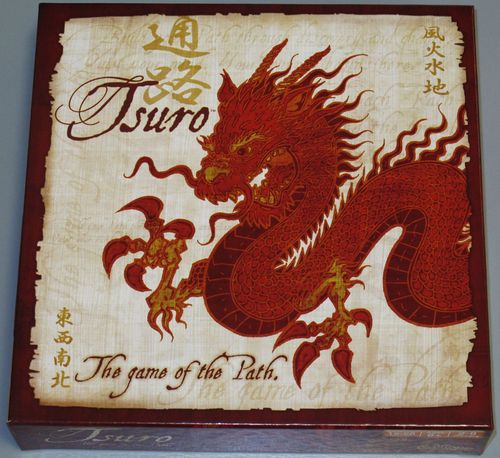
    5) Tsuro

    A square board game box with a large dragon on it. Text reads Tsuro The Game of the Path
    The rules are simple but winning is not

    I was only introduced to this wonderful game recently, and while I don’t own it, it’s definitely on my list! The game is really quick (averaging 15-20 minutes) and a great “appetizer” in front of longer games or one to play while waiting on people to show up. The premise is simple -each player has a token and a tile in front of them. You create the board as you go along, with each person playing one tile per turn. Your token moves along the path you are creating.  The goal of the game is to be the last one still on the board – tiles can move you off the board, at which point you are out. As the game progresses, your token may be affected by other players who want to knock your token off the board. The game is gorgeous to look at and elegant in its simplicity. It can have anywhere between 2-8 players and the recommended age is 8 years and up. I highly recommend it.

    4) Ticket To Ride

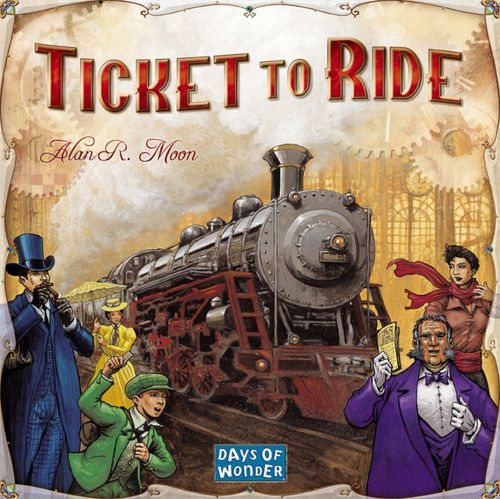
    A square box with a steam locomotive engine and drawings of people from the early 1900s. Text reads Ticket to Ride
    There are many variants to this game

    I was introduced to Ticket to Ride by friends soon after the European map came out in 2005. It was a lot of fun to play and I really liked that it was a strategy game that could be learned in about 15 minutes and played in 30-45 minutes. While several of my friends prefer the European map because it has stations that allow you to connect your trains through cities that would otherwise be inaccessible because others have played there, I love the North American map because it doesn’t have stations.  You really need to plan your strategy. The object of the game is to collect and play matching train cards to claim railway routes between cities. Trains of differing lengths have different point values. You can also score points by finishing destination tickets (connecting 2 distant cities by trains), and there are bonus points for longest route.  The game play is very simple with only 3 possible actions each turn (drawing train cards, playing a set of train cards to claim a route, or drawing more destination tickets) so the game pace is very quick.  Ticket to Ride is for 2-5 players ages 8 and up.  It’s lots of fun and is considered a “gateway” game to introduce people to tabletop gaming.

    3) Qwirkle

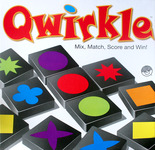
    A square box with black tiles featuring symbols in a variety of colours on it. Text reads Qwirkle
    I own both the large size and the travel size versions of this game

    Qwirkle falls into the category of what I would describe as deceptively tricky games.  The premise is really simple: match tiles either by colour or by shape. There are 108 tiles total – 3 sets of 6 different shapes in 6 different colours.  The catch is that you must play your tiles in a line and that the lines cannot contain duplicates and must contain a tile that matches either the shape or colour of the line you are joining.  You get a point for each tile in the line(s) that you play, and a bonus of 6 points for completing a set of 6.  The tricky part comes in the strategy – do you play your tile knowing that your opponents may be able to finish the line of 6? Do you wait and hope you draw the needed tile? Will someone else block the space you need? It can be really hard to pre-plan moves because the board changes with each player’s turn.  Qwirkle is for 2-4 players aged 6 and up. I’ve played it with both kids and adults and everyone enjoys this game – especially since it takes between 30-45 minutes for a game.

    2) 7 Wonders

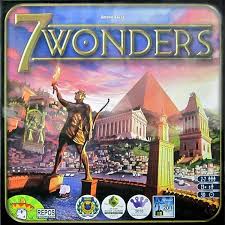
    A square box with images of the 7 wonders of the ancient world on it. Text reads 7 Wonders
    This game is definitely more complex but I love it

    This game isn’t considered to be an introductory game, though there’s no real reason it couldn’t be.  It’s fairly complex but once you’ve played it through, it has a high replay value. 7 Wonders is essentially a card development game – you build cards to either help you now or help you later. The game has 3 stages and each stage has different cards in it (and they tend to go up in cost as well as point value). The object is to have the most points and there are tons of different ways to gain points. You have a deck of cards to begin the stage and then choose one card to build immediately and pass the rest on to your neighbour (on left or right depending on the stage).  You can also bury your card to build a part of your wonder (which usually gives points at the end of the game). That’s where the strategy comes in – which card do you build / bury knowing that all the rest are going to your opponent. (Cards move around after every turn and you display what you built immediately so you know approximately how you are doing in relation to the other players). It is very possible to overthink the game or try too many strategies and fail at all of them. It’s also possible to have no real strategy at the beginning and still win. I’ve done both. 7 Wonders takes between 10 and 15 minutes to set up and between 30-45 minutes to play depending on how long each person takes to decide what they are doing each turn.  You can play with 2-7 players (I’ve never tried 2 player) and the recommended ages are 10 and up. If you take the time to learn to play, it’s a great game to pull out with friends.

    1) Bananagrams

    A banana shaped yellow cloth bag with a zipper at the top and the word Banagrams on it
    The bag is part of the appeal here

    I’m a word geek. I loved scrabble but finding people to play against me was always hard.  I also didn’t like having to have a board and the restrictions the board imposed on gameplay or having to wait for the other players to play before I could enter my next word. Enter Bananagrams. In Bananagrams, each player works independently to create a crossword grid of words using letters from their own pile.  Everyone starts with the same number of letters, and when one person has used up all their letters, each player picks up an additional tile from the joint pool. When there are no tiles left to pick up, the person who uses all their tiles first is the winner. It seems easy but you only have your own words to build off of, and there are no letter values so being stuck with a Q and no U or a Z just makes it harder to play instead of giving you extra points. That said, it’s a fantastic mental challenge and lots of fun for 1-8 players to play at the same time. A game can last as short as 10 minutes depending on the speed at which players can use their letters. The game is best for ages 7 and up as you do need to be able to spell enough words to make use of the tiles.   It’s a fun and very portable game that can be played pretty much anywhere.

    So those are my 5 favourite games right now. Tell me in the comments what games your family enjoys!

  • Book Review – Somewhere in France by Jennifer Robson

    Book Review – Somewhere in France by Jennifer Robson

    I’m a historian, and as such, I’m generally leery of reading historical fiction set in the time period I studied – World War One.  Small inaccuracies can drive me crazy.  Especially ones that I consider to be lazy – when the author didn’t do his or her research and messed up dates or places. Or when they have a character write a letter from France and their loved one in England gets it within days.  That rarely happens now, it sure as heck didn’t happen with a war going on and mail being censored.  When I saw the cover of Somewhere in France, I was intrigued. I have friends who really enjoyed the book and I wanted to love it but I was afraid it wouldn’t live up to the high expectations I have for World War One historical fiction. I needn’t have worried.  Jennifer Robson has set the new bar for the genre. From the first page I was captivated and unable to put the book down until I had finished. (Total time elapsed – 2.3 hours.) I then went out the next morning and bought the sequel, After The War Is Over, and proceeded to devour it. Then I re-read Somewhere in France.  Re-reading a book isn’t all that uncommon for me, but re-reading a book less than a week after I first read the book? Now *that* was a first.

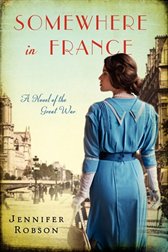
    The cover of the book Somewhere in France by Jennifer Robson. A woman dressed in a blue dress that evokes the 1910s looks  out over a sepia toned image of a French street from the same era
    The cover art is absolutely gorgeous.

    I made an instant connection with the character of Lilly Ashford. I loved her spunk, and her unwillingness to do what others (mostly her parents) wanted her to do with her life and instead follow her heart. I adored the fact that the life she was running away from is the life many of us think we would want – that of an upper class gentlewoman. I may have connected first with Lilly, but every single character in the book was well written.  I felt connected to all of them. Edward, Robbie, Charlotte – each character stole a piece of my heart, I wanted to know everything about them.  I wanted them to be real.

    For a historian, the best part about Somewhere In France is the rich detail that is woven into the narrative. The characters were figments of the imagination but the setting was real.  There really was a Women’s Army Auxiliary Corps (WAAC), and the jobs described in the book such as ambulance driver (Lilly’s chosen vocation), catering (I love the positive spin the Brits put on “mess hall duty”), clerical, and motor transport were actual jobs filled by women during the war in an effort to free up men for front line service.

    The plot moved along at just the right pace, and the side plot with Edward (Lilly’s Brother), kept me on the edge of my seat until the last page.  The ending was perfect, and left me wanting more, which is why I went out and picked up the sequel After The War Is Over.  I would recommend this book to anyone who wants a great piece of fiction that is steeped in the truth. The book doesn’t sugar coat the war, or leave out the tough parts in favour of a love story – it blends the two together perfectly.

    The mini essay “Women Ambulance Drivers in the Great War” which appeared at the end of my copy of the novel went a long way to explaining why I adored the book. Jennifer Robson wasn’t content in finding a single source to prove that there were female drivers in clearing hospitals near the front lines, she dug and dug until she unearthed multiple sources. Truly an author after my own heart.

    My recommendation for Somewhere in France is this: go out and get this book immediately.  Read it, and prepare to have your heart stolen.

  • Book review – Juliet’s Nurse by Lois Leveen

    Book review – Juliet’s Nurse by Lois Leveen

    The Roman Philosopher Marcus Aurelius said that: “Everything we hear is an opinion, not a fact. Everything we see is a perspective, not the truth”. This is true even of the greatest works of fiction. The stories we know and love come to us from one perspective – that which the author has chosen to give us. Major characters are (usually) well developed and minor characters are often not given a second thought by the reader.

    In Juliet’s Nurse, we are presented with an alternate view of characters in William Shakespeare’s famous play Romeo and Juliet. Told from the point of view of Juliet’s wet-nurse, we get to meet Juliet and the Cappelletti (aka Capulet) family from the day of her birth until her tragic demise. Juliet, however, is not the focus of this rich and well written tale – though without her there would be no story – it is instead her nurse whose life we step into in this book.

    %{include image.html url=“/wp-content/uploads/2015/03/juliets-nurse.jpg” alt=“Book cover with the title Juliet’s Nurse by Lois Leveen. The cover art is a Renaissance style painting of 2 people laying across the top and bottom of the cover respectively. You can see the face and hand of the top person who presents as female and the lips, chin, neck and torso of the lower figure whose gender is indeterminate” description=“The cover art got me again”}

    The story begins with tragedy as Angelica (the nurse) loses her own child; in an attempt to ease her grief, her husband, Pietro, finds her a position as a wet-nurse to the Cappelletti family.  The author takes us through Juliet’s childhood years, while also giving life to another minor character in the play – that of Juliet’s cousin Tybalt.  Indeed, it was Tybalt who captured my heart in the story – the descriptions of his childish antics were so vivid that I could see him outside the nursery scaling trees and getting into mischief as if looking through a window.

    The book is divided into two parts, with the first part being considerably longer than the second.   The back-story, the history, and the years between Juliet’s birth and her teenage years are covered in lavish detail.  The second part deals with the story as we already know it – but with the added benefit of Angelica’s point of view and with a more robust character to Tybalt.   The book is rich with details of everyday life in 14th century Verona, right down to the descriptions of the designs for the dresses worn to the now infamous masquerade ball.  As a work of historical fiction, Juliet’s Nurse reminded me of the works of Eva Stachniak author of The Winter Palace  and Empress of the Night, in the way the reader was able to vividly visualize the scenes.

    As a lover of history, and of Romeo and Juliet, I really enjoyed this new take on an old classic and think that it is a wonderful choice for a spring reading list.

  • Book Review: Emily Giffin’s The One and Only

    Book Review: Emily Giffin’s The One and Only

    %{include image.html url=“/wp-content/uploads/2014/09/toao_100-1-3-2.jpg” alt=“TOAO_100 1 3 (2)” description=““}

    For those of you who don’t know me, I’m a complete and total football junkie and have been since I was a toddler.  I’m also an avid reader and quite enjoy the genre known as “chick lit”. One of my favourite writers in this genre has been Emily Giffin . I find her work engaging and fun to read with characters I can relate to. Given this, imagine my glee when I found out that Giffin’s latest book, The One & Only,  was going to feature a female football reporter as the protagonist. I may have squealed. Loudly. Then I made an almost fatal mistake – I crowd sourced. I often hit up Goodreads when I find a book I like just to see what others have thought about it.  I saw a lot of negative Nellies complaining about the book making generalizations about women who love football always being in it for a guy, that there was too much football (no such thing imho) and not enough plot, or that the characters weren’t relatable. I hate feeling disappointed or let down by an author I love so I put the book aside for a few days to think about whether or not I wanted to read it. I took it up to the cottage with me because I’m always running out of books to read (especially when the weather is as dismal as it was this summer, rainy and cold for most of my vacation) and I’m really glad I did. Had I not read the book based on those few Goodreads users who really disliked the book, I would have missed out on one of my favourite books so far this year.

    I could immediately relate to the main character, Shea Rigsby. I lost track of the number of times I said “Oh My God, Yes. That.” while reading after the first 3 chapters. I thought there was just the right amount of football details in the book, especially considering that a portion of the target audience wouldn’t have much prior knowledge of the intricacies of the sport. Giffin was careful to give readers enough information to be able to understand how football worked within the context of the plot but didn’t overload readers with useless tidbits. Being Canadian, I am more used to how college football works up here, so the extra insight into the NCAA and how the organization impacts every team was eye opening.


    The One & Only isn’t just a book about football though; it is a book about love, loyalty, football, and change. None of these themes operate in isolation and they all complement each other beautifully to make this book impossible to put down. I think almost every reader can relate to Shea’s struggle to follow her heart and the questions of loyalty that doing that create for her. We have all been in Shea’s shoes at one point in our lives – trying to decide if we should step off the edge into the unknown or stay close to home, with our security blanket. For Shea, stepping off the edge means leaving the town she grew up in, the one where her best friend lives, where she went to college, and where she got a job working for the athletic department at the school. Shea has begun to wonder if all she has ever known is enough – or if there is something better out there in the wider world.  Along the way, Shea finds that some of the people in her life aren’t who she thought they were and that loyalty is more than wearing a team jersey on game day.  In essence this is a coming of age novel, where the protagonist is left to discover The One and Only thing that makes her life worth living.


    In the end, I was not able to put the book down until it was finished and have re-read it once already and recommended it to random strangers in bookstores if I saw them hovering near a copy of the book. The moral of my story is pretty simple – don’t judge a book by it’s cover (although this one is gorgeous and understated and perfect), and don’t be put off by a few negative reviews on a social media site. You may miss out on an amazing read.


    The One & Only is available in Hardcover, Trade Paperback, Audio, and E-book editions.