It comes as no surprise to those who know me that I’m a sports nut. Football (particularly the CFL and the Toronto Argonauts, but also the NFL and the Detroit Lions) was and continues to be my first love, with Auto Racing (Formula 1, IndyCar, and NASCAR in that order) a close second. Third place has changed a few times – most of the time it’s Baseball, unless the Olympics are on, with Hockey and Basketball tied for fourth in my hierarchy of sports. Living in Blue Jays’ country (which, technically is all of Canada since they’re the only professional baseball team in the country) though, it’s hard not to get caught up in the excitement that has been gripping the Toronto sports community.
Skydome at its finest. Image courtesy CTV News
Yes, I scream at the television whenever a commentator says “the city of Toronto has been starved for a championship” because the Argos won the 100th Grey Cup in 2012, also taking home the title in 2004, 1997, and 1996 since the Blue Jays last won the World Series in 1993. Despite that, I get it. This city really wants to be seen as a world class city and part of that is having a championships in one of the 3 professional sports (Hockey, Baseball, and Basketball) played in both Canada and the United States. As the Blue Jays season has progressed, so has my interest in watching baseball. Which brings me to today, and scheduling work around being able to watch the first game of a doubleheader against the Baltimore Orioles, to see if the Jays could clinch their first division title since the world series win in 1993.
The Blue Jays clearly knew the importance of the game and worked hard to get out in front, never looking back. After the game, and despite the fact that game 2 of the doubleheader was set to start half an hour after the end of the first one, the team erupted onto the field. Which brings me to today’s word Wednesday word: Jubilation. It’s the perfect word for the look on the faces of the Blue Jays’ players, coaches, and management. It is also what many long suffering Toronto sports fans are feeling tonight.
Jubilation
Jubilation comes from Middle English (with a nod of the head to French)jubilacioun, which in turns, come from Latin jūbilātiō which means to shout for joy. Seems pretty fitting for a team that was jumping around and shouting as soon as the final out was recorded.
Jubilation (ju·bi·la·tion) noun
great happiness or joy
an act of rejoicing : the state of being jubilant.
Now, I’m going to go back to watching the second game to see the further jubilation that ensues when the Jays are able to fully celebrate when the second game is over.
In case you haven’t guessed I’m pretty passionate about my work with kids who have autism. This means that I occasionally get pulled into some of the Autism wars. I firmly believe that there are very few black and white situations in life, and even fewer in the world of autism. There’s a saying that if you’ve met one person with autism, then you’ve met one person with autism. Which is all well and good except it really doesn’t only apply to people with autism. Every person is different, and one-size-fits-all thinking should really be called one-size-really-fits-none.
Recently one of the kids I work with was told that he needs to stop calling himself “autistic” and use person first language, saying, “I am a person who has autism”. I understand why person-first language is great and why it should be the default when dealing with people you haven’t met. However, when someone who HAS autism, declares a preference for the term “autistic”, who are we to judge? This is a conscious decision made by the person most affected by the language and I, for one, will support his choice as well as his right to change his mind if he wishes to in the future.
The one thing I am very ardent about is the fact that I don’t see autism as a disease that needs to be cured. In fact, I don’t see it as a disease at all. I am a strong believer in the neurodiversity paradigm and the belief that autism is part of the natural neurological variance found in humans. The neurodiversity paradigm, has 3 main tenets: 1) that neurodiversity is a natural and valuable form of human diversity; 2) that the idea that there is one “correct” form of neurocognative functioning is an artificial construct and is no more helpful to society than the idea that there is one “correct” form of gender or ethnicity; and 3) that the social dynamics relating to neurodiversity are no different than the social dynamics of other forms of human diversity (ethnicity, culture, gender), including and especially that this diversity, if embraced, can be a source of creative potential.
I believe that people with autism should be welcomed into society and that we shouldn’t be trying to change them to become more like neurologically “typical” people. That isn’t to say that I believe we should abandon all programming and services for people with autism, because I believe that as they are neurological outliers on the bell curve, the world isn’t geared towards them and so there are some skills that need to be learned in order to have life be less frustrating for them and for those who care about them. In honour of this belief, today’s Word Wednesday word is neurodiversity.
Neurodiversity
The neurodiversity movement is relatively young, about 20 or so years old. The term was coined by an Australian social scientist who was on the autism spectrum, and has become more and more widespread as time goes on. The movement encompasses more than just the autism community now – other neurological differences such as learning disabilities (LD), obsessive-compulsive disorder (OCD), attention deficit hyperactivity disorder (ADHD), and bipolarity are part of the neurodiversity movement. I think part of the reason I like the neurodiversity movement so much is because I’ve always considered myself neurologically diverse – I have a learning disability, ADHD, and was identified as gifted in school – the triple threat of neurological differences. So I’m clearly in the neurodivergent camp.
The word is a compound word – comprised of the prefix neuro – which is from the Greek word neuron – which means nerve and is used in medicine to refer to things relating to the brain. The word diversity comes from the Latin word diversus – meaning separate, opposite, or different.
Neurodiversity (neur-o-di-ver-si-ty) noun
The infinite variation in neurocognative functioning in the human species.
I spent a lot of time this summer with my eyes turned towards the skies. Unlike last summer where it seemed to rain every time I went up to the cottage, and a lot of the time at home (which put a serious damper on the amount of time I could spend stargazing), this summer had less evening / nighttime rain. Mosquitoes aside, there wasn’t anything keeping me from going out on the dock and just staring up at the night sky. While I wouldn’t consider myself an astronomer, I do have a healthy appreciation of the heavens and love learning more about space (and not just from Doctor Who, although that’s pretty awesome too). Speaking of The Doctor, this week’s Word Wednesday post would not apply to anyone from the planet of Gallifrey.
The word that came to mind (mostly because I heard it on an episode of Antiques Roadshow referring to the astronomical tool, when I was trying to figure out what word I should use for this week’s post, is tellurian. The word tellurian has two meanings, one of which is an old astronomical device that I know of as a tellurion but can also be spelled tellurian (at least according to both the Antiques Roadshow and Wikipedia). I’m keeping with the more traditional meaning: a noun meaning “an inhabitant of the earth” (now does the Doctor Who reference make more sense? Probably not, unless you’re a Whovian like me).
Tellurian
Once again, unsurprisingly, this word comes to English via Latin. Though unlike some recent words it is a pretty direct link. The Latin root word is tellus which means “earth”. Interestingly I can’t come up with any other words with the same root, which is unusual for a Latin root. (That’s not to say that there aren’t. If you know of any, please let me know in the comments!) To use it in a sentence: While The Doctor is an alien, his companions have traditionally been tellurian in their origins. Though once they are in the TARDIS are they still able to be described as tellurian? They’re not really inhabiting the earth when they’re off exploring time and space except for all the times they explore earth in another time period. Maybe semi-tellurian should be a thing? While I go ponder that, I’ll leave you with the traditional definition and pronunciation guide.along with a picture of the Earth, taken from space (but sadly, not from the TARDIS). Happy stargazing fellow tellurians.
Home Sweet Home
Tellurian (te-loo r-ee-uh n) noun
An inhabitant of the earth.
adjective
Of or characteristic of the earth or its inhabitants, terrestrial.
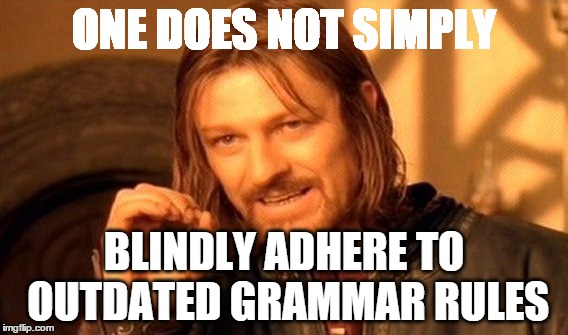
There are certain grammar rules that seem to have been passed down through the generations as “thou shalt not” commandments, when, in fact, they are more “use in moderation and with intention” guidelines. Today, instead of picking a word to use, I’d like to write about one of the rules that governs how we use words, and why it’s okay to break it on occasion (and by occasion, I mean whenever you feel like it). The first rule was drummed into me by numerous English teachers over the years, and I blindly accepted it as fact, when in fact it bears more resemblance to fiction: Never end a sentence with a preposition. Switching a sentence around to ensure that you don’t break this “rule” leads to sentences that bear little resemblance to how people actually speak and think, causing overly formal, stuffy writing. Instead of the perfectly acceptable “Which team are you rooting for?” question at a Superbowl party, blind adherence to this so-called rule would have us asking “For which team are you rooting?” which isn’t horrible, but seems overly formal. There are times when changing the sentence structure to comply with this rule actually makes the sentence harder to understand. For example, “What did you write that paper for?” is a perfectly understandable sentence, while “For what [reason] did you write that paper” requires an extra word to be understood, and is very formal. Since the object of writing is to clearly communicate ideas, I’d like to propose that instead of saying “Never end a sentence with a preposition”, we change it to” Use prepositions at the end of sentences when they make grammatical sense”. So, go ahead and use a preposition at the end of a sentence, but if the sentence makes sense without the preposition, drop it. (So you don’t need to ask “Where are you at?”, because the word at is redundant. The question makes just as much sense if you ask “Where are you?”)
I did a little digging and found out that this “rule”seems to have originated in the 17th century, and not so much as a rule but as an observation on another writer’s work. Then again, the word preposition actually tells you where it should be in the sentence by virtue of the Latin words that make it up. (Looks like I will be doing a traditional explain-the-word Word Wednesday post after all!) The word combines the Latin word prae (pre) meaning before and ponere which means to place. So the word preposition literally means to place before. In Latin grammatical constructs, which have far fewer exceptions than English ones, a preposition is placed before the noun in a sentence (the main exception being the word cum, meaning with, which sometimes followed the noun) and sentences do not end with prepositions. That said, Latin is a language with more flexible word order than English, so I’m not sure that it wouldn’t have evolved in a similar pattern.
I’m going to leave you with a meme I found that made me chuckle
An Open Letter to Parents of Special Needs Children
I’ve got something to tell you, and I’m pretty sure you all need to hear it right about now. Whether it’s back to school time coming up shortly, or your kid has already been in school for the past few weeks, it’s going to be okay. It may not seem like it now – with the routine changes and the frustrations of explaining once again why sitting Johnny by the door is an invitation to disaster, but it will be okay.
I’m not just talking about school either. I’m talking long term here. I know you’re worried about your children and their ability to cope in a world that seems have the deck stacked against them. I understand your fear that your sensitive child will have his nascent ego shattered by an unkind word or action. I feel your frustration when the services that you worked so hard arrange fall through.
I get it. I really, really do.
So here’s the first phrase:
It’s going to be okay.
You will get through this with the love and support of friends and family. You will fight for your child with more ferocity and determination than you knew you possessed.
Your child will surprise you again and again with their resilience. They will fill your heart with joy as they progress towards their current goal. You will be there every step of the way, cheering their accomplishments, comforting them in their setbacks, and helping them get set to try again, because that’s what you do.
Now here’s the second phrase:
You are not alone.
You will get through this with the love and support of friends, family, and community supports. Your child will survive – and thrive – because there are so many great teachers, therapists, personal support workers, doctors, and parents out there to help them. They will shine as the world slowly changes to accept that different from does not mean less than.
You’re in the trenches day in and day out. It can be hard to see the forest when you’re staring at one tiny sapling bending in the wind, but I can see the forest. It’s beautiful and full of hope.
Our children are growing up learning that our differences make us special and that everyone deserves love and respect. Yes, there are some adults who never learned that lesson, but they are the minority. Most of the world sees your child not as an object of pity, but simply as another child. Don’t let the unfortunate few who have not moved with the times cast a shadow over your happiness – keep moving until you are no longer touched by their shadow.
As the parent of a special needs child, you are raising hope. You are raising part of the next generation, the generation who teach the world being different is awesome and everybody has something to contribute to society, even those who cannot speak for themselves, or those who are more finely in tune with their senses than the rest of us.
Children today are more accepting than even their parents, who, in turn, are more tolerant than the generation before them. Change doesn’t happen overnight but it does happen. The world is changing, slowly but surely, and kids like yours are the catalysts for this transformation.
Take a deep breath and repeat after me:
It’s going to be okay. Because you are not alone.
%{include image.html url=“/wp-content/uploads/2015/08/IMG_20141011_153446_hdr-001.jpg” alt=“A rainbow as seen between trees over a lake” description=“It’s going to be okay”}
I’ve written before about my introverted nature and how I can actually be very shy in social situations, but to those who know me well, I’m a chatterbox. I always have been. If I’m talking your ear off, it means I’m comfortable with the situation I’m in. I’ve found that since mum died, I’m less talkative, and don’t feel the need to fill the silence with idle talk, but I still have my moments. One of the ways my introversion shows itself is that I hate small talk. I’m happy to talk to people about big ideas but not about things like the weather. If I ask you about your day, it’s because I actually care about what you say, not because I’m performing a social nicety.
It’s funny, because I would never have guessed that I am an introvert, but by the classic definition of an introvert I am. I can handle myself in crowds, and even enjoy social occasions, but I need alone time to recharge. If I have too many days where I’m surrounded by people, it affects my sleep and my mood. Even a few hours on my own or with one or two friends instead of a crowd will put me in a much better headspace. Like the meme says, Introverts Unite! (Separately, in your own homes). It’s so true. I love social media because I can control how much socializing I do. Plus it’s behind a computer, which makes things easier.
%{include image.html url=“/wp-content/uploads/2015/08/introverts1.jpg” alt=“A cartoon with a figure with a raised fist. Text reads Introverts Unite. Separately, in our own homes.” description=“Yep. This is it.”}
All of this makes my Word Wednesday choice somewhat ironic (in the sense that it’s contradictory to what one would expect from an introvert). One of my favourite words to say and write, has to do with one of the things in life that I enjoy the least. To confabulate means to talk informally – small talk in other words.
%{include image.html url=“/wp-content/uploads/2015/08/coollogo_com-247142025.png” alt=“Stylized text reading confabulate” description=“Confabulate”}
I’m back to the Latin roots with this word, and to one of my favourite Latin words to boot: fabula – meaning story. This is also the root from whence we get the word fable. (Side note, I’m going to have to look into the word ‘whence’ at some point.) It’s surprising that this word isn’t used more often, since it’s kind of awesome. Instead of saying “let’s talk”, you can say “let’s confabulate”. I think I’m going to start using it more often, simply because I can.
Confabulate (con·fab·u·late ) noun
to talk informally or casually (chat)
to hold a discussion.
Want to confabulate? Leave me a comment below or catch me on Twitter or Facebook .
Word Wednesday – In search of the ghost of Tom Thompson
It’s been a busy week around here. I spent most of the day Thursday and all day Friday and Saturday getting ready for Dad’s 60th birthday party at the cottage. Thursday I put in a full 8 hours of work writing for clients, packed the car for dad and the dog to leave for the cottage right after dinner, and then went into town to get some supplies for the party (and a card for dad since I’d forgotten to get one when I got part of his present). Somehow, I managed to volunteer for a couple of hours AND get the errands done but it meant I was out until 10:45 pm which was longer than planned. Friday, I got up early, loaded the van with all the last-minute things like gas cans for the boat that can’t go in the night before, packed the cooler, went to the vet to pick up Monty’s special cookies, dropped a bag at home, picked up the ice pack I’d forgotten, and drove to the cottage stopping at Costco and for Gas and other party supplies on the way. I had lists on top of lists on top of lists, with photographs of said lists on my BlackBerry in case I misplaced one. It was supposed to be a quick in and out mission at Costco. Of course, if you’ve ever been to a Costco en route to cottage country on a Friday during the summer, you’ll realize the folly of my plan.
Actually Costco itself wasn’t the problem. Their debit system wasn’t working though which made for longer than usual lineups and very frustrated people in line. This despite having multiple employees walking through the line-up area announcing that the debit was unavailable but MasterCard or cash would work. I know I heard the announcement at least 4 times while waiting in line. Whatever was messing with the debit system also made the bank machine at Costco not work. People were given the option to put their carts to the side and go out of the store, across the street to a bank (and there were multiple banks available within a 5 minute drive of this Costco) and pay cash for their purchases or they could line up at the one customer service till that managed to have debit service. I didn’t need debit so I was fine but the number of people who screamed at the Costco employees astounded me. I mean, grow up people. Sometimes things happen, and yes, it’s annoying but I highly doubt the Costco employee you’re currently berating woke up and thought “hey you know what would be fun today, pulling the plug on the debit machine to completely screw over customers”, so cut them some slack. (OK the rant portion of this post is now over – I needed to get that off my chest though!)
Having made all the stops I needed to, I proceeded up to the cottage pulling over a few times because the rain was so heavy I couldn’t see the road. (PSA – when it’s raining cats and dogs put on your headlights people – yes your daytime running lights give you a little light but they don’t activate tail lights and those are kind of important when driving on the 400 series highways in a rainstorm!) The normally 2.5 hour drive took me a bit shy of 5 hours with the stops and the rain. I was frazzled when I got to the cottage. My uncle arrived a couple of hours later and we had some dinner which made everyone feel better. I asked dad if it had rained at the cottage and described my drive. He said it hadn’t yet. The speed at which a storm can roll in at the lake never fails to astound me. One minute there are scattered clouds, and the next it’s a downpour. This storm was one to remember too – the wind was whipping the water and the waves on the lake were moving from north to south at high-speed. At one point I could barely see the end of the dock because it was raining so hard. We lost power briefly but thankfully not for long. The rumbling thunder rattled the windows and the lightning lit up the evening sky. I went and sat in my bedroom with the dog, who, after years of being ambivalent about thunder and rain on the metal roof, has suddenly decided he doesn’t much care for it and would like to be petted and reassured please and thank you. I was glad I’d got all the essentials down from the van before the storm and was hoping the fierce storm would make way for a nice sunny day for the party. It did.
Saturday dawned with high heat, humidity, and lots of sunshine. I appreciated the sunshine as I spent six straight hours putting the last touches on the cottage, trying to clean the resin patio furniture, making beds at the rental cottage next door for guests who would be staying overnight, and getting appetizers ready for the party. Dad and my uncle also helped, moving stuff out of the way, vacuuming the cottage, and stocking the beer fridge. They also did some quality testing of each of the 4 types of beer we had in stock for our guests. We all jumped in the lake to cool off, then I jumped in the shower because my hair was legitimately gross from sweating so much while trying to make the patio furniture look less dingy (I swear, I’m just going to buy that plastic spray paint next time). We still had an hour before the first guests were due to arrive – except some decided to show up early. Naturally. For the next 6 hours I ran around like a mad woman – greeting guests, introducing people, getting drinks, making sure there was enough food, meeting and helping the caterer bring down the main course, cleaning up spills, putting leftovers in the fridge, finding containers for the leftovers when the big catering trays wouldn’t fit in the fridge, bringing the cake over from next door, and generally being social. As an introvert, that party was exhausting. Even with slightly less than 20 guests, I felt like I was always being pulled in a multitude of directions. I tried to escape for a few minutes a couple of different times but one guest in particular seemed to *desperately* need my help to find *something* the minute I closed my door (she also had no qualms about opening my closed bedroom door to ask me things – what if I’d been changing?) so I never managed to steal away for those much-needed recharging minutes alone.
All of that aside, the party was a great success. Much fun was had, the food was amazing, and the designated driver system I’d arranged worked as planned. Everyone got home safely and I fell into bed about 1:30 am exhausted. Of course I didn’t sleep well because I was over-tired. Which leads me to my Word Wednesday for this week and what I’ve been seeking since Sunday morning.
%{include image.html url=“/wp-content/uploads/2015/08/coollogo_com-467413.png” alt=“Stylized word Quietude” description=“Quietude”}
Quietude – a favourite synonym of mine for tranquility. While this is a working holiday for me in that I have some writing to do for clients, it’s also a week for recharging my batteries by the lake. I’ve been more quiet than normal on Twitter, because I just don’t have the energy to do it right and I’d rather be quiet than simply broadcast tweets without engaging. I’ve got my colouring books and pencil crayons, a stack of books in a TBR pile on my nightstand, a kayak to explore in, a motor boat for trips further around the lake, and a Muskoka chair sitting on the deck that overlooks the lake. I’m off in search of quietude and know I’ll find it here. I love sitting and looking at the wind move the tree branches. Several of the pines I saw on my boat ride on Monday looked like they’d leapt off of the canvas of a Tom Thompson painting. Indeed, our cottage is only about 45 minutes away from one of the southern entrances to Algonquin Park where Thompson drew his inspiration from the Canadian Shield. Whenever I see a windswept pine tree, I am reminded of the print we had hanging in the house I grew up in, and of this great Canadian artist who managed to capture the places where rocks, trees, and water meet so vividly.
The word quietude is one of my favourite words, not just because it’s what I’m often seeking, but because it has a very simple etymology. It’s derived from the Latin word quietus which means (according to my trusty Latin-English dictionary) a stillness or pause; something that quiets or represses; removal from activity; especially: death. While death is somewhat extreme, I am enjoying the removal from activity, and the stillness of the lake. I’ve included a couple of pictures I took on our Monday boat ride up the lake that capture some of the quietude I find up here.
Quietude (qui·etude) noun
The state of being quiet or calm; tranquility.
The trees seem to just grow out of the bare rocks. There is so little soil that I’m constantly amazed more don’t topple over into the lake. I love this group of trees, close to the cottage of a childhood friend. Whenever I go by and it’s windy, it looks like they’re waving to me.
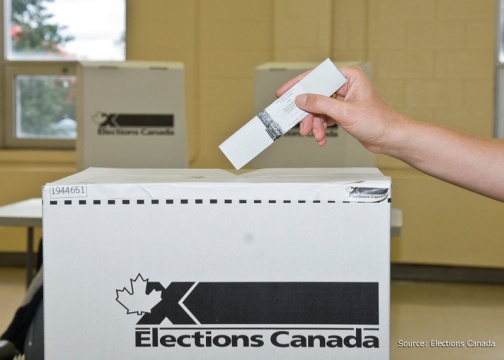
Unless you’ve been living under a rock (or aren’t Canadian), you will have heard that a general election has been called for October 19th 2015. The election period is an unusually long 12 weeks (most are considerably shorter) and I’m already sick of the rhetoric. It’s like the old joke – how can you tell when a politician is lying? His (or her) lips are moving. I will vote come election day, because I was raised to believe that they who do not vote have no right to complain about the government. Since I happen to quite enjoy complaining about the government, I have to vote. I’m fully prepared to pay more attention to the election – once the summer is over. I have a limited attention span for political doublespeak and it’s definitely not 12 weeks long!
I’ve worked the last few elections as a poll clerk. I haven’t decided if I want to work this one. For one thing, it’s the day after a big conference I’m really looking forward to attending. For another it’s a really long day and if you don’t have a good partner, it can really suck. The pay is decent though, and it is fun to be a part of the democratic process.
Courtesy of Elections Canada
That said, you’d have to have been under a rock to not have heard something about the first leader’s debate. I chose not to watch it on television or stream it, but instead kept track of who was saying what about whom via Twitter. I noticed, that as politicians are wont to do, there was a lot of prevarication going on. Which gave me the idea for today’s Word Wednesday post. So some good came out of it at least.
Some of the politically savvy readers may know that as a matter of parliamentary procedure, one member cannot call another a straight out liar in the House of Commons. It has consistently been ruled as “Unparliamentary language” and there’s a partial list of all the words deemed unacceptable here. I’m not sure what the rule on thesaurus use is, because I would like to point out that almost every member is guilty of prevarication on occasion.
%{include image.html url=“/wp-content/uploads/2015/08/coollogo_com-195076142.png” alt=“Stylized word Prevarication” description=“Prevarication”}
Prevarication(pre·var’i·ca’tion** ) noun
a false or deliberate misstatement; a lie
2) the act of deviating from the truth
Maybe calling someone a liar would be better if we used a fancier word? Don’t accuse your opponent of lying – say they’re prevaricating. By the time they look up the meaning, you’ll be long gone. At least the first time.
Prevarication has a pretty interesting etymology. it comes from the Latin word praevaricatus, past participle of praevaricari, meaning to act in collusion – or literally to straddle. The meaning comes from the second half of the word, which has its roots in the word varus, meaning bowlegged.
So the next time you think a politician is straddling the truth, don’t accuse them of lying – accuse them of prevarication instead. You’ll say the same thing, but it sounds better.
Wordless Wednesday – Looking up at the Sky, through the woods, and into a campfire
As much as I love #WordWednesday, I’m up on a mini vacation right now and am too busy staring at clouds, following overgrown paths in the woods, and gazing into campfires to choose a word. I’ll be back next week but in the mean time, take a look at these gorgeous distractions.
Sunset at the lake This path led to wild raspberries, some cuts and scrapes, and more than a few mosquito bites A crackling campfire, shared with my cousin and his family.
Word Wednesday – Baby It’s Hot Outside (and Inside)
Summer took awhile to arrive this year here in Ontario – we flirted with mid to high 20s (I’m Canadian, and read my temperature in degrees Celsius – for my American readers either use Google’s ultra convenient calculator or go to All Measures to convert the temperature to Fahrenheit) in June but July has been cooler than normal. The season decided to make up for lost time this week by throwing us into 30+ degree weather with a high level of humidity. After a long, cold winter, I’m happy it’s hot outside, but I do wish it would cool down a little more at night. I decided after 3 days of sweating it out at home to decamp to the cottage where it’s a little cooler and there’s a lake to jump in when I feel the need. I would have been in it as soon as I arrived, except I left a little late and arrived at mosquito o’clock. That’s a real time up here – in a matter of minutes it goes from no bugs at all to they’re trying to eat me alive”. So I decided that changing into a bathing suit and giving them MORE flesh to feast on was a bad idea. Which gave me time to write the post so I guess it’s a good thing.
A view from the cottage on one of the sunny days earlier this month
I commented to the ever awesome Laureen from Tempered with Kindness that I was going to skip this week’s Word Wednesday post because of the drive / heat / the fact that I haven’t slept well in a week but she suggest doing a quick posts with words people can use to describe this kind of hot summer weather. Just as “it’s cold” doesn’t quite do it in the winter when it’s -30 out, “it’s hot” is wholly inadequate to 37 degrees with humidex. I know it’s not as hot as it gets in a lot of other places, but that’s partly why I choose not to live in those places.
While looking at the list of synonyms she came up with (which was quite impressive and comprehensive – balmy, summery, tropical, boiling, boiling hot, blazing hot, baking, scorching, roasting, searing, flaming, parching, blistering, oven-like; sweltering, torrid, sultry, humid, muggy, close, airless, oppressive, stifling, frying, melting, sizzling, nuclear) one jumped out at me. I love using sultry to describe hot and humid weather. To me, the word brings up images of a New Orleans jazz club and can describe either the singing or the weather outside the club on a summer evening. So today’s Word Wednesday is sultry.
%{include image.html url=“/wp-content/uploads/2015/07/coollogo_com-156271354.png” alt=“Stylized word Sultry” description=“Sultry”}
Interestingly, this word is old English in origin (well middle English, having first appeared in 1594). It comes from an obsolete English word sulter which means to swealter. Which is what I’m doing in this weather! Sultry includes both the heat and the humidity in its definition so it’s the perfect word for this weather. Though right now it’s cooled off nicely and I’m going to take advantage and hopefully get a good night’s sleep.
Sultry (sul·try) adjective
1. very hot and humid
2. hot with passion or anger
3. exciting or capable of exciting strong sexual desire
I’m hoping everyone is enjoying these sultry days, because before we know it, summer will be gone and with it the warm weather.