Blog

  • Word Wednesday: It’s Fashionable!

    Word Wednesday: It’s Fashionable!

    I’m not the kind of girl who can spend a whole day at the mall. I don’t mind window shopping with a friend, but it’s not a solo activity I actively pursue (unless it’s at a board game store – then kiss the afternoon goodbye). While 95% of the time I’m a jeans and a faded concert t-shirt kind of girl, I do clean up nicely and like to get dressed up for an event. So when an invitation came through my inbox to attend the VIP preview night at Saks Off Fifth in Vaughan, I was all in. The invite promised refreshments and a one night only discount and I knew some of my other blogging friends were going so if nothing else, it would be a nice night out. I’ve never been overly concerned with being fashionable – I don’t need a new wardrobe every season, and I don’t have a closet full of shoes, though I appreciate a well-made pair of shoes as much as the next woman. 

    A red carpet with the Saks 5th Avenue logo on it
    They had an actual red carpet!

    So I made the trek out to Vaughan Mills in some seriously weird weather conditions – in the span of the 35 or so kilometers from my house to the mall, I encountered rain, hail, sleet, high winds, and blazing sunshine. I was really thankful I hadn’t been lulled into a false sense of security and switched out my snow tires – I needed all the help I could get! I got there a bit early and hit some of my favourite stores at Vaughan Mills (and said hi to the fish in the big tank at Bass Pro). I went to Saks and saw a red carpet and a line, so like any good Canadian, I got in line and made small talk with the people around me (mostly about the weather). I gave my name to the nice lady with the clipboard, said my plus one was delayed, and went on in. I quickly found the coat check (since it had been so miserable out, I’d worn a full length, lined trench coat) and set off to explore. I got the lay of the land and met up with my friends and we had a blast looking at all of the clothes, shoes, purses, and jewelry. We all tried on hats and took the obligatory group selfie (or groupie – I’ve been researching and it’s not a selfie if there are multiple people in it, and the term ‘usie’ which I’m not a fan of anyway, is predominantly used for couples pics).
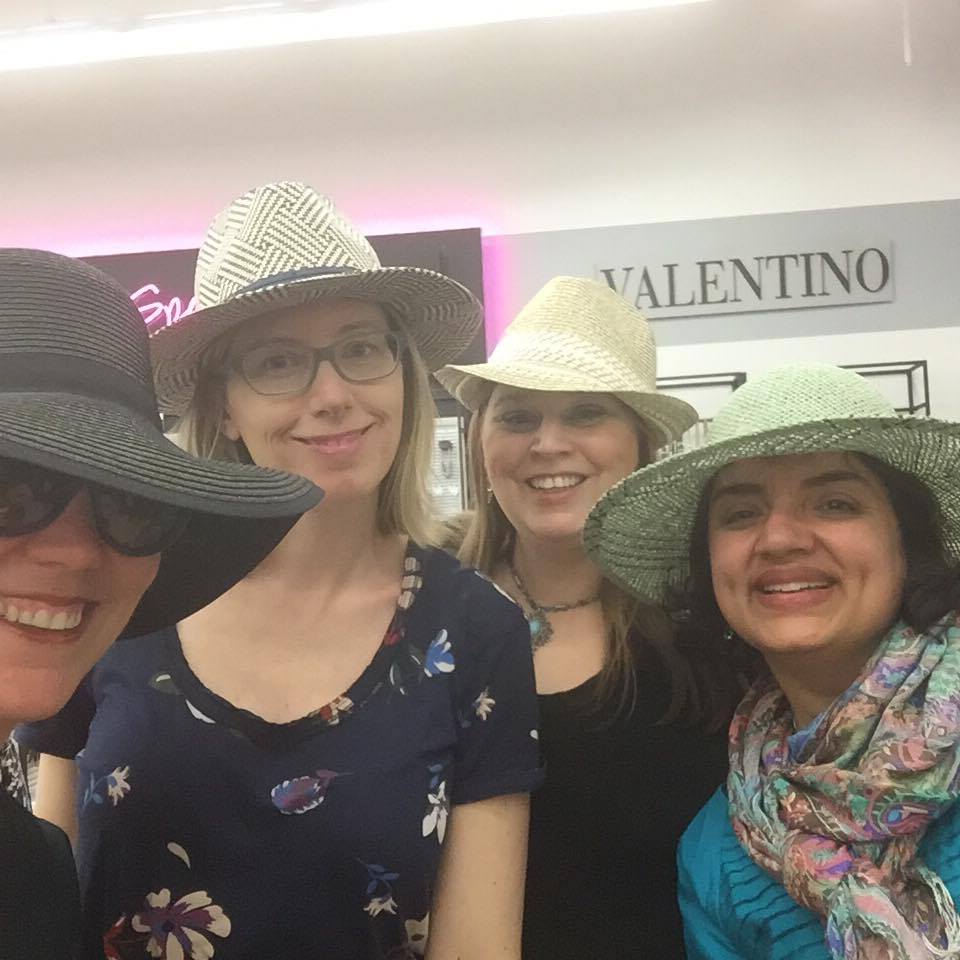
    Four women smile at the cameras wearing oversized hats
    Photo courtesy of Jenn Powell


    After the hat picture, we went to the shoe section. As I said earlier, I’m not the type to collect shoes, but the selection at Saks was fabulous. There were so many!  It’s not like they were all the same either – there weren’t more than a couple of pairs of any shoe in a given style and size so there were literally dozens of shoes to try on. I fell in love with a pair of Frye Boots, but one of my partners in crime had fallen in love with the same pair and was the same size as me and the rational part of my brain said “you don’t need these boots, even if they are fabulous and fit perfectly” so I gave them to my friend and apart from some pangs of non-buyer’s remorse as I scope out the boots that were not to be on the Frye site, I don’t regret it. I will own a pair of Frye boots one day (Looking at the website, there are at least 4 more pairs that I’m currently coveting). Besides they looked better on my friend with the rockin’ new jeans she got.

    multiple rows of racks all filled with shoeboxes and shoes
    Shoes, as far as the eye could see.

    Most of the clothes were reasonably priced, but there was the couture section – runway and off runway designs with the corresponding price tag. I’d love to be in a place where I wouldn’t bat an eye at a $2,000 dress but that’s not in the near future for me. All of this got me thinking about couture and what, exactly, the word means. I knew it had something to do with fashion but wasn’t sure exactly what it meant so I decided to look it up. I was surprised to learn that the word is just over 100 years old – the first recorded use being in 1908. Unsurprisingly, it has its origins in Latin via French. The Old French word cousture came from the past participle of the Latin word consuere – meaning to sew together. Which fits right in with couture having to do with runway fashion.  While I may not be ready to spend the kind of money needed to own couture pieces myself, it doesn’t mean I can’t appreciate a fun night out looking at them with a great group of  women.  I can’t wait to go back and explore more and possibly get a pair of gorgeous boots for myself.

    %{include image.html url=“/wp-content/uploads/2016/03/coollogo_com-192134962.png” alt=“Stylized word Couture” description=“Couture”}

    Couture  cou·ture noun

    1.  The business of designing, making, and selling fashionable custom-made women’s clothing

    2.  The designers and establishments engaged in couture

    3. The clothes and related articles designed by such designers.

  • Word Wednesday: Circular Logic

    Word Wednesday: Circular Logic

    It should come as no surprise that I subscribe to two different “word of the day” emails – I love language and jump at any chance I get to expand my vocabulary. Sometimes I already know the “word of the day”, and other times they’re so obscure I can’t find a use for it in my everyday life, but file it away in my brain for later use. Once in awhile a word comes into my inbox that is new to me and fits perfectly into my life – and today’s word is one of those.

    Being a word nerd from a very young age (I was reading chapter books in kindergarten and read the Hobbit for a grade 2 book report when the rest of my class chose Clifford or Franklin books) means that I have a pretty decent vocabulary, and the fact that I took Latin and French in high school helps me figure out words I haven’t come across before. I have a predilection for words that roll off the tongue nicely. Some words just feel right as you say them, and others just always feel awkward and no matter how much you try to make yourself like them, you find yourself using them less and less. I have tons of words that fall into this category – I still try to use them but they never feel right.

    %{include image.html url=“/wp-content/uploads/2016/03/coollogo_com-187152691.png”” alt=“Stylized word Lexical1” description=““}

    Words have a tendency of being tied up in their grammatical rules and losing favour because of that. I’ve often wished there was a way to look at words on their own, separated from all the grammatical constraints that can render them useless. It turns out there is a word for that. The fact that there’s a word specifically for the study of words and vocabulary of a language separate from grammatical aspects, means that I’m not the only one who wants this kind of information. We should start a club or something. There would have to be a ban on word games though, us word nerds can get super serious and uber competitive about Scrabble, Bananagrams, or Upwords, and that wouldn’t be much fun. Hrm. A word nerd club. I’m going to put that on my “great ideas” list that I never seem to manage to get to. How does one start a club anyway? Can anyone start a club? Related idea: a club for people who like to go off on tangents… or have ADHD… or both. I could totally be president of that club.

    A small brown squirrel sits in a tree
    Squirrel! Wait… what was I saying?

    Back to my word though. It’s a fairly recent word. though significantly older than grok was when I talked about it last month. Lexical dates from the mid 19th century, when I suppose people had time and the literacy skills to start thinking about words more. It comes from the Greek root  lexikos  which means “of or relating to words”. Not to be confused with the Latin root word Lex which relates to laws or ruling.

    Lexical (lex·i·cal) adjective

    Of or relating to the words or vocabulary of a language

  • Word Wednesday – I detest that!

    Word Wednesday – I detest that!

    Last year, I wrote about the Canadian General Election and how it seemed to go on forever. What I didn’t mention at the time is that our elections seem to go by in the blink of an eye when compared with our neighbours to the south. 12 weeks of election run up isn’t even close to the 60 or so weeks that the U.S. Presidential Election seems to last. I know it’s not the actual election until November, but the Primaries and all of the other things that go along with a Presidential election just never end. Even a dedicated political junkie like me is getting election fatigue.

    It’s not just the fact that the election seems to be never ending and the jokes on late night television started sounding the same about two months ago, it’s that I cannot stand one of the candidates. Naturally it’s the one who gets the lion’s share of the media coverage because the world is a cruel place sometimes. At first, sitting here in Canada, I thought that Donald Trump running for the Republican nomination was funny, a lark if you will. Now, it’s March and it’s not funny anymore. Not even close. To hear the hatred spewing forth from both the man and his supporters makes me queasy. When he was just a blowhard with a lame reality show (The Apprentice), I could (and did) choose not to watch. Now that he is running for the highest office in the United States, I can’t turn it off.

    %{include image.html url=“/wp-content/uploads/2016/03/dump-trump.png” alt=“A picture of Donald Trump with a red circle with a line through it across his face” description=“Just say no to Trump”}

    To those who say “You’re Canadian, the Presidential election doesn’t affect you” (though most of them say it far less eloquently than that), I reply that as our largest trading partner, the political state in the U.S. does affect us. In that vein, I’d like to offer the words of former Prime Minister Pierre Trudeau – when speaking to the Press Club in Washington DC in 1969. “Living next to you [America] is in some ways like sleeping with an elephant. No matter how friendly and even-tempered is the beast, if I can call it that, one is affected by every twitch and grunt.” Our media is heavily influence by the United States, our economy is intertwined, and our position relative to them is unchangeable. We cannot move further away, and Trump is not a friendly or even-tempered elephant.

    It’s not just that he’s a racist and has refused to distance himself or decline the endorsement he received from a former Grand Wizard in the Klu Klux Klan (KKK) (and by the way, thanks KKK for making the word wizard a bad thing by using it in your hate-filled organization), but that’s definitely part of it. It’s not just that he is a misogynist and that I disagree completely with his views on women.  It’s not even that he regularly makes up ‘facts’ and that his supporters blindly believe him until somebody dares to question him and he claims that he was “misheard” or “misquoted” or “taken out of context”.  It’s that he’s a bully and I absolutely abhor bullies.

    I was going to use abhor as my word for today but it’s a little too popular for my liking. Then I went to detest, but it didn’t feel strong enough to express how much I loathe Trump and what he stands for. So I racked my brain and came up with Execrate – it’s a synonym of abhor, loathe, and detest but it’s a little less common and a little more fun to say. Plus execrate has a fun etymology – it comes from Latin (of course) exsecrat, which means cursed. Ex is a Latin prefix meaning not and the Latin word sacer unsurprisingly translates to sacred – so the literal translation of execrate was “to put someone under a curse” – which I find very soothing in relation to Mr. Trump (I really like the idea of putting him under a curse – maybe the Imperius curse.. hrm this has possibilities). Nowadays, execrate simply means “to utterly detest” which fits well with my feelings on the subject.

    %{include image.html url=“/wp-content/uploads/2016/03/coollogo_com-11610166.png” alt=“Stylized word Execrate” description=“Execrate”}

    Execrate ( ex·e·crate ) Transitive Verb

    1. To declare to be evil or detestable :  denounce
    2.  To detest utterly
  • Thinking about Thinking Day (Founder’s Day)

    Thinking about Thinking Day (Founder’s Day)

    This past Monday, February 22nd, was a special day for members of Boy Scouts and Girl Guides / Girl Scouts worldwide. February 22nd is the shared birthday of the founders of Scouting and Guiding – Lord and Lady Baden-Powell – and is commemorated as Thinking Day in the Girl Guide / Girls Scout world and Founder’s Day in the Boy Scout world.

      %{include image.html url=“/wp-content/uploads/2016/02/WAGGGS-web-3_detail_362934.jpg” alt=“A crest with a circle in 4 coloured parts and the word WAGGS World Thinking Day 2016” description=“This Year’s crest”}

    Every year World Thinking Day has a theme, and this year’s theme was “connect”. I thought that it was particularly apt because through the *cough* almost 30 *cough* years that I’ve been involved with Guiding, it has allowed me to connect with some pretty awesome people.

    As a girl member, I got to meet other girls from around the world, formed friendships that I still have to this day, and learn a lot of skills that I’ve used in non-Guiding capacities. I have a great repertoire of campfire songs and quiet games that come in very handy when babysitting. I know the best way to make a campfire for cooking versus for heat (and that there are different styles of fires for different purposes). I can tie knots that stay tied or come apart – depending on what the situation calls for – and I know the difference between a sheet-bend and a half-hitch. I got to attend an international camp and became pen-pals with one of the girls that was in my patrol, exposing myself to a different culture through a common experience – Guiding. I earned my Golden Hand as a Brownie, All Round Cord as a Guide and Canada Cord as a Pathfinder and earned almost every Brownie and Guide badge available. (I was unable to earn ALL of them in Guides because of my parents’ unwillingness to let me have a cow in our suburban backyard so that I could earn the dairy farmer badge, or chickens for the poultry farmer badge – some people just don’t understand that sacrifices have to be made!) I had a lot of friends who were in Guiding in Brownies and Guides (I’m old enough that there wasn’t Sparks until I was Guide age) who dropped out at the Pathfinder stage – but I was having far too much fun to think about that. In Pathfinders, my friends and I got in to all sorts of trouble and gave our leaders a lot of grey hairs (sorry!) but also made memories that I cherish to this day. For example, we didn’t like the Pathfinder song much, but didn’t want to sing the Guide Marching song because that was for younger kids – well the first verse was. So we sang the second verse before meetings. I think it was the “hardly ever afraid of cows” line that sold it for us. (We found out during my Gold Camp that the second verse of the Guide Marching Song was inaccurate for our unit – we were ALL afraid of wasps!) Our leaders simply shrugged and figured it was a Guiding song and only made us sing the Pathfinder song when we had the Commissioner or Guides visiting.

    Mum was a leader, craft trainer, and commissioner over the years, so I helped out at a lot of events. I have great memories of helping her set up camps at Doe Lake before heading to my site. I was often pressed into service as a colour guard at various ceremonies and was the go-to kid in uniform when the local paper needed a picture of cookie selling or for an article about guiding. I spent evenings setting things up and giving directions when we were doing a Thinking Day or other group campfire at the local mall, and manned the cookie sales booth whether I wanted to or not (usually in the time slots other people didn’t want to take). I was a unit helper with a Brownie unit starting from the time I was a 2nd year Guide – because the unit asked mum if I could do it, having seen me work at herding cats Sparks and Brownies at a multi-unit event and thought I’d be an asset. I stayed with that unit throughout my Guide and Pathfinder years and added another Brownie unit that I helped with as well. After Pathfinders, I debated Cadets versus Rangers (the program was different then), but ultimately knew my heart was with being a Junior Leader with those same units for the next 3 years. I also got to do things like be on planning committees for things like Venturee ‘95, and be the “do whatever needs doing” person at Division and Area camps (which often turned out to be “do whatever other people don’t want to do”). Sometimes being a ’Leader’s kid’ was a lot of work, but I wouldn’t trade the experiences I got for anything.

    %{include image.html url=“/wp-content/uploads/2016/02/IMG_20160222_135329.jpg” alt=“A white scarf adorned with red maple leafs with pins down the two sides of it that are visable.” description=“Some of the Guiding pins I’ve earned over the years.”}

    As I left for university, I didn’t think I wanted to continue in Guiding – or rather I didn’t think I’d have the time to commit to a unit. So I signed up for Link. By November of my first year, I missed Guiding so much I went looking for a unit to help out with and found an amazing Guide Unit that I stayed with for my entire time in university. The other Guiders were in university as well, and even though we were in very different programs, we became close friends because of Guiding. In fact, one of my favourite people on the planet is one of those other leaders. I haven’t seen her as much as I would have liked over the last decade, but when we do get together, it doesn’t matter.

    I have continued my Guiding career as a Brownie leader, Guide leader in another unit, craft trainer, District Guider (or Guider-at-large), a return to being a Brownie leader in another city, taking over the unit and running it for 5 years, and now I’m a Pathfinder leader. With every new step in my Guiding adventures I meet new people, have new adventures, and find different ways to connect. I’m due for my 30 year pin soon, and I can’t wait to find out what the next 30 years has in store for this organization that has given me so much more than I could have imagined the first time I put on my Brownie uniform and stepped into a school gym. On Thinking Day, I wore my uniform shirt and the classic Guide Enrollment pin that my mum gave me when I became a leader with pride, and explained to anyone who would listen why I was so proud to be a member of this awesome organization. To conclude, I will address the question I get the most often about Guiding: Yes I can connect you with cookies. 😉 If you need me, I’ll be swinging along the open road with a pack on my back and a song in my heart to ease the load.

  • Word Wednesday – Why I need a vacation!

    Word Wednesday – Why I need a vacation!

    It seems that practically everybody I know is either on vacation, planning for a vacation, or just back from a vacation. Currently my father is in Arizona, visiting friends of his and golfing, while I’m home shoveling the seemingly never-ending snow and hanging out with the adorable but slightly neurotic Bichon Frise.

    Don’t get me wrong, Monty is adorable – but he’s also very stubborn and at 14, very set in his ways. He has cataracts and his night vision isn’t very good so when he wants a drink at 2 am, he stands at the end of the bed and whines until he is either lifted down to the water bowl or it is brought to him. I don’t really mind the nocturnal awakenings, because I like having him sleep with me. He knows it, and sometimes, if he thinks I’ve been too slow to get him water, he stays on the floor and sleeps either in his dog bed or in his ‘house’ (kennel with the door removed and blankets inside). To those who say a dog is incapable of plotting retribution of this sort, I’d beg to differ. This adorable Bichon is totally able to plot and exact revenge.

    A small white dog gazes up with his head resting on a stuffed toy otter.
    Yes, that’s an otter he’s resting his chin on, while he plots revenge.

    Between dad “helpfully” sending me BBM messages with the weather in Arizona while we were in the middle of a cold snap that resulted in a frozen pipe in the basement, and my friends posting amazing travel photos as they go on their own vacations, I’ve been left with a serious case of wanderlust and no outlet for it in the foreseeable future. The last true “vacation” I went on was over 20 years ago. I’ve been on school trips since then, and a few business trips but nothing that could qualify as a vacation.  I’ve got a travel bucket list that grows almost daily as I learn about another place that would be amazing to visit.

    The top place on my travel bucket list has been there since I was 9. I was more than a little obsessed with the computer game “Where in the World is Carmen Sandiego?” and played it until I finished the game and then went back and played it again, because I loved it and it was educational so my parents deemed it a good use of computer time. I kept tracking Carmen’s villains to Reykjavík, Iceland, and told myself that one day I would see more of the city than the 3 points of interest in the game.  (Seriously, who goes to a bank as one of the first stops in a new place? Apparently V.I.L.E. henchmen do, all the freaking time.) I liked the way Reykjavík rolled off my tongue, and as I’ve learned more about both the city and country, my desire to visit hasn’t lessened. Recently, I learned that there is a craft distilling movement afoot in Iceland – the Eimverk Distillery produces both whiskey and gin – which makes it somewhere I *need* to visit.

    Of course there’s always the dream of going somewhere warm and sunny to escape the cold and snowy winter. I went to Disney World with my parents when I was 8, but that was 2 years before I discovered that I actually like roller coasters and rides in general so I missed a lot. It was also before any of the auxillary parks opened – it was just the main park and Epcot, so there’s a lot more I want to explore there. I’m not big on sitting on a beach for more than an hour or two (mostly because of my pale skin and the fact that I have a family history of skin cancer so sitting in the sun isn’t high on my list of fun activities), but I love to swim and snorkel. I also like exploring new places, and am an absolute sucker for museums and local history, so I can always find something to do to entertain myself.

    Stylized word Vacation
    Vacation

    I think the time has come to start planning a vacation of my own.. maybe with a couple of friends or solo. Either way, I need a break. I need to get away from the everyday stress and go somewhere where there isn’t just different work to do. (As much as I love the cottage, it isn’t exactly a relaxing getaway when there’s always something to fix / change / paint.) I’ve been reading studies on why it’s important to take vacations and how thinking about and planning vacations can actually increase your happiness. I’ve been under a lot of stress since mum died, and need a place to unwind that isn’t full of memories already.  By all accounts, a vacation is in order! Now to save up and decide where to go.

    Here in North America, vacation is commonly defined as an extended period of recreation, especially one spent away from home or in traveling. It’s akin to the word “holiday” in Europe. The word comes from Late Middle English, which (surprise surprise) took it from Latin. The Latin root word is vacare which means “to be unoccupied” . Whether this is relating to the house or the mind is anybody’s guess. I’d say a bit of both.

    vacation  (va·ca·tion) noun

    1. (North American)

      An extended period of recreation, especially one spent away from home or in traveling.

    2. The number of days or hours per year for which an employer agrees to pay workers while they are not working.

    3. A fixed holiday period between terms in schools and law courts.

    4. The action of leaving something one previously occupied.

    vacation  (va·ca·tion) verb

    1. To take a vacation.

    I’m off to peruse some travel sites and dream.

  • Word Wednesday – Be Generous

    Word Wednesday – Be Generous

    Today isn’t just any Wednesday, it’s Ash Wednesday, the traditional beginning of Lent. I used to do the whole “giving something up for Lent” thing, but I found that it didn’t help me become more in tune spiritually, or enjoy the spirit of Easter any more, as I was looking forward to getting whatever ‘treat’ I had given up that year. (Granted, this was better than Lent when I was younger and gave up Lima beans or liver which I never liked anyway.) Still, it felt like I was going through the motions. A few years ago, a friend introduced me to the concept of 40 Acts – where instead of giving up something for Lent, you take something on. While I’ve moved away from organized religion for the time being, I love this concept of giving of myself for 40 days. I can do that in whatever way I feel is best (though if I’m stuck for ideas the 40 acts website has some), whether that’s helping a friend online, donating to the local food bank, or volunteering at the local thrift store.

    %{include image.html url=“/wp-content/uploads/2016/02/18677308266_fac3b2aab8_z.jpg” alt=“Two hands, wearing black gloves hold a heart made out of snow” description=““}

    The challenge this year is to be generous with ourselves to people not only in our inner circle, but also the people around us, the ones we don’t have regular contact with. While planning my acts of generosity, I got to wondering about the word generous, and what it really means. Once again, my curiosity pays off for the blog as it turns out that the word generous has a pretty interesting etymology.

    %{include image.html url=“/wp-content/uploads/2016/02/coollogo_com-158191633.png” alt=“Stylized word Generous” description=“Generous”}

    The word generous came into English in the late 16th century, from Old French, which took the word from Latin. This isn’t exactly new, as almost half the words we use in English took this route. Where it gets interesting is the Latin. The first Latin root word was generosus which means noble or magnanimous. This makes complete sense and is in line with the modern meaning of generous. The root of the word generosus, though, is genus, as in gene or generations. The word genus means stock or race. The original meaning of generous was ‘of noble birth’ or ‘characteristic of noble birth’ which was expanded to magnanimous and the rest followed nicely and translated through the years and across languages. I find it very neat that the word generous has the same root as the word genome. Language can be awesome like that.

    Generous (gen·er·ous)  adjective

    (of a person)

    1. Showing a readiness to give more of something, as money or time, than is strictly necessary or expected.
    2. showing kindness toward others.

    (of a thing)

    1. (of a thing) larger or more plentiful than is usual or necessary.

    I’ll post the highlights of my 40 Acts deeds on my Facebook page – so if you want to follow along, give me a like!

  • Word Wednesday: I Grok That (finally)

    Word Wednesday: I Grok That (finally)

    After a bit of a respite from Word Wednesday, I’m back at it again. I didn’t think I would miss it but I did. I am an unabashed logophile (more on that another week) and truthfully, picking a favourite word each week isn’t a chore, it’s more of a labour of love. I’ve been working on the craft of writing more this year and have dedicated some time each week for professional development – for the first few months of the year that means reading about writing. Currently, I’m in the middle of Stephen King’s wonderful book On Writing. While I’ve never been a huge fan of King’s horror novels (I still have a mild case of coulrophobia thanks to It – but only those with Pennywise makeup. other clowns aren’t objects of abject terror but I once rode 2 stops past where I needed to get off on the TTC because there was a guy dressed as Pennywise on the platform I needed to use) I appreciate the thought and hard work he devotes to his craft.

    King devotes a lot of energy to the notion that writers must be, above all, readers. He says that it really doesn’t matter if the books are classic or even good. Indeed, he argues that “One learns most clearly what not to do by reading bad prose – one novel like Asteroid Miners (or Valley of the Dolls, Flowers in the Attic, and The Bridges of Madison County to name just a few) is worth a semester at a good writing school, even with the superstar guest lecturers thrown in”. I’m inclined to agree, though there are some books I haven’t been able to force myself to finish because the grammatical errors were so egregious that they muddled the plot. At the end of On Writing, King offers up a list of books that he has enjoyed – he says he’s not Oprah and this isn’t a book club reading list but simply a list of books that he has enjoyed and that have helped him grow in his craft. This got me thinking and I’ve been trying to stretch my reading muscles in the weeks since. (Yes I read the “And Furthermore, Part II” section before finishing the book – I’m a rebel like that). One book that I picked up recently and started reading (I typically have at least 3 or 4 books on the go at any given time –  I pick and choose which book to read depending on my mood) is the 1961 classic Stranger in a Strange Land by Robert Heinlein. It was here that I came across the word I want to write about today.

    %{include image.html url=“/wp-content/uploads/2016/02/If-you-dont-have-time-to-read-you-dont-have-the-time-or-the-tools-to-write..png” alt=“A notebook with a pen across it and the text: If you don’t have time to read, you don’t have the time (or the tools) to write. If you want to be a writer you must do two things above all others: read a lot and write a lot. Stephen King” description=“Words to live by”}

    There’s no etymology of this word since it is out of the mind of Heinlein. I have many awesome and geeky friends who use this word often enough that over the years, I’ve figured out the meaning by osmosis. I didn’t truly grok it until I read the definition given by Heinlein in the book:

    Grok means to understand so thoroughly that the observer becomes a part of the observed—to merge, blend, intermarry, lose identity in group experience. It means almost everything that we mean by religion, philosophy, and science—and it means as little to us (because of our Earthling assumptions) as color means to a blind man.

    So now when a friend comments that they grok something, I can smile knowing that I’m in the know. I grok what it means to grok.

    %{include image.html url=“/wp-content/uploads/2016/02/coollogo_com-23492915.png” alt=“Stylized word Grok” description=“Grok”}

    Grok (grok) verb

    1. To understand thoroughly and intuitively.


  • Making the holidays manageable for kids on the spectrum

    Making the holidays manageable for kids on the spectrum

    The holidays are supposed to be full of fun and relaxation – but to many kids on the spectrum (and their parents), they are just the opposite. Between the increased social engagements, the lack of familiar routine, and the sensory overload happening everywhere – the holidays can be really tough. And that’s not even counting gift giving which I wrote about last week. I’ve rounded up some of my best tips for a happy and hopefully less stressful holiday season.


    • Don’t over-schedule yourself – tempting though it is, one event per day is probably enough. Most kids have exhausted their coping skills after the first event and need time to recharge before heading out to another event.
    • Headphones are a huge help at blocking out sensory distractions. You may need to do some advance work with family or friends who think it’s rude for your child to wear headphones in public or at a gathering. Simply explain how they help your child and leave it at that.
    • Have a safe place where your child can go if overwhelmed. Use an inexpensive bathmat as the “safe spot” and bring it with you when visiting – I practice this with the kids for a few days or weeks before the first event. These adorable round spots from Ikea are great for “safe spots”. There are also more intricate patterns available if that is soothing to your child.
    a red circular rug
    These are a great size for travelling – but you can also use a bathmat or small towel.
    • Bring along some toys / activities your child can use when overwhelmed. Even (or especially) if they will be getting new toys at the event, bring a toy or two that you *know* your child will enjoy playing with – just in case. The new toy may need batteries that aren’t included in order to work, or it may not be something your child is into. Having a backup will prevent frustration and upset for your child.

    • If the event is at your house and there will be other children present, work with your child in the days or weeks before the event to figure out which toys he is comfortable sharing and which ones need to be put away before the party. Ask him again on the day of the party if there is any toy he doesn’t want others to play with.

    • Make sure that your child still has somewhere to escape to at your house – try to leave her room untouched if at all possible, so that if she needs to escape, she can.

    • Role play potential situations that could come up at a party. One that takes many by surprise is what to do if the washroom is occupied. If you have multiple washrooms (or even better an ensuite one) designate one as the guest washroom and the other for family use. Some kids with autism have delayed signals that they need to use the bathroom so waiting in a line-up can lead to accidents.

    • Use a calendar or visual timetable to prepare for Christmas, for specific events, to highlight school days and home days, or the night when Nana is coming to sleep.

    • Set up a daily calendar using a white board to outline what will be happening each day. Visual schedule tools can also help.

    • Try using a visual schedule if you are celebrating the holidays on more than one day (e.g., Hanukah) to show when there will be parties/gifts and when there will not – otherwise the child may expect gifts every day.

    • Make sure you give plenty of advance warning for changes – “In 15 minutes, we are going to put on our coats and say good bye to Grandma” is a good cue before transitioning to another activity, repeat the warnings as needed so that your child isn’t surprised by the change of activity.

    • Be careful with “fun” traditions such as elf on the shelf. We may think it’s fun but for a child who is anxious about being watched, an elf that watches and reports back to Santa is highly stressful. (Same goes with some Christmas carols – the line in Santa Claus is coming to town “He sees you when you’re sleeping, he knows if you’re awake” can be very stressful for some children. Actually, the whole idea of a stranger coming into the home while they are sleeping can be very stressful for some children. If your child is showing signs of stress over the elf, it may be time to send it back to the North Pole or try an alternative tradition.

    • Consider decorating gradually – so the house doesn’t transform overnight. One day you could put the Christmas tree in position, decorate it the next day, then put up other decorations even later (if at all).

    • On the decoratios front, be aware of how your child reacts to different decorations. Flashing and noisy ones may upset some children. Motion activated ones (Like a Santa that says “Ho Ho Ho” as you walk by) can be very distressing to kids (and adults!) so those may have to either find a new home or be switched off until the child is ready.

    • Have “the talk” with your family members. If your child hates being hugged, and Great Aunt Sally is a hugger – you need to explain that to her. It may be uncomfortable, but you want both sides to have a good experience. Make them aware of your child’s self soothing behaviours and whether or not they should approach him if he’s in his “safe spot”. [If you’re part of the extended family of a child with autism, the best gift you could give the parents and the child is to listen to their cautions. They know what works and what won’t and a holiday is not the best time to suggest alternatives.]

    • Keep mealtimes as consistent as possible. (Also make sure your child eats). Offer to bring something you know your child will eat if she is a picky eater. You can also feed your child before an event if needed and provide them with a quiet activity to do while the meal is being served.

    • Model / practice buffet behaviour – washing hands before going to get food, not sticking hands in food / using utensils provided, what to do if you don’t like something, not going straight for the desserts – these are not common occurrences and your child may not know how to handle a buffet, so practice.

    • You may want to find a less busy place for your child to eat if they are easily distracted, the kids’ table is generally pandemonium, so see if there’s somewhere a little quieter where he could eat with maybe 1 or 2 helpful older cousins.

    • Don’t be surprised if your child doesn’t want to eat when everyone else is eating, then is ravenous once things are quieter. Set aside a plate for easy access later.

    A table full of different kinds of food at a holiday event
    Try to make meals as stress free as possible
    • Avoid shopping at peak times, or for extended periods of time. Malls are full of sensory stimuli – the carols being played over the speakers, the voices of other shoppers, the bells some charities use to collect donations, the over the top window displays, the smells of the food court, the feelings of fabrics – it all adds up to one seriously overstimulating experience. If you can manage it, try only taking your child to smaller free standing stores, and do it when there isn’t a crowd.
    • Santa can be scary for kids. Some malls do a sensory sensitive Santa (try saying that 5 times fast), or open early on a weekend so sensory sensitive kids can visit Santa with fewer people around. If not, ask one of Santa’s helpers if perhaps your child could visit right at opening or closing when Santa tends to be less busy.
    Photograph of Santa Claus
    Photo Courtesy Lyall Cousins. Devonshire Mall Santa 2013
    • Or, see Santa at a smaller event such as a pancake breakfast or a company holiday party and skip the mall Santa altogether.


    I hope these tips make the holiday season a little less stressful. If all else fails, remember that it’s about the spirit of the season and having fun with your family, not about everything being perfect. (Spoiler alert – it’s never perfect, which is what makes it awesome.)

  • Word Wednesday – through with the cough

    Word Wednesday – through with the cough

    I had big plans for a bunch of posts right around this time last week. Then I got hit hard with a virus that is going around. It started off with me being really tired, but since I’ve been on the verge of exhaustion for the last few weeks, I didn’t really notice. Phase II resembled a gastro bug. Unpleasant for sure but I figured they’re usually really short lived so rest for the weekend and I’d be good as new Monday. Not so much. Monday brought phase III – the cold of doom. My nose is either stuffed up or running like a faucet, my head is pounding, my sinuses ache, and then there’s the cough. I had a month long cough after Blissdom in October – heck I even lost my voice the day before I was supposed to present.  I figured I’d paid my dues, but the universe has other plans. It’s not too bad in the day time, apart from the occasional coughing fit that leaves me winded. At night though, I sound like a lost seal barking for her rookery (or pod, or colony – the internet gods were a little indecisive on this).

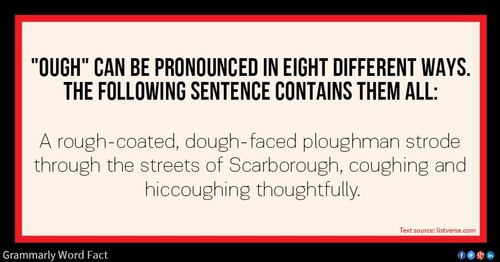
    The cough is keeping me up at night, which is having a decided impact on my ability to string coherent sentences together. I’m also not kicking this virus very quickly so the thought of waiting until I feel better to post was making me worry that it’d be 2016 before I wrote here again. So, I decided to suck it up and put together a Word Wednesday post. Inspired by a post I saw on the Grammarly Facebook Page and my current predicament, I bring you “Word Wednesday: getting through a cough – hey why don’t those words rhyme?”. One of the things that popped into my mind around 3 AM as I was coughing (again) was why is ‘ough’ such a weird letter combination. I can think of 8 different ways that the four letters can be pronounced in a word. EIGHT.  Two or three, sure, but eight? Insane.

    It’s true though. In ‘thought’ there’s an ‘aw’ sound, in ‘though’ it’s ‘oe’ – though, in ‘cough’ it’s more of an ‘off’ sound, which is similar but not identical to the sound at the end of ‘rough’ – ‘uff’, ‘bough’ ends with ‘ow’, and ‘through’ is the always fun ‘oo’. Those are the main six. The other two are less frequent but are used enough that they bear mentioning. ‘Scarborough’ ends with an ‘erow’ sound and the weirdest example of all – ‘hiccough’ has an ‘up’ sound at the end due to popular pronunciation. Is it any wonder people learning English as a second (or third.. or even first) language have issues when it comes to spelling words ending in ‘ough’? If my head wasn’t already spinning, this would do it.

    Text reading "OUGH can be pronounced eight different ways. The following sentence contains them all. A rough-coated dough-faced ploughman strode through the streets of Scarborough coughing and hiccoughing thoughtfully"
    Granted, I don’t think it’s a very natural speech patern.

    Now that we’ve figured out how to pronounce all the ‘ough’ variants, may I present today’s Word Wednesday word: sick. Ha. I bet you thought it was going to be an ‘ough’ word like cough. I was kind of leading you that way wasn’t I?  Okay, two for one deal time. I’ll present two words and their origins simply because I’m nice.

    Interestingly, at least to me, sick is an older word than cough – dating from before the year 900 AD. Sick comes from the Middle English word sik or sek, which in turn comes from the Old English sēoc; sēoc is cognate with Dutch: ziek, German: siech, Old Norse: sjūkr, and Gothic: siuks (Source: Dictionary.com). I find it interesting that so many languages have a similar sounding word for sick and they all rhyme (mostly) with ick which describes how I feel right about now. 

    Cough, on the other hand, dates from around 1275 AD – Middle English form was coghen (note the ‘gh’ which was pronounced similarly to the Scottish ‘ch’ as in ‘loch’ ), which came from the Old English word cohhian which comes from the Germanic keuchen which means to wheeze. 

    So there you have it, cough and sick – two Word Wednesday words for a week when I’ve been down for the count.

    Sick (sik) Adjective

    1. Afflicted with ill health or disease; ailing.
    2. Feeling nauseous and wanting to vomit.
    3. Intensely annoyed with or bored by (someone or something) as a result of having had too much of them.

    Cough (kof) Verb

    1. To expel air from the lungs with a sudden sharp sound

    Noun

    1. An act or sound of coughing.
    2. A condition of the respiratory organs causing coughing.
  • Teaching your child with ASD about gifts

    Teaching your child with ASD about gifts

    One of the most common questions I hear during the holiday season is “How do I teach my child gift etiquette?” Gift giving occasions with kids on the spectrum can be tricky to say the least. Gifts may overwhelm, kids may forget the social niceties we spend all year teaching them causing friends or relatives to get upset when a child forgets to thank them, or worse, is unable to tell one of the social white lies when a gift isn’t quite what was expected. I’ve known more than one child on the spectrum who blurted out “I didn’t want this”, “Yuck”,or “I already have this” when presented with a gift that wasn’t on their radar. I have previously written about buying gifts for kids with special needs so this post is going to focus on ways you can help your child both giving and receiving gifts.

    A stack of presents wrapped in silver and gold paper with red bows and ribbon
    A pile of wrapped gifts

    Giving

    Gift giving can be a really tough skill for kids to learn, and kids on the spectrum have a tougher time than most. There are quite a few strategies I’ve used to teach kids about giving (both gifts and in a larger, charitable sense) and others that friends have used successfully. It’s hit and miss what works with a particular kid, but with some trial and error, a method that works for a particular kid can almost always be found.

    • Write your own social story about giving gifts to others. Important points to include are why we give gifts, and how to respond when thanked for a present. You can also include a section on choosing gifts if you wish. For a quick and easy social story maker I use ConnectAbility’s Visuals Engine. It’s free and you can download the story as a PDF and print it once made. Read the social story often leading up to the gift giving occasion. Make one specific to the holiday season and another one for other gift giving occasions such as birthday parties.
    • Involve the child as much as possible in the process. From making a list of people he would like to give gifts to, to picking a suitable gift. You may need to model desired behaviour and show your own thinking “I know daddy likes cars, and needs socks, so he would like these socks with cars on them” – walk your child through how you pick out gifts for others. (Do this cautiously if the child is prone to blurting out to others what they’re getting, or do it with hypothetical gifts only)
    • Help your child wrap the gifts. If your child becomes anxious about wrapping, use a box or a bag. If they really don’t want the gift hidden (and some kids don’t), then just put a bow on it.
    • Use photos as gift tags to indicate who the present is for – this serves to remind the child that the gift is for another person (so may discourage them from opening it) and who the recipient is.
    • Practice, Practice, Practice! Enlist an older sibling or friend and model gift giving (and receiving). When the child has seen the example a few times, have them switch into the scenario.
    • Some spectrum kids pick things they really like for their friends and siblings and then don’t want to give it away. Make sure you talk about the recipient a lot when you’re buying the gift, and talk about how much they will enjoy it. They may still not want to give the gift away, but be firm and explain that it is not theirs.
    • Kids who are rule followers may find the idea of social conventions comforting. So explaining in in terms of a “non-optional social convention” a la Big Bang Theory is a good way to introduce them to the rules of gift giving.(In general, I don’t believe that gift giving is a social obligation but for kids who need rules… this helps).

    Receiving

    • Practice opening gifts, taking turns and waiting for others, and giving gifts. Try to practice this daily. Wrap boxes with favourite toys and some new items to simulate the experience. Having an established order for opening gifts – each child opens one and the cycle continues.
    • Role play scenarios with your child in preparation for him/her getting a gift they do not want. Give them the right words to use to politely accept a gift. “Thank you for thinking of me” works well.
    • If your family tradition includes putting gifts under the Christmas tree, prepare well ahead of time by setting the rules (gifts are only to be opened when everybody is there, or after a certain time on Christmas morning). Perhaps wrap an empty box to see if your child is able to resist the temptation.
    • Alternatively, wait until just before the holiday to set out gifts, especially large tempting ones.
    • Wrap each family member’s presents in a distinct wrapping paper. That way the child knows which ones are theirs and hopefully won’t unwrap everybody’s presents looking for theirs.
    • When opening gifts as a family, use a consistent order to open gifts. You can try a signal such as an ornament or large candy cane that is passed around to signal whose turn it is to open the next gift. This helps alleviate disorganization and the frustration of waiting.
    • Set a limit on the number of gifts from extended family members and family friends. That way the child knows to expect 3 gifts from grandma and 2 from an aunt. This is very comforting to some kids on the spectrum.
    • Gifts can be overwhelming – especially all at once… so don’t! Open gifts all day long, or over multiple days, whatever works for your family.
    • Sometimes you will find that your child is only interested in playing with the gift he or she has just opened. Let them play. Forcing the child to move to the next present will only create a confrontational situation. Give them a timed warning “In 10 minutes, we’re going to open another gift”, and stick to it. Adjust the time limit if there’s a time sensitive situation like grandma needing to leave.
    • Some children with ASD prefer that you leave their presents unwrapped – others want to know exactly what is in each gift. Surprises can be a source of anxiety, so try to honour your child’s wishes. You can move towards wrapping in steps – wrap a little more each day or week.  Some kids are okay with a present wrapped if they know what’s inside. Experiment to see what works best for your child.

    Gifts are part and parcel of the holiday season, but the stress and anxiety that often come with them don’t have to be. What are your best tips to make gift giving and receiving easier for your children?