Category: Grammar

  • Word Wednesday – Why I need a vacation!

    Word Wednesday – Why I need a vacation!

    It seems that practically everybody I know is either on vacation, planning for a vacation, or just back from a vacation. Currently my father is in Arizona, visiting friends of his and golfing, while I’m home shoveling the seemingly never-ending snow and hanging out with the adorable but slightly neurotic Bichon Frise.

    Don’t get me wrong, Monty is adorable – but he’s also very stubborn and at 14, very set in his ways. He has cataracts and his night vision isn’t very good so when he wants a drink at 2 am, he stands at the end of the bed and whines until he is either lifted down to the water bowl or it is brought to him. I don’t really mind the nocturnal awakenings, because I like having him sleep with me. He knows it, and sometimes, if he thinks I’ve been too slow to get him water, he stays on the floor and sleeps either in his dog bed or in his ‘house’ (kennel with the door removed and blankets inside). To those who say a dog is incapable of plotting retribution of this sort, I’d beg to differ. This adorable Bichon is totally able to plot and exact revenge.

    A small white dog gazes up with his head resting on a stuffed toy otter.
    Yes, that’s an otter he’s resting his chin on, while he plots revenge.

    Between dad “helpfully” sending me BBM messages with the weather in Arizona while we were in the middle of a cold snap that resulted in a frozen pipe in the basement, and my friends posting amazing travel photos as they go on their own vacations, I’ve been left with a serious case of wanderlust and no outlet for it in the foreseeable future. The last true “vacation” I went on was over 20 years ago. I’ve been on school trips since then, and a few business trips but nothing that could qualify as a vacation.  I’ve got a travel bucket list that grows almost daily as I learn about another place that would be amazing to visit.

    The top place on my travel bucket list has been there since I was 9. I was more than a little obsessed with the computer game “Where in the World is Carmen Sandiego?” and played it until I finished the game and then went back and played it again, because I loved it and it was educational so my parents deemed it a good use of computer time. I kept tracking Carmen’s villains to Reykjavík, Iceland, and told myself that one day I would see more of the city than the 3 points of interest in the game.  (Seriously, who goes to a bank as one of the first stops in a new place? Apparently V.I.L.E. henchmen do, all the freaking time.) I liked the way Reykjavík rolled off my tongue, and as I’ve learned more about both the city and country, my desire to visit hasn’t lessened. Recently, I learned that there is a craft distilling movement afoot in Iceland – the Eimverk Distillery produces both whiskey and gin – which makes it somewhere I *need* to visit.

    Of course there’s always the dream of going somewhere warm and sunny to escape the cold and snowy winter. I went to Disney World with my parents when I was 8, but that was 2 years before I discovered that I actually like roller coasters and rides in general so I missed a lot. It was also before any of the auxillary parks opened – it was just the main park and Epcot, so there’s a lot more I want to explore there. I’m not big on sitting on a beach for more than an hour or two (mostly because of my pale skin and the fact that I have a family history of skin cancer so sitting in the sun isn’t high on my list of fun activities), but I love to swim and snorkel. I also like exploring new places, and am an absolute sucker for museums and local history, so I can always find something to do to entertain myself.

    Stylized word Vacation
    Vacation

    I think the time has come to start planning a vacation of my own.. maybe with a couple of friends or solo. Either way, I need a break. I need to get away from the everyday stress and go somewhere where there isn’t just different work to do. (As much as I love the cottage, it isn’t exactly a relaxing getaway when there’s always something to fix / change / paint.) I’ve been reading studies on why it’s important to take vacations and how thinking about and planning vacations can actually increase your happiness. I’ve been under a lot of stress since mum died, and need a place to unwind that isn’t full of memories already.  By all accounts, a vacation is in order! Now to save up and decide where to go.

    Here in North America, vacation is commonly defined as an extended period of recreation, especially one spent away from home or in traveling. It’s akin to the word “holiday” in Europe. The word comes from Late Middle English, which (surprise surprise) took it from Latin. The Latin root word is vacare which means “to be unoccupied” . Whether this is relating to the house or the mind is anybody’s guess. I’d say a bit of both.

    vacation  (va·ca·tion) noun

    1. (North American)

      An extended period of recreation, especially one spent away from home or in traveling.

    2. The number of days or hours per year for which an employer agrees to pay workers while they are not working.

    3. A fixed holiday period between terms in schools and law courts.

    4. The action of leaving something one previously occupied.

    vacation  (va·ca·tion) verb

    1. To take a vacation.

    I’m off to peruse some travel sites and dream.
  • Word Wednesday – Be Generous

    Word Wednesday – Be Generous

    Today isn’t just any Wednesday, it’s Ash Wednesday, the traditional beginning of Lent. I used to do the whole “giving something up for Lent” thing, but I found that it didn’t help me become more in tune spiritually, or enjoy the spirit of Easter any more, as I was looking forward to getting whatever ‘treat’ I had given up that year. (Granted, this was better than Lent when I was younger and gave up Lima beans or liver which I never liked anyway.) Still, it felt like I was going through the motions. A few years ago, a friend introduced me to the concept of 40 Acts – where instead of giving up something for Lent, you take something on. While I’ve moved away from organized religion for the time being, I love this concept of giving of myself for 40 days. I can do that in whatever way I feel is best (though if I’m stuck for ideas the 40 acts website has some), whether that’s helping a friend online, donating to the local food bank, or volunteering at the local thrift store.

    %{include image.html url=“/wp-content/uploads/2016/02/18677308266_fac3b2aab8_z.jpg” alt=“Two hands, wearing black gloves hold a heart made out of snow” description=““}

    The challenge this year is to be generous with ourselves to people not only in our inner circle, but also the people around us, the ones we don’t have regular contact with. While planning my acts of generosity, I got to wondering about the word generous, and what it really means. Once again, my curiosity pays off for the blog as it turns out that the word generous has a pretty interesting etymology.

    %{include image.html url=“/wp-content/uploads/2016/02/coollogo_com-158191633.png” alt=“Stylized word Generous” description=“Generous”}

    The word generous came into English in the late 16th century, from Old French, which took the word from Latin. This isn’t exactly new, as almost half the words we use in English took this route. Where it gets interesting is the Latin. The first Latin root word was generosus which means noble or magnanimous. This makes complete sense and is in line with the modern meaning of generous. The root of the word generosus, though, is genus, as in gene or generations. The word genus means stock or race. The original meaning of generous was ‘of noble birth’ or ‘characteristic of noble birth’ which was expanded to magnanimous and the rest followed nicely and translated through the years and across languages. I find it very neat that the word generous has the same root as the word genome. Language can be awesome like that.

    Generous (gen·er·ous)  adjective

    (of a person)

    1. Showing a readiness to give more of something, as money or time, than is strictly necessary or expected.
    2. showing kindness toward others.

    (of a thing)

    1. (of a thing) larger or more plentiful than is usual or necessary.

    I’ll post the highlights of my 40 Acts deeds on my Facebook page – so if you want to follow along, give me a like!

  • Word Wednesday: I Grok That (finally)

    Word Wednesday: I Grok That (finally)

    After a bit of a respite from Word Wednesday, I’m back at it again. I didn’t think I would miss it but I did. I am an unabashed logophile (more on that another week) and truthfully, picking a favourite word each week isn’t a chore, it’s more of a labour of love. I’ve been working on the craft of writing more this year and have dedicated some time each week for professional development – for the first few months of the year that means reading about writing. Currently, I’m in the middle of Stephen King’s wonderful book On Writing. While I’ve never been a huge fan of King’s horror novels (I still have a mild case of coulrophobia thanks to It – but only those with Pennywise makeup. other clowns aren’t objects of abject terror but I once rode 2 stops past where I needed to get off on the TTC because there was a guy dressed as Pennywise on the platform I needed to use) I appreciate the thought and hard work he devotes to his craft.

    King devotes a lot of energy to the notion that writers must be, above all, readers. He says that it really doesn’t matter if the books are classic or even good. Indeed, he argues that “One learns most clearly what not to do by reading bad prose – one novel like Asteroid Miners (or Valley of the Dolls, Flowers in the Attic, and The Bridges of Madison County to name just a few) is worth a semester at a good writing school, even with the superstar guest lecturers thrown in”. I’m inclined to agree, though there are some books I haven’t been able to force myself to finish because the grammatical errors were so egregious that they muddled the plot. At the end of On Writing, King offers up a list of books that he has enjoyed – he says he’s not Oprah and this isn’t a book club reading list but simply a list of books that he has enjoyed and that have helped him grow in his craft. This got me thinking and I’ve been trying to stretch my reading muscles in the weeks since. (Yes I read the “And Furthermore, Part II” section before finishing the book – I’m a rebel like that). One book that I picked up recently and started reading (I typically have at least 3 or 4 books on the go at any given time –  I pick and choose which book to read depending on my mood) is the 1961 classic Stranger in a Strange Land by Robert Heinlein. It was here that I came across the word I want to write about today.

    %{include image.html url=“/wp-content/uploads/2016/02/If-you-dont-have-time-to-read-you-dont-have-the-time-or-the-tools-to-write..png” alt=“A notebook with a pen across it and the text: If you don’t have time to read, you don’t have the time (or the tools) to write. If you want to be a writer you must do two things above all others: read a lot and write a lot. Stephen King” description=“Words to live by”}

    There’s no etymology of this word since it is out of the mind of Heinlein. I have many awesome and geeky friends who use this word often enough that over the years, I’ve figured out the meaning by osmosis. I didn’t truly grok it until I read the definition given by Heinlein in the book:

    Grok means to understand so thoroughly that the observer becomes a part of the observed—to merge, blend, intermarry, lose identity in group experience. It means almost everything that we mean by religion, philosophy, and science—and it means as little to us (because of our Earthling assumptions) as color means to a blind man.

    So now when a friend comments that they grok something, I can smile knowing that I’m in the know. I grok what it means to grok.

    %{include image.html url=“/wp-content/uploads/2016/02/coollogo_com-23492915.png” alt=“Stylized word Grok” description=“Grok”}

    Grok (grok) verb

    1. To understand thoroughly and intuitively.


  • Word Wednesday – through with the cough

    Word Wednesday – through with the cough

    I had big plans for a bunch of posts right around this time last week. Then I got hit hard with a virus that is going around. It started off with me being really tired, but since I’ve been on the verge of exhaustion for the last few weeks, I didn’t really notice. Phase II resembled a gastro bug. Unpleasant for sure but I figured they’re usually really short lived so rest for the weekend and I’d be good as new Monday. Not so much. Monday brought phase III – the cold of doom. My nose is either stuffed up or running like a faucet, my head is pounding, my sinuses ache, and then there’s the cough. I had a month long cough after Blissdom in October – heck I even lost my voice the day before I was supposed to present.  I figured I’d paid my dues, but the universe has other plans. It’s not too bad in the day time, apart from the occasional coughing fit that leaves me winded. At night though, I sound like a lost seal barking for her rookery (or pod, or colony – the internet gods were a little indecisive on this).

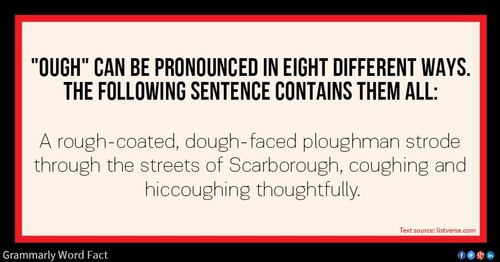
    The cough is keeping me up at night, which is having a decided impact on my ability to string coherent sentences together. I’m also not kicking this virus very quickly so the thought of waiting until I feel better to post was making me worry that it’d be 2016 before I wrote here again. So, I decided to suck it up and put together a Word Wednesday post. Inspired by a post I saw on the Grammarly Facebook Page and my current predicament, I bring you “Word Wednesday: getting through a cough – hey why don’t those words rhyme?”. One of the things that popped into my mind around 3 AM as I was coughing (again) was why is ‘ough’ such a weird letter combination. I can think of 8 different ways that the four letters can be pronounced in a word. EIGHT.  Two or three, sure, but eight? Insane.

    It’s true though. In ‘thought’ there’s an ‘aw’ sound, in ‘though’ it’s ‘oe’ – though, in ‘cough’ it’s more of an ‘off’ sound, which is similar but not identical to the sound at the end of ‘rough’ – ‘uff’, ‘bough’ ends with ‘ow’, and ‘through’ is the always fun ‘oo’. Those are the main six. The other two are less frequent but are used enough that they bear mentioning. ‘Scarborough’ ends with an ‘erow’ sound and the weirdest example of all – ‘hiccough’ has an ‘up’ sound at the end due to popular pronunciation. Is it any wonder people learning English as a second (or third.. or even first) language have issues when it comes to spelling words ending in ‘ough’? If my head wasn’t already spinning, this would do it.

    Text reading "OUGH can be pronounced eight different ways. The following sentence contains them all. A rough-coated dough-faced ploughman strode through the streets of Scarborough coughing and hiccoughing thoughtfully"
    Granted, I don’t think it’s a very natural speech patern.

    Now that we’ve figured out how to pronounce all the ‘ough’ variants, may I present today’s Word Wednesday word: sick. Ha. I bet you thought it was going to be an ‘ough’ word like cough. I was kind of leading you that way wasn’t I?  Okay, two for one deal time. I’ll present two words and their origins simply because I’m nice.

    Interestingly, at least to me, sick is an older word than cough – dating from before the year 900 AD. Sick comes from the Middle English word sik or sek, which in turn comes from the Old English sēoc; sēoc is cognate with Dutch: ziek, German: siech, Old Norse: sjūkr, and Gothic: siuks (Source: Dictionary.com). I find it interesting that so many languages have a similar sounding word for sick and they all rhyme (mostly) with ick which describes how I feel right about now. 

    Cough, on the other hand, dates from around 1275 AD – Middle English form was coghen (note the ‘gh’ which was pronounced similarly to the Scottish ‘ch’ as in ‘loch’ ), which came from the Old English word cohhian which comes from the Germanic keuchen which means to wheeze. 

    So there you have it, cough and sick – two Word Wednesday words for a week when I’ve been down for the count.

    Sick (sik) Adjective

    1. Afflicted with ill health or disease; ailing.
    2. Feeling nauseous and wanting to vomit.
    3. Intensely annoyed with or bored by (someone or something) as a result of having had too much of them.

    Cough (kof) Verb

    1. To expel air from the lungs with a sudden sharp sound

    Noun

    1. An act or sound of coughing.
    2. A condition of the respiratory organs causing coughing.
  • Word Wednesday Holi-daze

    Word Wednesday Holi-daze

    As of today, there is one month left until Christmas, and only 12 days left until the beginning of Hanukkah. Tomorrow is US Thanksgiving and the traditional start to the holiday sales season happens Friday with the retail event known as Black Friday. Most of the people celebrate something in and around December / January so it’s a busy time of year. Between family events, social events, work related events, and school concerts my December calendar is looking very full indeed.

    I have to admit that the holidays are much harder now since the death of my mum. She loved Christmas and the house would be bursting at the seams with decorations, music, baking, and presents (one year we had 3 trees – big one in the living room, small one in the family room, and a child / pet proof one in the basement). Dad on the other hand, has leaned more towards the Grinch side of the spectrum. He never begrudged mum all her decorations but we both knew if left to his own devices, there would be a lot less Christmas in the house. I’m somewhere in the middle. I like Christmas and love finding the perfect gift for friends and family members, setting up my nativity scene, and enjoy putting up the tree, but aside from that? I’m not big on decking the halls. Last year it was about  10 days before Christmas when we finally got the tree up (and that was because we had company coming over). I’m not sure when it’s going up this year.

    A decorated Christmas tree with multi coloured lights and an angel on top
    The Christmas tree last year


    I have a tradition of getting all the kids in my life (and there are a lot of them) who I buy presents for, books for Christmas. It’s much easier to keep track of reading levels than it is to figure out who likes Littlest Pet Shop vs Barbie vs Transformers vs Hot Wheels. I do that for birthdays – they’re (thankfully) spread out though the year. I get some books used (but in great condition) and some new – helps the budget and the earth. I find 2-3 books per kid and double check with mom and  or dad to make sure they don’t already have it, then I put a post-it note with the kid’s name on it and wrap them in a marathon session. The bonus is that books are far easier to wrap than most toys – straight edges and they’re generally flat.  This is about 2/3 of the total books for this year:

    Around 30 picture books and early readers with a few young adult novels lie in a pile on the floor
    At least they’re small and stack nicely

    All of this has me thinking about holidays and when holidays aren’t actually holidays. We celebrate 2 Thanksgivings here, although I only cook turkey for one. The US Thanksgiving is a social event with 6 or 7 people dropping by all afternoon and evening to hang out and watch football (starting, of course, with my beloved Detroit Lions game at 12:30). So it’s a holiday here, even if its’ not an official holiday in Canada. Today’s Word Wednesday, in celebration of all of this, is holiday. Holiday is defined as a day of festivity or recreation when no work is done. So I guess neither Thanksgiving counts as a holiday in my house – we’re doing outside work on Canadian Thanksgiving and I work before and during the games on US Thanksgiving. The word holiday comes from the Old English halidaeg which translates to ‘holy day’, reflecting that early holidays were religious observances.

    Holiday (hol·i·day) noun

    1. A day fixed by law or custom on which ordinary business is suspendedin commemoration of some event or in honor of some person.
    2. Any day of exemption from work (distinguished from working day ).
    3. a religious feast day; holy day. 

    Now, if you’ll excuse me, I need to get ready for tomorrow’s holiday. 


  • Dos and Don’ts of Giving Gifts to Special Needs Children

    Dos and Don’ts of Giving Gifts to Special Needs Children

    With the holiday season fast approaching, I’ve had a few queries as to how best to alert friends and family members as to what the best gift for a special needs child is. Buying gifts for kids at Christmas is tough, and if the child has special needs, it can be hard to figure out what kind of gift the child (and parents) would like. While there are no universal one-size-fits-all recommendations, there are some best practices to follow.

    14 square presents wrapped in purple paper with gold ribbon.
    That’s a lot of wrapping!

    Do – Ask the child (or the parents) what the child’s interests are.

    Don’t – Buy a generic gift for every kid you know in the age range. (A good rule to use for all the kids in your life.)

    Do – Buy items tailored to the child’s interests, even if you think the toys are “too young”. So what if the 8 year old still loves Sesame Street?

    Don’t – Only buy things that are labelled ‘educational’. Any toy can be educational, and many of the ones promoted as educational are boring and expensive.

    Do – Keep safety in mind – if the child is a chewer, stay away from items with small pieces (like marble runs!) that could be swallowed. Or metal cars if the child is prone to throwing things – they hurt!

    Don’t – Buy therapy supplies – while they may be useful, they’re not fun and can make special needs children feel singled out.

    Do – Be aware of the child’s limitations and buy accordingly – if there are issues with fine-motor control, the 1000 piece Lego set may not be the right gift.

    Don’t – buy kits for projects that the parents have to do most of the work for.

    Do – Think outside the box – maybe tickets for an experience (like the zoo) would be better than a traditional gift.

     Don’t – Get the child the same thing you got them last year. Nobody needs 10 sets of stacking cups. Nobody.

    Do – Get a gift receipt.

    Don’t – Be insulted if the parent returns the gift or exchanges it – duplicates happen.

    Do – Get your child involved – if your child is friends with a special needs kid, they’ll probably have some great ideas!

    Don’t – Buy toys with no volume control or that don’t have an off switch. Again, don’t do this period – special needs or not.

    Do – Get games the family can play together.

    Don’t  – Get games that have complicated rules, or are completely random in the way the game works. (Uno Attack, Ker-plunk, Jenga)The randomness of the games can be a huge source of frustration for kids in general, but special needs kids can have a much harder time accepting the randomness. You can find my list of games for kids on the Autism Spectrum here.

    Above all, ask. I know quite a few special needs parents and none of them are insulted or upset about polite questions regarding their children’s likes, dislikes, and abilities. As more than one of my friends with kids who have special needs have pointed out – they LOVE to talk about their kids, so just get them started and they’ll supply you with the information you need (and adore you for being so thoughtful). Sometimes there’s an expensive item on the wish list, and multiple friends and family members can each contribute to it. Finding the right gift for a kid with special needs isn’t an impossible task, it just takes a little time and thought.


  • Word Wednesday – An Act of Remembrance

    Word Wednesday – An Act of Remembrance

    Today I will stand at a cenotaph and speak at a Remembrance Day event. I will have the honour to shake hands with veterans who served this country in times of war and peace. Today I will cry for a friend who never made it home after serving his country, and for another who made it home in body but not in spirit. I will cry for every soldier who died in service, who was wounded physically or mentally, and for every soldier who saw a friend, a brother or sister in arms, die or be wounded.

    I trained as a military historian, investigating recruiting techniques in small-town Ontario during the First World War. I wanted to know what made thousands of young men travel halfway across the world, to the muddy trenches of Belgium and France, and fight other young men with whom they had no personal quarrel – only the disagreements of their leaders. These young men left everything they knew in order to fight an ‘enemy’ doing much the same thing. What I learned over the course of my research fundamentally changed me. I learned that for the most part, it wasn’t about “King and Country” or justice for Belgian orphans, or one of the myriad of noble reasons that I found in my history textbooks. No, what changed me was that these young men almost a century ago went to war for reasons much closer to home. They went because they were promised adventure. They went because they were going to inherit the same farm that their father and grandfather worked and wanted to see the world before settling down. And they went because their friends were going and they didn’t want to miss out. Reasons I could see my friends signing up. Reasons I would have signed up for war. Suddenly I could put myself in the place of those soldiers. They became more than names on the cenotaph.

    As I continued my research, I discovered that local newspapers regularly published letters home from the soldiers. I spent days searching out every one of the letters from each of the soldiers. I read their queries about their siblings, the farm, and how everything was back home. Things at the front were often described as “fine” or “no change”, without much description. This was partly due to the censors, but partly escapism too. For, when writing home from a cold, damp, and muddy tent behind the supply lines at the best of times, and a wet, rat infested trench at the worst, it would be easier to focus on happier times at home than on the circumstances at hand. One of my professors warned me that personalizing the soldiers was dangerous, that military historians couldn’t be emotionally tied to their research. I looked him in the eye and told him the day I didn’t shed a tear over the death of a soldier was the day I was no longer fit to be a military historian. I shed a lot of tears over the course of my research and produced a paper that was, I hope, a fitting tribute to all of the soldiers I studied. I vowed to never forget them, and, so far, I have kept my promise.

    Why World War One? Well that is one question I can answer easily. I walked the trenches at Vimy Ridge at the tender age of 17 thanks to a high school music trip. We saw a lot of impressive monuments on that trip: York Minster Cathedral, Hadrian’s Wall, The Elgin Marbles at the British Museum, the Palace at Versailles, the famous artwork in the Louvre, but it was the trenches of Vimy that changed me. Before that trip, I’d loved history – but it was ancient history that held my heart. The Romans, the Greeks, and the Egyptians – they were what I was going to study. I had plans to go into archaeology and uncover the secrets to long-lost civilizations. I’d done well in my grade 10 Canadian History course, but I wasn’t a fan of the military history – it was all about the numbers, the battles, and the tactics. Those never held much sway for me. In contrast, my ancient history courses had all been about the people so I was interested. Walking the trenches at Vimy, walking up to the monument and seeing the names of Canadians who weren’t much older than I was that day, who were buried in cemeteries that adorn the French countryside. I asked the tour guide why these young men signed up for war, and she gave the well rehearsed answer of “for King and Country”, but I wasn’t satisfied. I wanted to know more, and so I researched.  I wanted to know what would motivate someone my age (I was almost 18) to sign up to endure such horrific conditions: cold, muddy, rat-infested trenches for years on end. I was curious as to whether I, or my classmates, if faced with the same decision would make the same choice. I admit that I was fairly confident that we would not. I was wrong. The boys of a century ago were not so different from teenagers today, and that is what I will be remembering today. The young men who served with valour, honour, and courage. Who did not know the horrors they had signed up for, but once faced with them, bravely fought and put on a cheery facade for their friends and family when writing home. These are who I will be thinking of as  I mark the eleventh hour on the eleventh day of the eleventh month.

    The view inside a trench - there are high stone walls on either side and a narrow concrete walkway with grooves cut into the stone to allow for drainage
    Inside one of the trenches at Vimy Ridge – I took this when I was there in 1998.

    Many Remembrance Day ceremonies end with the words of British poet Laurence Binyon. His poem For the Fallen was published in The Times newspaper on September 21st 1914. The third stanza has become known as the Ode of Remembrance.

    They shall grow not old, as we that are left grow old:
    Age shall not weary them, nor the years condemn.
    At the going down of the sun and in the morning,
    We will remember them.

    I, for one, will always remember and ask you to pause and do the same.

    Remember (re·mem·ber ) verb

    1. To have in or be able to bring to one’s mind an awareness of (someone or something that one has seen, known, or experienced in the past).
    2. To cause (something) to come back into your mind
    3. To keep (information) in your mind : to not forget (something).
    very hilly ground with the top walls of the trench just visible, students are walking beside the trenches and in front of the forest that has grown up beside the trench
    The grounds at Vimy. The surrounding area is flat… the undulations were made by artillery on both sides.
  • Word Wednesday – New Beginnings

    Word Wednesday – New Beginnings

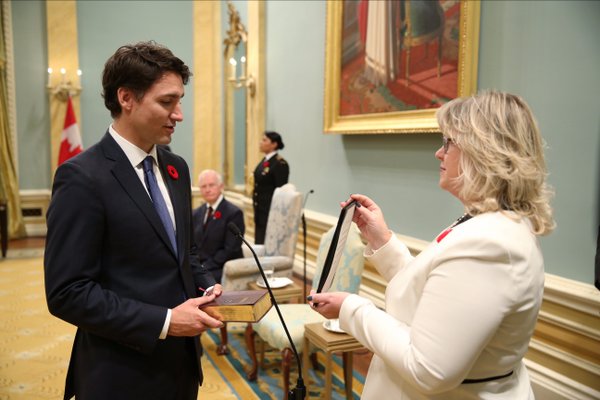
    Canada got a new Prime Minister today. Just 16 days after Canadians voted decisively for real change, Justin Trudeau was sworn in as Canada’s 23rd Prime Minister at Rideau Hall this morning.  While not everyone is happy about this (but honestly no government will ever please everyone), I am excited for the change. I think that the gender equal cabinet (there are 15 female cabinet ministers – the largest percentage of women ever) that is also the most diverse cabinet ever is going to ultimately be a good thing. It’s not like cabinets in recent memory have ever been about putting only the most qualified people into the portfolio that most suited them. There has always been an element of regional parity in cabinet making which already hampers the “best person for every position” philosophy, and I don’t think that any of the 14 women chosen weren’t qualified for their portfolio (besides, the only portfolio that you really need prior qualifications for is Finance IMHO).

    It has been said that Canadians don’t vote a government in, they vote one out – which I think is true. We’re a multiparty country that vacillates between two governing parties in cycles ranging between 8-12 years. Part of me, the political idealist who is mostly hidden, wants to think that this election wasn’t just about voting out a leader who had overstayed his welcome, it was about something much bigger – possibility.

    Justin Trudeau holds a book and swears an oath in front of a female Justice
    The new Prime Minister being sworn in. Photo from @JustinTrudeau on Twitter

    The possibility of a different direction for the country. One open and honest and accessible to everyone. My amazing friend, (I still can’t believe I’m her friend… I feel like she’s going to wake up and realize I’m nowhere near cool enough to be her friend) Amanda, wrote a heartwrenchingly honest letter to our new Prime Minister asking him to keep his promise to make transgender rights a priority. I feel like if anyone is going to be able to help Alexis grow up in a country that affords her the protection and respect she deserves, it is Mr. Trudeau. And if he doesn’t follow through on this promise, I will be right there with Amanda and all the other allies protesting and holding him accountable.

    Already there has been change. Today’s swearing in ceremony was different from any other one in Canadian history – with the public being invited to the grounds of Rideau Hall and with Mr. Trudeau going out and mingling with the crowd. Another amazing woman I know, Amy Boughner, was fortunate enough to be able to go and she got to meet the new Prime Minister and get this picture of him when he was out meeting with the people who came out to witness this historic event.

    Justin Trudeau speaks with a reporter in front of a crowd. He is smiling and wearing a poppy
    Photo Courtesy of Amy Boughner

    I was trying to decide what my Word Wednesday word was going to be, and flipped on the television coverage of the ceremonies, and the words “hope”, “change”, and “new beginning” kept coming up. I think the perfect word to encapsulate the feeling from today is possibility. So that’s my choice for Word Wednesday on this gorgeous November day. Possibility. It’s a word that has positive connotations, and I think it’s a great thing to have positive thoughts at the swearing-in of a new cabinet.

    Stylized text of the word possibility
    Possibility

    Possibility is another word with Latin roots (I always come back to the Latin roots), coming from Latin to French to English – a fairly straightforward etymological progression. The Latin root word is possibilis meaning “able to be done”, which inspired the Old French word possibilite, from whence (yes, I’m aware that “from whence” is redundant, and I’m going with it anyway because it’s less awkward and Shakespeare used it) we get the English word possibility. Possibility – it even sounds positive, and full of hope and opportunity.

    Possibility (pos·si·bil·i·ty ) noun

    1. A thing that may happen or be the case.
    2. The state or fact of being likely or possible; likelihood.
    3. A thing that may be chosen or done out of several possible alternatives
    4. Unspecified qualities of a promising nature; potential.

    So there’s a definite possibility that next week’s Word Wednesday post will have something to do with the word whence, because it’s awesome and makes me happy, and there’s an air of possibility in the new government that took office today.

  • Word Wednesday – Decaf edition

    Word Wednesday – Decaf edition

    All my life I’ve been a tea drinker. There are pictures of me with tea in my bottle (thanks grandma!) and with my British heritage, not drinking tea wasn’t an option. I came to coffee very late in the game. I was well into my 30s before I could stand the taste of non-specialty coffee. You know, the kind without all the artificial flavours and sweeteners that costs an arm and a leg and has half of your daily calories in a venti? Yeah those didn’t count in my “I don’t drink coffee” phase. Now, I quite enjoy a nice cup of coffee with milk and a very small amount of sugar with my breakfast. Until Wednesday that is. I’d brewed a pot of coffee, and gone to my “office” (currently the couch in the family room in the morning because the dog likes to snuggle beside me and I quite enjoy that) when I caught whiff of the unmistakable aroma of burning plastic. The coffee maker had set itself on fire. The torrential deluge we experienced was good for something as I took out the carafe and put the whole thing outside on the porch, then dropped it into the bin once it was well and truly out. I should mention that the fire was contained inside the machine at the time.

    That dealt with, my attention turned to the new problem. No coffeemaker. If it was just me drinking coffee, I’d use the French Press and make a single cup, but my household goes through a 10 cup pot (because coffeemaker cups are not the same as actual cups – I can easily fit 2-3 in a decent sized mug) every day. So I posted on Facebook and Twitter asking for recommendations for a new coffee maker. Several people had wonderful things to say about the single serve coffee machines, but I worry about the environmental impact of them, plus I like brewing a full pot of coffee in the morning. A few recommendations came in for machines that I’m pretty sure you could launch the space shuttle from. All I want out of a coffee maker is the ability to set a timer for the days when I need to be out of the house at the crack of stupid, the ability to keep coffee warm for an hour or two, and it not to self-combust leaving me in a state of caffeine withdrawal. After sorting through all the options and checking for sales and price matching  and reading way too many online reviews, I finally found a replacement which I can get in a couple of days. Sometimes living in the middle of nowhere sucks.

    So I’m writing this post without the benefit of my morning coffee and let me tell you, I miss it. So in honour of that, today’s Word Wednesday post (appearing on Thursday because of the whole coffeemaker debacle) is dedicated to coffee (also known as “writing fuel”).

    Stylized version of the word Coffee
    Coffee

    Coffee is actually a fairly modern word, and the first historical evidence of humans drinking coffee (or knowing about the coffee tree) is mid 15th Century with the word coffee tracing back to the mid-late 16th Century. (No wonder the Dark Ages come to an end around 1500 – coffee was discovered!) The word coffee comes either from the Dutch word koffie, which was then translated to the Arabic word kahwa, which begat the Turkish word kahveh, which finally led to the Italian word caffe – which is pronounced much like the original Dutch word. I suspect that linguists are also fueled by coffee.

    Several of my friends are far more dedicated to coffee  than I am (though I suspect with time I will be just as addicted to a good cup of steaming hot coffee as they are) and take pictures of their daily brew or write hymns to the beverage and I’m going to close with those.

    Coffee (cof·fee) Noun

    1. A drink made from the roasted and ground beanlike seeds of a tropical shrub, served hot or iced.
    2. the shrub of the bedstraw family that yields the coffee seeds, two of which are contained in each red berry. Native to the Old World tropics, most coffee is grown in tropical America.

    Now, if you’ll excuse me, I’m off to have a cup of tea and hope for the best.


  • Word Wednesday – chaotic edition

    Word Wednesday – chaotic edition

    I’m not sure if this happens to everyone but every time I head to a conference, like the fabulous Blissdom Canada Conference, I return to utter chaos. It’s not necessarily the house (though it wasn’t as orderly as I’d left it), it’s more that my life seems to be tossed upside down by the new things I learn at the conference. 

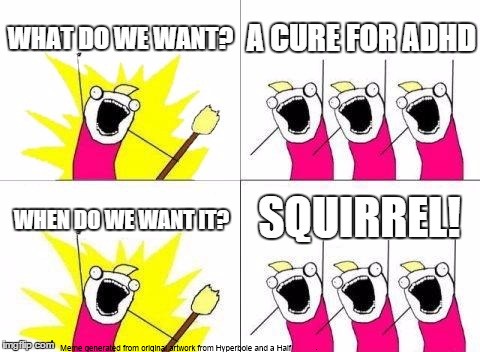
    I want to implement things right away so that I don’t forget them. At the same time, I don’t want to jump into changes too quickly so I spend a lot of time thinking over (and overthinking) everything. I come home full of amazing ideas and wanting to keep up with all of the new friends I made. This being the digital age, that means a lot of time spent online. Given my ADHD squirrel tendencies, online time tends to devolve quickly into a never ending Facebook spiral with the occasional Youtube or Reddit interlude. Chaos, I tell you, chaos.

    4 panel comic. Panel 1: a stick figure asks What do we want? Panel 2: a group of stick figures answer A cure for ADHD Panel 3: the lone stick figure asks when do we want it? Panel 4: the group of stick figures answers Squirrel
    Meme based on the original Hyperbole and a Half meme

    Inspired by all of this, today’s word Wednesday word is chaos. Chaos comes to us via 14th Century France , taking the word from Latin. The Romans, as they were wont to do, took the word directly from the Greeks. The Greek word in question was khaos which means: abyss, that which gapes wide open, [something that] is vast and empty. The modern definition of chaos, meaning utter confusion, came into being circa the 16th century and comes from a theological interpretation. The Vulgate version of the book of Genesis (circa 1530) used the word chaos to mean “the void at the beginning of creation”.

    Stylized version of the word chaos
    Chaos

    It was the Roman poet Ovid who gave us our current meaning of chaos in his epic, Metamorphoses, when he juxtaposed Khaos with Kosmos – the ordered universe. So the modern meaning of chaos came to be orderless confusion. Which pretty much sums up my life right now. Orderless confusion and plenty of brain squirrels.

    Chaos (cha·os) noun

    1.  Complete confusion and disorder : a state in which behaviour and events are not controlled by anything
    2. The state of the universe before there was any order and before stars and planets were formed

    Hopefully I’ll restore order to my little piece of chaos soon. Until then, I’ll be out chasing the squirrels.