Tag: Sports

  • Word Wednesday – Para what?

    Word Wednesday – Para what?

    As I wrote in an August Word Wednesday Post, I love the Olympic and Paralympic games. I love the way entire countries rise up behind their athletes and how small acts of kindness between athletes make you realize that even in the heat of competition, people are inclined to help one another. One of the things that drives me absolutely crazy about the Paralympic games though is the way they’re treated in the media and by the general public. During the Olympics, I couldn’t log on to Twitter, Instagram, or Facebook without seeing #Olympics or #Canada or one of the Olympic filters on a profile picture. During the Paralympics, however, I have had to actively look to find people mentioning the games. I understand that there is some degree of “sports fatigue” – in that a lot of people who aren’t necessarily into sports watch the Olympics but aren’t actually all that interested beyond their favourite sports.  The 2 week wait between the Olympics end and the Paralympics begin also plays a role in diminished media attention and public appetite.  What I vehemently disagree with is that the Paralympic games are in any way or shape less important than the Olympic games. Paralympians are elite athletes – period. If you think that just because someone is physically disabled, they aren’t training just as hard or just as athletically gifted as an able bodied athlete, I challenge you to go to the Canadian Paralympic Team’s Paratough website and try one of the Paralympian workouts. I tried the swimming core workout 4 days ago, and my abs haven’t forgiven me yet!

    Before I get too far into  this, I should address the question I’ve been asked quite a few times on social media – why aren’t there athletes with autism or other intellectual disabilities in the Paralympics? There’s no really quick answer, but the best I can come up with is this: They were part of the Paralympics in 1996, 1998, and 2000, which is when the wheels came off. Several athletes who competed in the intellectually disabled categories during the Sydney Paralympics were proven to have cheated the classification system and were not actually intellectually disabled at all – the International Sports Federation for Persons with Intellectual Disability, which had been formed to represent elite athletes with intellectual disabilities hadn’t been doing the background checks and documentation checks on all of the athletes which created a loophole that was exploited by dishonest paralympic committees. After the scandal in 2000, the Intellectual Disabled category was removed from all Paralympic competition with some integration brought back with very tight oversight for the 2008 Summer Paralympic games in Beijing China and there are ID (intellectually disabled) classes in several Paralympic sports.  Still, the majority of intellectually disabled athletes compete in the Special Olympics World Games which happen in offset years to the Olympic and Paralympic games. The Special Olympics World Games are recognized by the International Olympic Committee as are the Deaflympics – which are actually older than the Paralympics and are exclusively for athletes with hearing impairments. The Deaflympics are distinct from the Paralympics and any other Para-sport organization because only members of the hearing impaired community can serve on the board for the The International Committee of Sports for the Deaf – who run the Deaflympics.

    So, the Paralympics are primarily for athletes with physical disabilities including visual impairments. The visually impaired categories in para-sport are determined by degree of vision loss and in some disciplines the need for a guide, with one sport – goalball – being exclusively for visually impaired athletes. If you haven’t seen goalball you should try to watch one of the matches via the CBC Sports website – it’s really cool. The game is played in total silence so that the bells inside the ball can be heard by the players. Athletes with partial vision compete with completely blind athletes because all players wear eyeshades that block out vision. The court has tactile markings to help players orient themselves – the lines on the court are marked by lengths of twine that are then taped over. A goal is scored by throwing the ball using a bowling motion into the opposing net – while the opposing team attempts to block it of course.  Goalball and Boccia are the two sports in the Paralympics that don’t have a Olympic counterpart. Boccia is a sport open to only physically disabled athletes with 4 classifications – 3 of which are for athletes with Cerebral Palsy. In Boccia, athletes throw coloured leather balls towards a white target ball (called a jack) on a long, narrow field of play that looks almost like a patch of grass but is smooth. The object is to be the closest to the jack after all 12 balls (6 per player or team) have been thrown. Boccia has been deemed to be similar to lawn bowling but I see it as more like lawn curling. I had a chance to try Boccia at a Para-sport day hosted by some local service organizations when I was younger. It was much harder than it looked, and I lost pretty soundly.
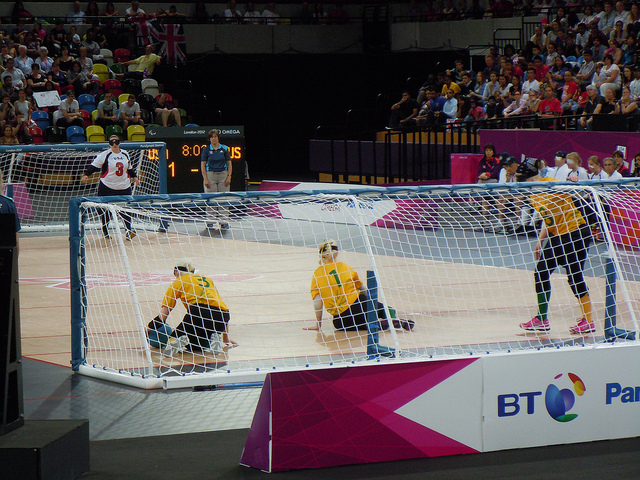
    Goalball at the London Paralympic games. There are 3 people in yellow 2 are sitting one is standing, all in front of a net. Across the court there is one person in white visible in front of their net.
    Goalball at the London Paralympic games.

    This week there has been a lot of media attention focused on the fact that the top 4 runners in the Men’s T13 1500m final all posted faster times than the Olympic Gold Medalist at that distance. The T13 classification is the highest level of functionality of visually impaired athletes so there were no prosthetic limbs or blades involved in the times.  This was the one time I saw quite a few posts about the Paralympics, usually full of shock that Paralympians could run that fast. I replied to every comment with the same question – why should a visual impairment make an athlete run slower? I wasn’t surprised that these men ran faster than the Olympians – they are still elite athletes after all. I think Wendy-Ann Clarke of CBC hit the nail on the head when she reminded everyone that every race at the Olympics and Paralympics is different, especially at a distance like 1500m where strategy plays a big role in race management. The goal at the Olympics and Paralympics is to get a medal – records are secondary. So the athletes are going as fast as they need to to win, but not necessarily as fast as they possibly can.  The gold medal winner at the Olympics, Matthew Centrowitz, controlled the race pace to one that gave him the biggest advantage – which was a slow first 2 laps and then a faster final lap – a tactic that would have forced his opponents to expend a lot of energy to try to pass him earlier in the race which would have drained their resources for later in the race when they needed to push. The T13 1500m final on the other hand had a racer, Bilel Hammami get off to a really fast start and the rest of the runners pushed to try to match it, resulting in a faster race overall.  The assumption that para-athletes are somehow inferior to able bodied athletes has been bothering me for the past few days and is ultimately what inspired this post. Paralympians and Olympians are the top athletes in their sports; of course some amazing times will be posted during the Paralympic games, but the focus should be on the performance in and of itself. Comparing Paralympic times to Olympic times makes it seem like the Olympics are somehow better than the Paralympics when they’re not. The Olympics, Paralympics, Special Olympics World Games, and the Deaflympics are all the preeminent sporting events for the athletes competing. The difference is merely in who competes not in the athletic ability of the competitors.

    %{include image.html url=“/wp-content/uploads/2016/09/Paralympic-or-Olympic.png” alt=“a gold, silver, and bronze medal with the text Paralympic or Olympic an equal accomplishment” description=“A gold medal is a gold medal”}

    All of this got me curious about the origin of the word Paralympic. The games were first contested in 1948 as the Stoke Mandeville Games named after the London treatment centre for spinal injuries. They were not officially named the Paralympics until 1988, but from 1960 on were informally called the Paralympics while formally known as the International Stoke Mandeville Games. The first games in 1948 were only for wheelchair athletes – and early literature refers to the games as the Paraplegic Olympics or Paralympics.  As more categories of physical disabilities were added, the Para in Paralympics was assumed to be the Greek prefix meaning beside. So the Paralympics  run alongside the Olympics. Now, the word Paralympics is recognized as a word in its own right, not as a portmanteau. 

    Paralympics ( Para·lym·pics)  Plural Noun

    1. An international competition for physically disabled athletes, associated with and held following the Summer and Winter Olympic games. 
  • Saying Goodbye to SkyDome

    Saying Goodbye to SkyDome

    Tonight is the end of an era, albeit one that many Toronto sports fans (particularly CFL fans) have struggled with over the last 27 years.  Tonight the Toronto Argonauts play their last game at the Rogers Centre (formerly – and forever to me –  known as SkyDome). I was at the first game at SkyDome on July 12, 1989, and I will be there tonight at the last game.  In between those dates I’ve seen around 70% of the Canadian football games played there (including Vanier Cups and Metro Bowl finals but not including the Bills in Toronto series or the NCAA games). I’ve been feeling nostalgic today and reading some of the articles about the best memories at SkyDome including this one by the very talented Andrew Bucholtz, Mike Hogan’s trip down memory lane, and this one from the Toronto Star that focuses on Michael “Pinball” Clemons’ memories of the stadium where he played his entire CFL career and still calls home as Vice Chairman of the Argos.

    I’d like to start by addressing the elephant in the room, the notion that Sky Dome / Rogers Centre is not a good place for football. While it’s not one of my favourite places to have watched a game, it’s not at the bottom of the list either. Multi-purpose stadiums (especially ones that convert between baseball and football) are never going to have the same great sight-lines as somewhere like Ford Field that was built for football and football alone. I agree that in the first few seasons, before the team got their act together, there were some truly awful seats available for football. I would know, my family’s seasons’ tickets were moved from being really amazing at Exhibition Stadium to being horrible at SkyDome. The first 10 rows in the 100 level don’t have enough of a slope and left fans staring at the back of players on the sidelines instead of the action on the field. The team eventually realized this and covered up those seats with banners. Apart from that, the SkyDome is not a horrible place to watch football. Sure there have been times when it is agonizingly empty, but that has less to do with the stadium itself and more to do with the people running the organization / marketing and a bad on field product.  Toronto football fans are fickle and when the team is crap, they make their opinions known.

    That said, some of the most passionate CFL fans I know are Toronto Argonauts fans. People who, like myself, have been there through thick and thin, and have felt the highs of winning a Grey Cup at home in 2012, and the lows of 3-15 seasons (1993 and 2009 are the two I remember as being horrible – though nobody really cared too much about 1993 since the Jays won the World Series that year). Don’t believe anyone who tells you that Torontonians don’t like football. They do, but in recent years scheduling woes have made figuring out when the team plays a challenge. The team had a playoff game re-scheduled for a Wiggles Concert in 2004, were forced to have games on Tuesday and Wednesday evenings in the past 5 seasons (hardly a typical night for a football game), and this season were forced to play home games away from home by both the PanAm Games and the Blue Jays’ playoff run. With Rogers Communications buying the Blue Jays in 2000 and the SkyDome in 2004 (renaming it the Rogers Centre in 2005), the Argos have been given the short end of the stick many times. In 2009, the Argos had to play a game without the availability of Alcohol (and that was the season where fans really needed a drink) because of Rogers Centre infractions. What made it worse was that there were 2 Blue Jay games affected by the suspended liquor license but baseball fans were allowed to trade their tickets in for another game while Argo fans were not.

    Even with the frustrations of the past decade, the SkyDome has been a good home to the team for the past 27 seasons. The 2012 Grey Cup, won by the hometown Toronto Argonauts had an electric atmosphere and the fans who packed the stadium were loud and proud.

    For the past 18 years, I have been attending Argos home games as a member of Argonotes, the official band of the Toronto Argonauts. For someone like me, who adores football and music, the band has been an amazing part of my life. It allows me to combine two of my passions and the people in the band are some of the most fantastic people I know.  Skydome has been Argonotes’ home since the band came into being in 1995. Over the years, we’ve played in different locations from section 124, to the stage in the end zone (my favourite location ever), to our current “not real seats but amazing view of the game” seats. Not that the pleasure of listening to us is restricted to those with seats within earshot. Nope, we’re an equal opportunity band and wander the stadium (usually during the 3rd quarter of the game) and entertain the fans [except the 200 level where we haven’t played in a couple of years because some people complained that we were annoying them]. The band has been a big part of the game day experience in some years, and almost forgotten in other years but the fans always get a show at gate 2 after the game. Win (Argos Rule!) or lose (Heartbreak Hotel), the band plays a post-game concert after every home game. I’m going to miss our gate 2 concerts almost as much as our beloved pregame ritual of playing in bars and restaurants along Front Street on our way to the SkyDome from our meeting point at Front and Simcoe Streets. Most of the bars love us, some forget to tell their weekend managers that this happens (which is always fun – the look of shock on the hostess’ face at Lonestar one Sunday afternoon was priceless), and some demand we not play on the stairs close to their restaurant located at the base of the CN tower.

    A group of people wearing matching jerseys and holding instruments stands outside Skydome watching a conductor in jersey 94 with the word dictator on the back.
    Argonotes outside gate 2 – our traditional post game concert location

    Starting next season, the Argos will have new ownership and a new home at BMO Field. I’m excited for an open-air stadium experience, thrilled to be getting away from the scheduling nightmare that has been part of the Argos’ season of late, but also sad that all of my familiar landmarks (and favourite stadium food) won’t be part of my game day experience anymore. The memories, and there are so very many of them, will continue to live on though. Whether it was Pinball’s Last Run in September of 2000, Rickey Foggie’s amazing game in 1990 (7 touchdowns and 100 yards – and he was the BACKUP quarterback), the hometown heroics of the 2012 Grey Cup, Rocket Ismail’s 87 yard kickoff return int he 1991 East Final, or watching Doug Flutie and Pinball Clemons join forces in the 1997 Eastern Final to lead the Argos to the Grey Cup, the SkyDome will always have a place in my heart.  Next season, marks a new era for the Toronto Argonauts, one that will hopefully return the excitement the city used to feel about the oldest professional sports team in North America still playing under its original name (and the oldest professional football team in North America). BMO field will be the Argos’ 5th home in the team’s 143 year history and I’m hopeful that the team will re-capture some of the magic I remember from Exhibition Stadium.

    Tonight, however, I’m heading into Toronto, making the familiar turns towards the SkyDome, meeting up with the band at Front and Simcoe, doing a little bar crashing on the way into SkyDome, playing during breaks in the game (and watching the game when it’s on), and heading outside for one last Gate 2 post game concert, trying to pack a few more SkyDome memories into my heart. ARRRRRGOOOOOOSSSSSS!

    A marching band wearing matching grey t-shirts holds up instruments in a parking lot. The conductor is looking at the camera, the musicians are focussed on the conductor
    Photo (I think) by Wayne Dawe – from Argonotes.com. Our pre-game warmup spot in warmer weather circa 2002. That parking lot is now a condo building.


  • Book Review: Emily Giffin’s The One and Only

    Book Review: Emily Giffin’s The One and Only

    %{include image.html url=“/wp-content/uploads/2014/09/toao_100-1-3-2.jpg” alt=“TOAO_100 1 3 (2)” description=““}

    For those of you who don’t know me, I’m a complete and total football junkie and have been since I was a toddler.  I’m also an avid reader and quite enjoy the genre known as “chick lit”. One of my favourite writers in this genre has been Emily Giffin . I find her work engaging and fun to read with characters I can relate to. Given this, imagine my glee when I found out that Giffin’s latest book, The One & Only,  was going to feature a female football reporter as the protagonist. I may have squealed. Loudly. Then I made an almost fatal mistake – I crowd sourced. I often hit up Goodreads when I find a book I like just to see what others have thought about it.  I saw a lot of negative Nellies complaining about the book making generalizations about women who love football always being in it for a guy, that there was too much football (no such thing imho) and not enough plot, or that the characters weren’t relatable. I hate feeling disappointed or let down by an author I love so I put the book aside for a few days to think about whether or not I wanted to read it. I took it up to the cottage with me because I’m always running out of books to read (especially when the weather is as dismal as it was this summer, rainy and cold for most of my vacation) and I’m really glad I did. Had I not read the book based on those few Goodreads users who really disliked the book, I would have missed out on one of my favourite books so far this year.

    I could immediately relate to the main character, Shea Rigsby. I lost track of the number of times I said “Oh My God, Yes. That.” while reading after the first 3 chapters. I thought there was just the right amount of football details in the book, especially considering that a portion of the target audience wouldn’t have much prior knowledge of the intricacies of the sport. Giffin was careful to give readers enough information to be able to understand how football worked within the context of the plot but didn’t overload readers with useless tidbits. Being Canadian, I am more used to how college football works up here, so the extra insight into the NCAA and how the organization impacts every team was eye opening.


    The One & Only isn’t just a book about football though; it is a book about love, loyalty, football, and change. None of these themes operate in isolation and they all complement each other beautifully to make this book impossible to put down. I think almost every reader can relate to Shea’s struggle to follow her heart and the questions of loyalty that doing that create for her. We have all been in Shea’s shoes at one point in our lives – trying to decide if we should step off the edge into the unknown or stay close to home, with our security blanket. For Shea, stepping off the edge means leaving the town she grew up in, the one where her best friend lives, where she went to college, and where she got a job working for the athletic department at the school. Shea has begun to wonder if all she has ever known is enough – or if there is something better out there in the wider world.  Along the way, Shea finds that some of the people in her life aren’t who she thought they were and that loyalty is more than wearing a team jersey on game day.  In essence this is a coming of age novel, where the protagonist is left to discover The One and Only thing that makes her life worth living.


    In the end, I was not able to put the book down until it was finished and have re-read it once already and recommended it to random strangers in bookstores if I saw them hovering near a copy of the book. The moral of my story is pretty simple – don’t judge a book by it’s cover (although this one is gorgeous and understated and perfect), and don’t be put off by a few negative reviews on a social media site. You may miss out on an amazing read.


    The One & Only is available in Hardcover, Trade Paperback, Audio, and E-book editions.

  • Why I love the CFL

    Why I love the CFL

    Recently I’ve had a number of conversations on twitter and out in the real world about the CFL and how it’s seen to be bush league or second tier.  First off, if you were one of the people with whom i had those conversations, I’m sorry.  I must have seemed like a zealot.  The fact is I love 3 down football.  Always have.  Maybe because i was exposed to it years before the 4 down version.  I know I that I live and breathe Canadian Football.  I’m sure the nice people at Toshiba were sick of me by the end of the She’s Connected conference.  While most of the other women there were worried about which apps were available for their kids, I kept asking about football apps.  (In case you’re wondering, I want an app that lets me create and run plays against multiple defensive schemes and – most important of all – allows the right number of players on the field).

    Yep.  I’m addicted to football.  I enjoy NCAA and NFL football too (Michigan State Spartans and Detroit Lions!) but given my druthers, I’d much rather watch 3 down football.  It’s not just the speed of the game (though on average it takes 45 minutes less to play a CFL game than an NFL game – and I’d argue that only about 20 minutes of this is commercial and the slightly (2 mins) longer halftime (again due to commercial breaks)) it’s the character.  I like the 20 second play clock because it keeps the game moving.  40 seconds feels like an eternity to me and i find myself yelling at the TV during NFL games for the Quarterbacks to “Hurry up”.

    I take issue with people who call the CFL second rate.  It’s not a second rate league in anything except the TV revenue.  In fact, until the late 1970s NFL players came up to the CFL because they could make more money!  People such as Cam Wake who have played in both leagues have said that the NFL isn’t a tougher league, just different.  In fact, in an interview with ESPN 760, Cam Wake said that the rules made the CFL tougher to play in as an outside linebacker.

    He’s right – and the changes don’t just make it harder for the Defence either.  The wider field has been known to give NCAA Quarterbacks, even those who have won a Heisman Trophy fits.   Wide receivers can have problems adjusting their routes to the wider field.  The extra 10 yards in field length makes running a kickoff back for a touchdown that much harder.

    Then there’s my favourite difference between the CFL and the NFL – the 3 downs.  Having 3 downs means that you actually have 2 real attempts to get the ball 10 yards.  This means that running (which typically averages 3-4 yards a carry) won’t get you a first down.  So there are more pass attempts in the CFL.  Take Sunday’s Eastern Semi-Final as an example and compare it to one of the NFL games on at the same time.  The LOSING Quarterback in the Eastern Semi-Final completed 30 of 42 pass attempts for 513 yards.  AND HE LOST THE GAME.  In contrast, Tim Tebow, the quarterback for the Denver Broncos, DID NOT MAKE A PASS ATTEMPT IN THE FIRST HALF.  At the end of the game he was 2 for 8 for 69 yards.  You just can’t do that in the CFL.  You have to have a good passing game as well as a running game to mix things up or you’ll be eaten alive. (Note the troubles that both the Argos and the Riders had this year as an example – though you *can* win in the CFL without a solid passing game, it’s much harder and usually at least partly dependent on special teams).

    The Rouge.  Oh the Rouge.  I love the Rouge (and not just because I’m on RougeRadio.com).  I have had to explain the Rouge until I’m literally red in the face.  It’s not a reward for missing a Field goal.  It’s a reward for preventing the other team from running it out.  If it was simply a reward for failure, it wouldn’t be awarded on a punt.

    No Lead is Safe – this is the CFL’s most recent ad campaign.  It’s very true.  Very few games are complete blowouts with no chance for redemption.  In the final week of the regular season, I stayed up really late to watch Montreal at BC.  Even though BC had a decent lead at the half, I didn’t want to go to bed because I have witnessed Anthony Calvillo put up insane numbers in one half, so I couldn’t trust that it wouldn’t happen.  It didn’t but overall, it seems that the last 4-5 minutes of a CFL game end up having more weird and wacky endings than the NFL ones.  (the one thing that drives me nuts with the NFL play clock is that with 1:30 on the clock, and a fresh set of downs, the QB can take a knee and the game’s done.  You’d have to get at least a 1st down in the CFL.

    Finally, I love the CFL because Our Balls are Bigger.  It’s not just a slogan.  It’s true.  I even have the T-Shirt.


  • Cheerleader etiquitte

    Cheerleader etiquitte

    Okay this post is a week overdue. Sorry about that but I wanted to make sure I wasn’t overreacting to the situation. Last weekend I went to the opening game of the Waterloo Warriors season with a friend and her daughters. I wanted to check out some of the Guelph Gryphon players and see how UW was going to do with their newly resurrected football team.

    The game itself was a blowout but I expected that.  What I didn’t expect was the complete lack of attention the cheerleaders paid to the game.  They were cheering through the huddle, through injured players on the field and when the other team was scoring.  They held up signs that blocked fans’ views of the field while the game was on.  It wasn’t only the signs, they also stunted and did cartwheels which also blocked the view of fans.  To me, doing backflips when there is an injured player on the field shows a lack of respect for the game that you’re supposed to be cheering at.  It seems like the UW cheerleaders have forgotten that they’re not the main attraction but are simply supposed to be cheering on the team and getting the fans involved IN THE GAME.  Distracting fans so they can’t see the game makes true fans not come back.  I’m not sure I want to go to another Warriors game – why would I pay to see a game that I won’t get to see all of because for at least 1 quarter there will be cheerleaders blocking my view and getting the fans to yell at completely inappropriate times?

    They also looked sloppy.  One of them was chewing gum.  the rest of them slouched, stood around with hands on hips (and not in the typical, cheerleader ready to cheer pose – in a I’m bored and don’t want to be here way). I have seen high school cheer teams behave more appropriately.  If the Waterloo cheerleaders don’t want to be at the game – then don’t go.  The true football fans will thank you.

    Because I know a couple of people who were involved in the Warrior Band over the years (and have been persuaded to play when they were shorthanded on more than on occasion) I feel the need to mention them too.  They were there.  They were far from mighty.  They were not balanced – 3 flutes, a trumpet, a sax and a badly played drum from what I could hear and see.  They also barely played.  This is unusual. Typically the Warrior Band is in direct competition with the Rider band for the “who can annoy the opposing team first” award.  I heard them 3 times – once before the game, once in the 3rd quarter when the PA announcer directed our attention to a passable version of the Magnificent 7, and when they murdered the Warrior song.  My friend who went with me to the game has been to a lot of UW games.  I have not.  I asked her if the song I heard was the Warrior song, she said “no”  then “maybe” then “i don’t know – it sounds kind of like the Warrior song but played really badly”.  Being a flute player, I am pretty sure that the flute part i heard was part of the Warrior song – but not so sure about everything else.  Hopefully they, too, get better with practice.


    With all of that said, I did have a great time at the game.  Saw some great football (mostly by Guelph) and spent an early fall day (yes I know it’s still technically summer but the leaves are starting to change colour so it’s fall to me) outside in the fresh air.

  • The Good, the Bad, and the Argos

    The Good, the Bad, and the Argos

    I’m not going to play armchair GM at 2 am the morning after a loss.  Especially after a home game where I didn’t see all of the game because I was playing in the band.  Yes the Argos played badly, no I don’t have a magic fix to make the season all better.  It wasn’t just one thing or one player that made the team lose, it was a number of factors working together.  It’s really easy to lay the blame at the feet of a single player but football is a team sport.  Part of the Argos’ trouble seems to be an inability to deal with unexpected changes such as a key player going down to injury.  If left to their own game plan, the Argos seem to be a decent (Not spectacular) team; but when a monkey wrench is thrown into the works, such as Rob Murphy’s injury this week or Kevin Eiben’s injury a few weeks ago, the team collapses in on itself.  I think it goes back to confidence and the Argos seem to be lacking in it.  When everything is carefully scripted, they’re fine but going off script is disastrous because the players are worried that in doing so they’ll make a mistake.  The most dangerous thing to be in football is cautious – it’s also the most boring!   There’s nothing worse than a team playing to not lose.  I can root for a losing team, but not a boring team.  Other than some spectacular special teams plays by Chad Owens. the Argos were boring tonight  There was a lot of potential to not be boring  – there was a great string of 1st downs in the first quarter but then the drive ended with a rather anti-climatic field goal.  Turnovers were not capitalized on, turning an exciting event into nothing.  Again I’m not sure how to fix it but I’m hoping one of the coaches on the Argos does.

    Even with the loss, the Argo game was fun tonight.  That’s the best thing about being in Argonotes – even when the team on the field is less than entertaining, the band is always awesome.  At halftime tonight, we did our usual show – 4 or 5 songs to a small but loyal crowd by gate 5.  As we were playing our first song, I noticed 2 little girls dancing along to the band.  I went over to our director Dictator’s big bag o’ musical toys and dug out a tambourine and gave it to the girls.  The look on their face was of pure delight.  They shook it together and were generally adorable.   Their dad took some pictures and the girls were having a great time.  For the next song, I asked the girls if they wanted to play WITH the band.  Our fantastic bass drummer Tyler came in front of the band and let the younger girl “help” play the bass drum and the older girl got to play the tambourine in front of the band, wearing the Dictators furry blue hat.  The looks of joy on their faces made my whole night.  To make things even better, when I was walking around the Dome after our half-time show, I saw the family.  The girls came up to me and thanked me and then the older one went to call her mum and was eagerly telling her about being IN the band.  The grandmother told me that we had made their night extra special and that they’d remember it for a long time.Thinking about that makes me put the loss in perspective.  The Argos may not have won, but this Argonote sure did.

  • Random thoughts on a CFL standard

    Random thoughts on a CFL standard

    I know a lot of CFL teams have at least one “football 101” day for women to learn about football.  Today, as I was explaining some of the basics of the game to a friend, I wondered why they don’t have the same thing for men.  Are men supposed to just know about football?  is there something in the Y chromosome that makes them know all about football?  What about recent immigrants from countries where there is no football tradition?  I don’t know how well it would go over but I’m thinking there might be a demand, even as part of the game day for a team.  In one of the commercial time outs, instead of some inane promo thing, (or even after one of the short ones), show a play or a formation on the scoreboard and explain it.   I think that you’d get more people coming back to games if they knew what was going on on the field.

    I had a friend from high school, a very smart woman, who when watching her first live CFL game asked “where’s the yellow line” – referring of course to the line that is generally added by television to show where the first down is.  Naturally since this line is added in production, you can’t see it in the stadium.  Her boyfriend at the time (now her husband), nearly choked himself laughing.  It’s not that it was a dumb question but it was one he had never thought of, having watched very few games on TV.  Everyone coming to the CFL for the first time is going to have questions.  Simple things such as what a first down is.  Why a team is kicking a field goal when they are, what a 2 point convert is, onside kicks, simple offensive and defensive formations, man versus zone defensive schemes.

    What about you, football fans?  what else would you love to know more about?

  • Only Children…

    Only Children…

    Some recent news articles have made me think  about my status as an only child.  My mum, asked me a few months ago whether I felt left out because I was an only child.   I didn’t then and I don’t now.  I loved being an only child.  I’m sure I would have loved siblings too but being an only gave me advantages I wouldn’t have otherwise had.  That’s not to say that I was spoiled.  My parents took great care to avoid that.  For starters I had a bunch of cousins within a 10 minute drive from my house who were over a lot and tortured me like siblings.   They took my stuff and roughhoused and generally had a good time.

    I was also involved in Guiding, hockey, and swimming lessons plus occasionally other things like a little chefs course.  I was well socialized and I’m not sure that I could have done all those things if there was a sibling in the mix.

    I wasn’t lonely.  I was the type of kid who was happiest reading a book, and in books I found all sorts of wonderful people and stories.  I also had a lot of friends who I could go and call on and play with after school or on weekends.    Yes… go out and play – around the corner or, when i got a little older, down the block and through the walkway.  I played with my friends, got annoyed by their siblings and returned to my cozy home.

    I am both my father’s daughter and my mother’s daughter.  Mum and I would sit and do crafts and she would patiently teach me how to knit day after day when I forgot.  Would we have had all that 1 on 1 time if I had siblings?   Dad treated me like one of the boys – I got to watch sports with him.  Hockey, Auto racing, and football.  Dad loves football and as he put it, they were pretty sure they were only going to have 1 kid, there was 1 tv, mum tolerated football but didn’t love it and he wanted to make sure the vote would be 2 vs 1 FOR football.  Hence my beginnings as a football junkie.  I wonder if I had had a brother, if my dad would have spent as much time explaining all the nuances of football to me?  I’d like to think so but I’m not sure.

    I know i missed out on things by not having a sibling.  Mum’s big worry is that I won’t have family to support me when they die.  I told her that I have friends and that just because people are related by blood doesn’t necessarily mean that they can stand each other.    I feel loved and supported by the friends I have made and that is enough for me.

    I wouldn’t have minded to have had someone else to blame things on either, come to think of it.    When there was trouble in the house or something got broken, it was almost always my fault and I took the blame.  If I’d had a younger sibling, I could have blamed them.  There’s only so much you can blame on a dog.

    Overall I feel like I had a well-rounded, happy childhood.  I don’t think that I missed anything huge by not having biological siblings, I have a few friends who are as close to me as they are to their biological siblings if not closer.

    I know quite a few only children, and none of us feel like we were deprived in any way of part of our childhood.  I’ve had friends worry that they don’t have a sibling for their child yet.  Relax, I tell them, even if you don’t ever end up with another kid, your firstborn won’t be horribly scarred.  I may not get the mushy “sister” cards, but that’s ok with me.

  • On injuries and life in the CFL

    On injuries and life in the CFL

    This has not been a good week for CFL players.  Two of the nicest guys in the game have gone down with season-ending injuries.  Fred Stamps of the Edmonton Eskimos suffered internal bleeding after taking a hard hit early in last week’s game.  He complained of tenderness and was taken to hospital where it was determined that he had internal bleeding and that he would need immediate season-ending surgery.  Thankfully the surgery went well and he is home in Edmonton recuperating.

    The second injury hits closer to home – Kevin Eiben one of the nicest guys on a team full of nice guys, the Toronto Argonauts, suffered a torn pectoral muscle (even typing that hurts!) in last week’s loss to Montreal.  the MRI revealed that surgery was required and Kevin’s season ended on Tuesday.


    Football is a collision sport.  It usually involves two (or more) people hurling themselves at each other in order to get or stop a gain of yards.  Injuries happen. What has been amazing is how each of these men have stepped back up and supported their teammates while injured.  Fred Stamps is a leader in the locker room as well as on the field and has stated that his injury will not alter that.  Kevin Eiben was at Argo team meetings on Wednesday morning after his surgery on Tuesday evening.


    That’s what is so great about the CFL.  Players care enough about their team and their teammates that even when their season is done, they still come back and support them.  This is truly OUR league.

  • on women and football

    on women and football

    Okay this has been a few days in the writing.  Earlier this week I had the unfortunate experience of being talked down to by a misogynist asshole.  He told me that “football is too complex a sport for the female mind to understand”.  Yes that’s a direct quote, and no I didn’t kick him in the family jewels.  (I was tempted, though) It did make me think though – Football is a very male-dominated sport.  It’s an old boys club and I’m not sure that it’s changing any time soon.  I was raised to believe that women can do anything but I’m not sure that it’s true anymore.  It’s the vicious loop of experience – it’s impossible to get a job doing what I love – and what I love is football – because I don’t have the experience and my gender is preventing me from getting the experience I apparently need.  A lot of football jobs seem to go to former players, and while I enjoy hearing their take on a play, shouldn’t there be a forum for students of the game to show off what they know?  I’m sick of the insinuation that the only reason women watch football is to watch the guys in the tight-fitting pants run around the field.  While I will admit that this is definitely a bonus, I watch football because to me it is an intellectual exercise.  I like trying to figure out what the offense is doing on a play and how the defense will react.  I like challenging myself to figure out what alternatives to a play would be.  I love the strategy of the game.  I found out recently that I really like the behind the scenes stuff too – I got to attend the CFL’s Evaluation Camp (or E-camp as it is known) and I loved watching the college players work so hard towards their goal.  You could see so much out of the players – you could tell which ones were willing to work hard for their goal – they were the ones who were still going full-out, play after play never giving less than their best.  They were the ones who had the work ethic to make it in professional football or in any other endeavor for that matter.  How am I any less qualified to judge that because of my gender?   Why is my gender even a factor in 2011?  it shouldn’t be but sadly, it is.   Women now make up a significant percentage of the viewing audience for football – and not always with their husbands either.  I know quite a few couples where only one person is interested in football – the woman.  Given the popularity of the sport among women, why are there so few women within the football industry as a whole?  Why are there no women amongst the talking heads on TSN or on most all sports radio stations?  Are the men afraid we’ll show them up at their own game?