Word Wednesday - Losing Faith
It’s been a week since I woke up to the news that Donald Trump had won the US Presidential Election. I’d like to say the world is the same place in the week since, but that would be a lie. There have been protests. There has been fear. There have been many bad words. There has been a President-Elect who has has zero experience in government making appointments that make supporters of BOTH parties cringe. There has not been much in the way of hope.
For those who are about to comment “but you’re Canadian” I’d like to point out the words of former Canadian Prime Minister Pierre Trudeau when speaking to the Washington Press Club about Canadian-American Relations in 1969. “Living next to you is in some ways like sleeping with an elephant. No matter how friendly and even-tempered is the beast, if I can call it that, one is effected by every twitch and grunt.” Canadians do have more than a passing interest in American politics - and not just because this year was best symbolized by this (photoshopped) image found on Reddit a few years back.

I’m kind of a politics geek, or I was until this recent US election cycle. The non stop election for 18 months exhausted me and I don’t even have to deal with it on every commercial break like my American friends do. I took lots of political science courses in university - I almost double majored in history and political science back when I had the crazy idea I’d want to be a Constitutional Lawyer (before I realized how tough the job market would be for constitutional lawyers). I learned a lot about the Canadian electoral system and a lot about the American electoral system thanks to a few comparative classes I took. I understand the way the Electoral College works and though I’ve often admired the ability to directly vote for the leader of the country the way the American system allows, I have never understood why a simple majority isn’t what decides the winner. (The answer is that the US is not a direct democracy, votes don’t actually determine who becomes president which is so mind boggling to me.)
A quick explanation of the Electoral College for those who don’t know or have forgotten. Instead of each vote directly going towards the candidate and the one with the most votes winning the presidency, the founding fathers of the US decided to make things interesting. The reasoning behind the decision was to keep power in the hands of the people and to make partisan politics less of a factor. It worked well in 1800… and even 1850. It does NOT work well in 2016. Anyway, instead of each vote directly going towards the president, they instead go to the members of the Electoral College who officially cast the 538 votes for president. Each state (and the District of Columbia) gets the number of Electoral College votes equal to their Representatives and Senators combined. It can be as few as 3 (Montana, DC, North Dakota, South Dakota, Vermont, and Alaska) or as many as 55 (California). The representatives are supposed to vote the way the popular vote in that state went. Every state other than Maine and Nebraska is all or nothing - so if 50.01 percent of the state votes one way, ALL of their electors in the electoral college are supposed to vote that way (in reality, Maine and Nebraska usually vote as a bloc too but they aren’t mandated to). So take Florida for example. It has 29 Electoral College votes - but all of them go to Donald Trump because he got a slim majority of the overall votes in the state.
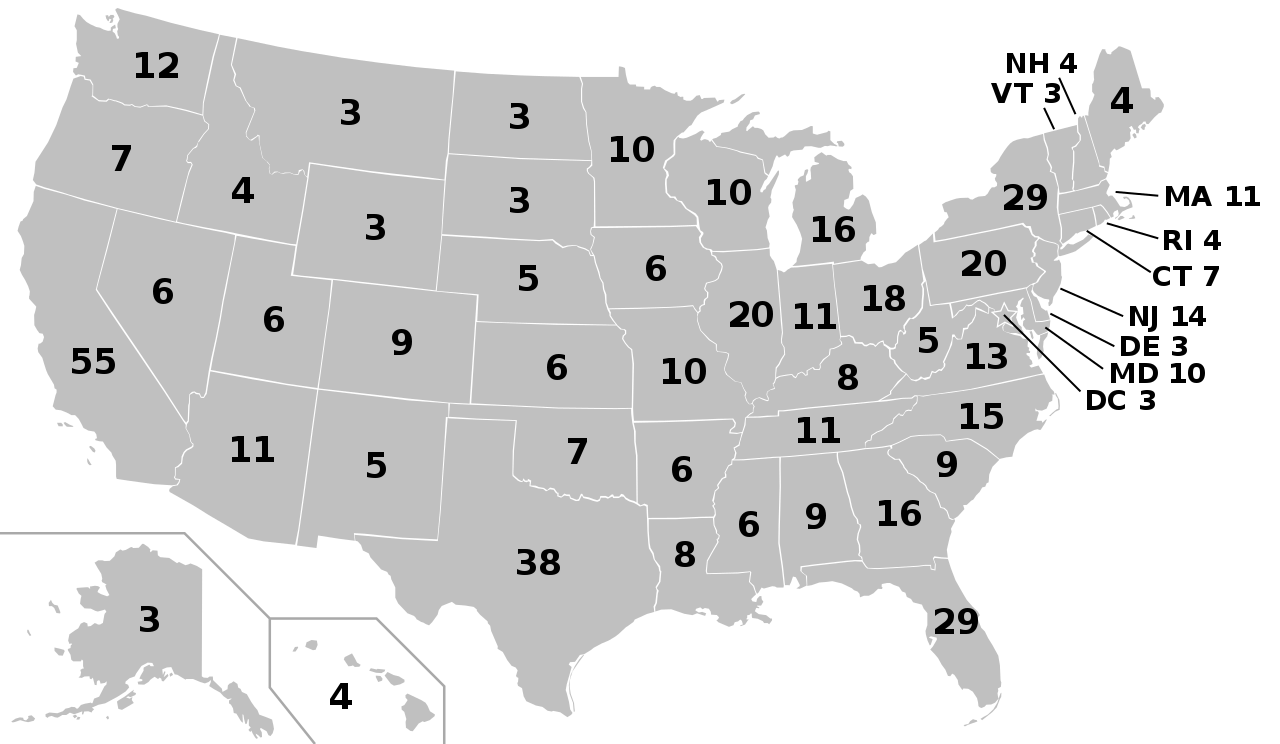
Right now, Donald Trump is president-elect. Nothing is official until the members of the Electoral College meet on December 19th and cast their ballots for President. There is still a scenario that has Trump not winning the presidency - if members of the Electoral College go rogue. The official term for this is going faithless - as in they have no trust in the results from their state. Some states have laws that punish electors who go faithless, usually by a fine, but others have no such rules. So in theory enough voters could go faithless in December and the result would be historic and unprecedented but more in line with the popular vote.
At the very least it will give the pundits something to talk about for the next month.
%{include image.html url=”/wp-content/uploads/2016/11/coollogo_com-109631196.png” alt=”stylized text faithless” description=”Faithless”}
Faithless (faith·less) adjective
- Disloyal, especially to a spouse or partner; untrustworthy.
- Without religious faith.
- (US politics) A member of the Electoral College who does not vote the way they were bound to by the state voting results.