Tag: Poppy

  • Word Wednesday – An Act of Remembrance

    Word Wednesday – An Act of Remembrance

    Today I will stand at a cenotaph and speak at a Remembrance Day event. I will have the honour to shake hands with veterans who served this country in times of war and peace. Today I will cry for a friend who never made it home after serving his country, and for another who made it home in body but not in spirit. I will cry for every soldier who died in service, who was wounded physically or mentally, and for every soldier who saw a friend, a brother or sister in arms, die or be wounded.

    I trained as a military historian, investigating recruiting techniques in small-town Ontario during the First World War. I wanted to know what made thousands of young men travel halfway across the world, to the muddy trenches of Belgium and France, and fight other young men with whom they had no personal quarrel – only the disagreements of their leaders. These young men left everything they knew in order to fight an ‘enemy’ doing much the same thing. What I learned over the course of my research fundamentally changed me. I learned that for the most part, it wasn’t about “King and Country” or justice for Belgian orphans, or one of the myriad of noble reasons that I found in my history textbooks. No, what changed me was that these young men almost a century ago went to war for reasons much closer to home. They went because they were promised adventure. They went because they were going to inherit the same farm that their father and grandfather worked and wanted to see the world before settling down. And they went because their friends were going and they didn’t want to miss out. Reasons I could see my friends signing up. Reasons I would have signed up for war. Suddenly I could put myself in the place of those soldiers. They became more than names on the cenotaph.

    As I continued my research, I discovered that local newspapers regularly published letters home from the soldiers. I spent days searching out every one of the letters from each of the soldiers. I read their queries about their siblings, the farm, and how everything was back home. Things at the front were often described as “fine” or “no change”, without much description. This was partly due to the censors, but partly escapism too. For, when writing home from a cold, damp, and muddy tent behind the supply lines at the best of times, and a wet, rat infested trench at the worst, it would be easier to focus on happier times at home than on the circumstances at hand. One of my professors warned me that personalizing the soldiers was dangerous, that military historians couldn’t be emotionally tied to their research. I looked him in the eye and told him the day I didn’t shed a tear over the death of a soldier was the day I was no longer fit to be a military historian. I shed a lot of tears over the course of my research and produced a paper that was, I hope, a fitting tribute to all of the soldiers I studied. I vowed to never forget them, and, so far, I have kept my promise.

    Why World War One? Well that is one question I can answer easily. I walked the trenches at Vimy Ridge at the tender age of 17 thanks to a high school music trip. We saw a lot of impressive monuments on that trip: York Minster Cathedral, Hadrian’s Wall, The Elgin Marbles at the British Museum, the Palace at Versailles, the famous artwork in the Louvre, but it was the trenches of Vimy that changed me. Before that trip, I’d loved history – but it was ancient history that held my heart. The Romans, the Greeks, and the Egyptians – they were what I was going to study. I had plans to go into archaeology and uncover the secrets to long-lost civilizations. I’d done well in my grade 10 Canadian History course, but I wasn’t a fan of the military history – it was all about the numbers, the battles, and the tactics. Those never held much sway for me. In contrast, my ancient history courses had all been about the people so I was interested. Walking the trenches at Vimy, walking up to the monument and seeing the names of Canadians who weren’t much older than I was that day, who were buried in cemeteries that adorn the French countryside. I asked the tour guide why these young men signed up for war, and she gave the well rehearsed answer of “for King and Country”, but I wasn’t satisfied. I wanted to know more, and so I researched.  I wanted to know what would motivate someone my age (I was almost 18) to sign up to endure such horrific conditions: cold, muddy, rat-infested trenches for years on end. I was curious as to whether I, or my classmates, if faced with the same decision would make the same choice. I admit that I was fairly confident that we would not. I was wrong. The boys of a century ago were not so different from teenagers today, and that is what I will be remembering today. The young men who served with valour, honour, and courage. Who did not know the horrors they had signed up for, but once faced with them, bravely fought and put on a cheery facade for their friends and family when writing home. These are who I will be thinking of as  I mark the eleventh hour on the eleventh day of the eleventh month.

    The view inside a trench - there are high stone walls on either side and a narrow concrete walkway with grooves cut into the stone to allow for drainage
    Inside one of the trenches at Vimy Ridge – I took this when I was there in 1998.

    Many Remembrance Day ceremonies end with the words of British poet Laurence Binyon. His poem For the Fallen was published in The Times newspaper on September 21st 1914. The third stanza has become known as the Ode of Remembrance.

    They shall grow not old, as we that are left grow old:
    Age shall not weary them, nor the years condemn.
    At the going down of the sun and in the morning,
    We will remember them.

    I, for one, will always remember and ask you to pause and do the same.

    Remember (re·mem·ber ) verb

    1. To have in or be able to bring to one’s mind an awareness of (someone or something that one has seen, known, or experienced in the past).
    2. To cause (something) to come back into your mind
    3. To keep (information) in your mind : to not forget (something).
    very hilly ground with the top walls of the trench just visible, students are walking beside the trenches and in front of the forest that has grown up beside the trench
    The grounds at Vimy. The surrounding area is flat… the undulations were made by artillery on both sides.
  • Poppies

    Poppies

    I have a thing for Poppies. I love them. I love what they symbolize, I love that I can grow them, and I think that they’re one of the prettiest flowers out there.  I also love how they blossom on the lapels of Canadians for 2 weeks before Remembrance Day.  With Remembrance day being less than 2 weeks away, I thought I’d post some fun facts and figures about our symbol of Remembrance (Source: Legion.ca)

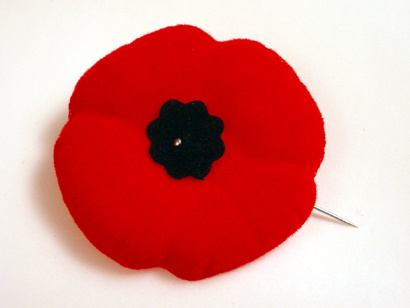
    %{include image.html url=“/wp-content/uploads/2012/10/poppy21.jpg” alt=“A red poppy with a black centre” description=“2012 Poppy”}

    • As I mentioned in my post on Remembrance, 18 Million poppies are distributed annually.
    • There is NO COST for a Poppy.  They are freely given.  If you wish to make a donation towards the Poppy campaign, that is strongly encouraged.
    • There is no “set period” for when Poppies can be worn, though traditionally they are worn for the 2 weeks prior to Remembrance day and the official kick off to each year’s Poppy campaign is the last Friday in October.  Poppies are also traditionally worn at Commemorative Services such as National Peacekeepers’ Day, The Battle of the Atlantic, The Battle of Britain, and at funeral services for Veterans.
    • While you can attach your Poppy however you wish, the Legion does not promote using any other pin through the centre of the Poppy (even if it is a Canadian flag or the ceramic Poppy pin that you buy at the Legion) In the words of Legion Canadian Command though their FAQs: “It is the position of the Legion that the Poppy is the sacred symbol of Remembrance and should not be defaced in any way. No other pin, therefore, should be used to attach it to clothing.”  That said, if it’s a choice between wearing a Poppy with a pin through the centre or no Poppy at all; Wear the Poppy!
    • To keep your Poppy on your coat or shirt, use a plastic earring back (you can get a package of 50-100 at a dollar store) or a piece of eraser on the pin.  You can also double the pin back but then you risk stabbing yourself.
    • Poppies should be worn on the left side – closest to the heart.
    • Poppy centres in Canada were originally black, then changed to green to represent the fields where Poppies grow.  In 2002, the Legion changed the centre back to black as that is what a true poppy looks like.
    • Proceeds from the Poppy Campaign are held in trust (separate from Legion funds) to be used to help Veterans, their families and to help promote Remembrance.

    Please wear your Poppy with pride and remember the sacrifices made by our veterans. [please-wear-your-poppy-with-pride-and-remember-the-sacrifices-made-by-our-veterans.]

    A Remembrance Day Craft Idea: Poppies made with love [a-remembrance-day-craft-idea-poppies-made-with-love]

    Last, but not least, I have a craft that I’ve used with my Brownies, Guides, and Sunday School kids in the past to help promote Remembrance.  It’s a Poppy made out of love.  I was trying to figure out how to make an easy Poppy craft and thought that hearts looked a lot like the petals of a Poppy.  I also really liked the symbolism of the hearts and the Poppies together.

    Supplies:  Red paper, black paper (you can also use red and black foam either precut or not), scissors, glue (glue sticks work well if you are using paper, white glue if you use foam), safety pins

    Optional: heart punch, Cricut machine (Especially if you are trying to cut out enough hearts for 50 kids!)

    Step 1:  Cut 4 hearts out of red paper (If you’re one of those people who can plan things in advance, you can use foam hearts from the dollar store purchased around Valentine’s Day)

    If you are using a Circuit Machine, my poppies were made using the basic heart from the George and Basic Shapes cartridge on the 1 1/2 inch setting or the 1 inch setting and the circles are either the smallest circle on the smallest setting or the inside of the charm circle on the smallest setting.

    Step 2 Cut a small circle out of the black paper.  This will be the centre of the Poppy so adjust sizes according to the size of the hearts.

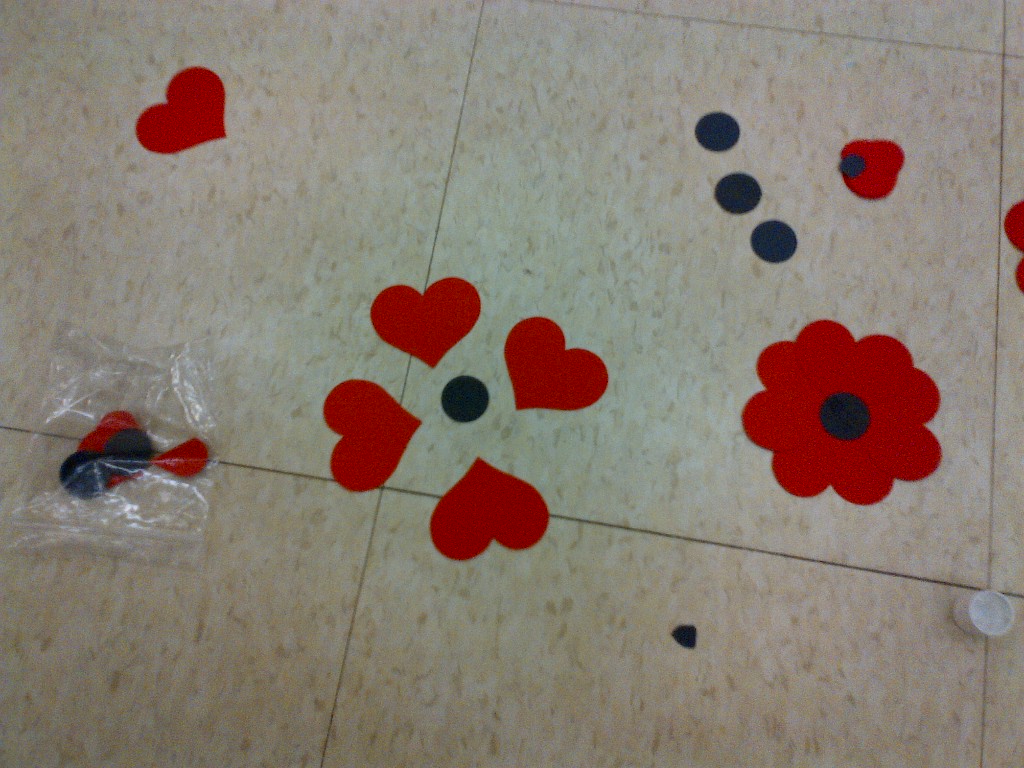
    a view of 2 hand made poppies, one put together and one with the 4 hearts spaced about 4 cm apart from each other and the black circle in the middle. There are extra pieces scattered on the floor around the 2 poppies.
    Exploded view of the process

    Step 3: Apply glue on the black circle.

    Step 4:  Attach hearts to the black circle The can either be touching or spread out a bit.  It’s really up to you.

    Step 5.  Allow to dry for at least 5 minutes.

    Step 6. Attach a safety pin to the Poppy.

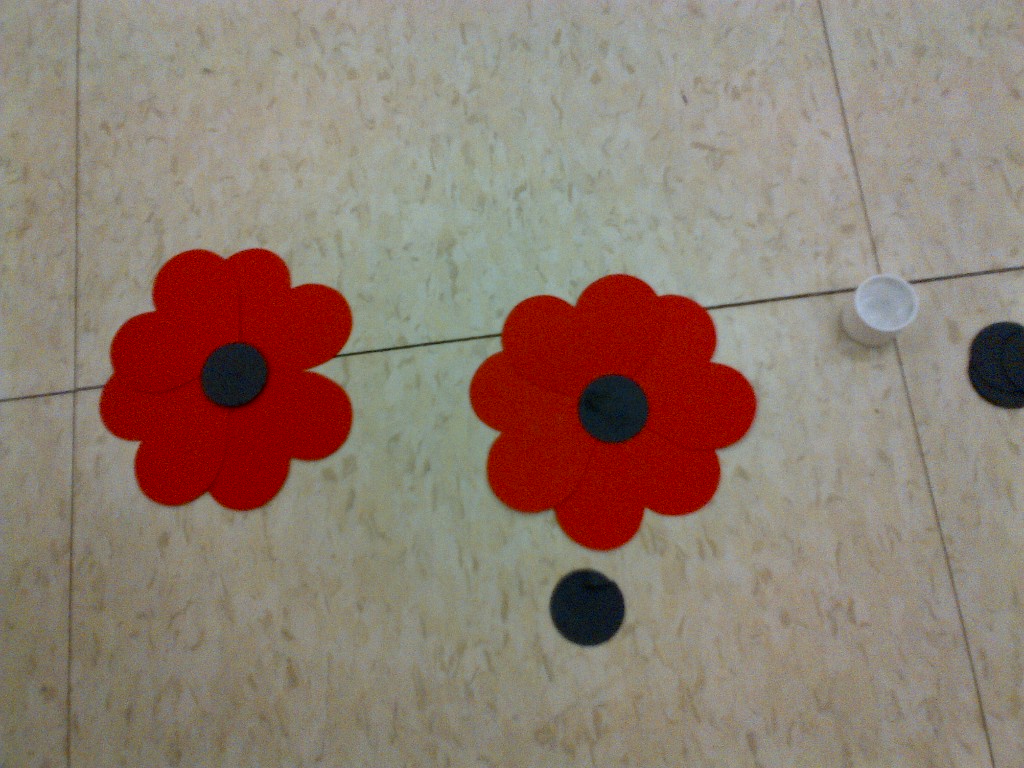
    Two completed construction paper poppies lay on a gym floor
    The Finished Product

    Voila you have a poppy made from love.  It’s a quick and easy craft – the hardest part is the prep work!

  • Remember

    Remember

    Remember   verb ri-ˈmem-bər

    1. To retain in the memory; keep in mind; remain aware of.

    2. To recall to the mind by an act or effort of memory; think of again.

    (Source: Dictionary.com)

    Today is the last Friday in October, which means that it’s the start of Poppy Campaign by the local branches of the Royal Canadian Legion.  I have worn the same poppy for the past three years but I always make a donation into the box whenever I see a volunteer giving out poppies.   It’s a common misconception that poppies are for sale.  Poppies are not for sale, rather they are freely given away.  You can choose to make a donation but it is not mandatory.  According to the website of the Royal Canadian Legion, “During the Poppy Campaign some 18 million poppies and 70,000 wreaths, crosses and sprays are distributed across Canada and overseas annually”.  18 million poppies.  The number is staggering.  When you make a donation to the Legion through the annual Poppy Campaign, the money is used to help veterans and the families of veterans.  The main purpose of the Poppy Campaign, though, isn’t to raise money but to remind Canadians of the sacrifices made by over 117,000 Canadians who died in service to their country.

    With the Canadian involvement in Afghanistan in recent years, Canadians have begun to think more about military service and what it entails.  Canada is very fortunate.  2012 marks the 200th anniversary of the war of 1812, the last war fought on Canadian soil.  As a nation, we do not know first hand the horrors of war.  Our military, however, is full of brave men and women willing to forgo the safety and comfort of their home and native land and serve in countries such as Afghanistan, the Democratic Republic of Congo, Egypt, Kosovo, Cyprus, Sudan, and Libya as well as protecting Canadians here at home.   All veterans, regardless of whether they were involved in military action overseas or remained in Canada are eligible for membership in the Royal Canadian Legion.  Regardless of military service, all Canadians are eligible to become members of their local legion branch.  Like donating to the Poppy Campaign, Legion Membership is another way to help support the terrific programs and services that the Legion provides.

    A red lapel poppy with a black centre
    My 2012 Poppy.

    Back to the poppy though.  One of the most common misconceptions about the poppy is that it is somehow promoting war or militarism when in fact the opposite is true.  The poppy is an international symbol of remembrance, our promise to those who died so that we could be free that we will not forget their sacrifice.  Rather than promoting militarism, the poppy is our unspoken vow to the fallen that their death shall not have been in vain; our promise that we will strive to keep the peace that they fought so valiantly for.   Wearing a poppy over the left lapel of your coat or on the left side of your shirt (close to your heart) is a way every Canadian can say thank you to the brave men and women who made the ultimate sacrifice.

    This year, Remembrance Day is on a Sunday.  I truly hope that everyone who is able comes out to a cenotaph near them to pay respect to our veterans.  Every year the number of World War II and Korean War veterans diminishes.  We owe it to all of our veterans to have a strong turnout at cenotaphs across the country this year.  It is likely that this is the last weekend Remembrance day with many of our WWII vets.  Having been fortunate enough to spend time with veterans at my local Legion branch for the past few years, I can assure you that the veterans appreciate it when people take time out of their busy lives to attend a Remembrance Day ceremony.  If you cannot attend, please observe two minutes of silence at 11 am on November 11th.

    I close now with the words of the poet Laurence Binyon (1869-1943) in his poem “For the Fallen”, that are spoken at Remembrance Day and memorial services around the world:

    They shall grow not old, as we that are left grow old:
    Age shall not weary them, nor the years condemn.
    At the going down of the sun and in the morning
    We will remember them.

    How will you remember?