Tag: New words

  • Word Wednesday – Rocks and Hard Places

    Word Wednesday – Rocks and Hard Places

    Most of you already know that I have a slight  healthy obsession with board games. I love to play them with friends and I use them to teach social skills such as patience and turn taking when I work with kids and teens on the Autism spectrum. I remember spending a lot of rainy afternoons at the cottage as a kid playing games like the Hardy Boys Treasure Game,  Scrabble, Don’t Lose Your Head, and even Sorry! (which caused far more tears than smiles). I’ve since graduated to more strategic games that don’t rely purely on luck to win. I was taught to play chess when I was in grade three – mostly because I couldn’t keep my hands off the gorgeous chess set my parents had bought on vacation, and dad figured it was a good way to teach me to think a few steps ahead.
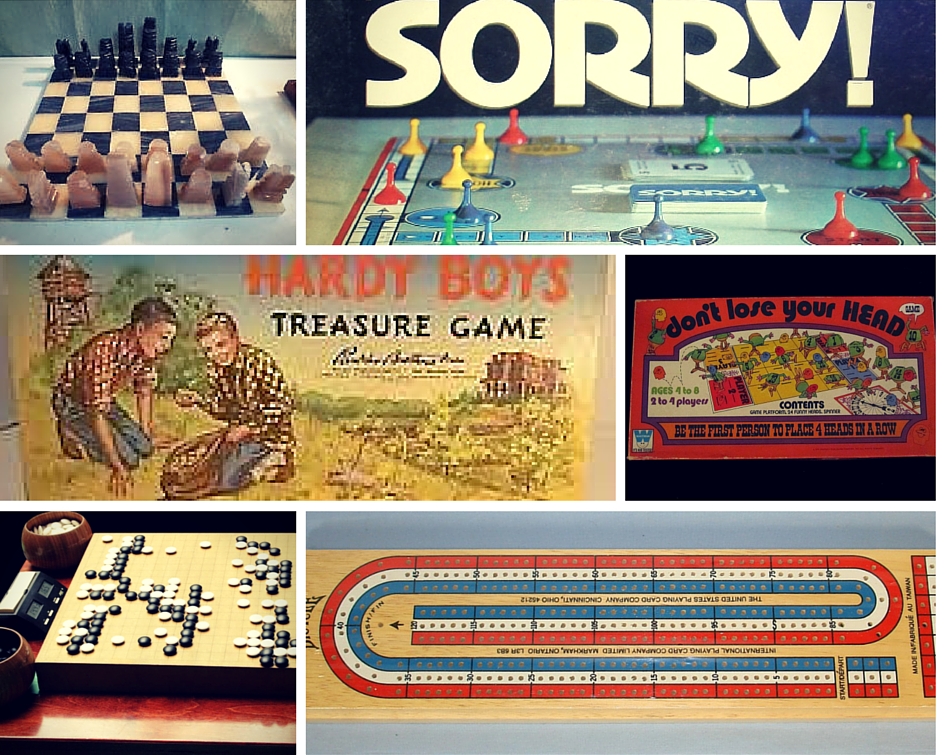
    Board games including chess, sorry, the hardy boys treasure game, don't lose your head, go, and cribbage.
    Some of my favourite childhood games

    I was by no means the next Bobby Fischer, but I got pretty good at the game throughout my childhood and teen years. Sure I had games where I got too cocky and underestimated my opponent and promptly had my rear end handed to me on a platter, but overall I was always learning and getting better. My grade six teacher introduced my class to the strategy game of Go – and for a few years I abandoned chess and played Go every chance I could, but by high school I was back to chess.

    There was a brief period of time where I didn’t play board games in early university – though my best friend is one heck of a cribbage player and we did play a lot of online cribbage. The crowd I hung out with didn’t really play board games and I was busy with school, football, and the newly discovered world of online gaming. Then I found friends who loved board games as much as I did, or even more and they introduced me to games I’d never heard of and some I’d heard of and never played. Sometimes there was a good reason for having not played them as I discovered when I lost an entire weekend to a mega game of Risk and another weekend to Axis and Allies. Those games take an amount of patience I just don’t possess most of the time.

    So I was launched into the world of strategy board games with offerings like Settlers of Catan, Carcassonne, Puerto Rico, Thurn and Taxis, and Ticket to Ride. My friends would often host board game afternoons or evenings and we’d start with a warm up game and move to the more pure strategy games afterwards. Every so often Jenga would come up and I’d be reminded of a word I first learned in the context of playing chess, but that is applicable to a lot of other games when you have to make a move even if it’s not in your best interest to do so: Zugzwang.

    %{include image.html url=“/wp-content/uploads/2016/06/coollogo_com-33313043.png” alt=“Stylized word Zugzwang” description=“Zugzwang”}

    The term zugzwang was first used in chess literature in Germany in the 1850s and was used in English referring to chess by the turn of the century. The concept, however, is far older than that having appeared in chess literature in the early 1600s. Zugzwang is a compound word, comprised of zug – meaning “move” and zwang – meaning “compulsion”. Zugzwang, then, is the compulsion to make a move even if it is to your detriment. Often the condition of zugzwang is such that the player will lose by making any of the possible moves. The word has escaped the chess world though, and can also be applied to those rock and a hard place scenarios where you’re damned if you do and damned if you don’t.

    What got me thinking of zugzwang this week wasn’t board gaming, but the situation at the Cincinnati Zoo where the Gorilla was killed by zookeepers after a young child got into the enclosure and the 400 lb gorilla was standing over him. The zookeepers were very much in a condition of zugzwang – no matter what they did they would have been wrong in the eyes of the public. Had the gorilla killed the boy, while zookeepers were waiting for tranquilizers to take effect they would have been criticized for taking too long. Had they attempted to rescue the boy and something gone wrong, they’d be criticized. If you’ve seen any of the coverage, you will know they are being criticized for shooting to kill. Total zugzwang. 

    Zugzwang (zug·zwang) noun

    A situation in which the obligation to make a move in one’s turn is a serious, often decisive, disadvantage.


  • Word Wednesday: Nothing if Not Persistent

    Word Wednesday: Nothing if Not Persistent

    For those who know me off-line, it comes as no surprise that I characterize myself as persistent and mildly stubborn. It’s not that I don’t like change, it’s that I need time to get used to the idea and adequately prepare myself. I will never be the type of person who heads off on a vacation with nothing more than an airline ticket and a dream. There are times when I really want to be that kind of person, but even the idea of doing that stresses me out to no end. My best friend is moving soon, and will be without a place to call home for two weeks. She has 2 kids, works for herself, and has a husband who commutes and can work long hours. The idea of not having a firm place to call home for just me fills me with anxiety, yet she is unflappable. I know this wasn’t the plan, but it’s just how things worked out with the closing date on their house and the one they’re moving into. She took it all in stride – I envy that quality – I’d be freaking out. I wish I could be so trusting that everything will work out but I’m an obsessive planner.

    Which means when things I’ve been planning and counting on fall through, I can be a bit of a mess. This week has been bad for that. I’ve had plans cancelled at the last minute, I’ve had a big freelance job put on hold indefinitely because of circumstances beyond my control, and I’ve had a few things pop up that need to be dealt with “right away”, which forces me to alter other plans to get things done. Yet, as stress filled as I am right now, I persevere. I do it mostly out of stubbornness and because I don’t know what else to do. I continue to work freelance because it gives me a quality of life I enjoy and because I really like having the ability to work from home or the cottage or wherever I have an internet connection. Sometimes it means working until midnight and on weekends to get stuff done, but it means I can do things like spend a couple of days with my best friend’s kids over March Break, so it’s a fair trade in my opinion. This month marks the end of my first official year of doing freelance work, and I’ve had a lot of success but also my share of failures.

    %{include image.html url=“/wp-content/uploads/2016/03/you-are-lovely.png” alt=“A woman sits on a log looking out from a mountaintop” description=“I made it.”}

    I was talking with friends over the weekend about perseverance, and how both perseverance and resilience are skills that need to be taught at a young age in order for kids to internalize them. Kids need to know that it’s okay to fail, it’s okay to not be good at everything, and that sometimes if you really want something you have to work hard for it and try different approaches along the way.  I think that we need to force kids out of their comfort zone and teach them that failure IS an option. It WILL happen to everyone at some point in life, and it’s how we act in the moments following failure that shows our true character.  I’m not saying that I’m comfortable with failing, in fact I hate it when I fail at something, but I don’t let the failures stop me. I keep going. I persevere. I use the failure as motivation to do better next time. So today’s Word Wednesday word is persevere.

    %{include image.html url=“/wp-content/uploads/2016/03/coollogo_com-175281398.png” alt=“Stylized word persevere” description=“Persevere”}

    The origins of persevere are late Middle English: from Old French perseverer, from Latin perseverare ‘abide by strictly,’ from perseverus ‘very strict,’ from per- ‘thoroughly’ + severus ‘severe.’

    Persevere – per·se·vere verb

    1. To persist in anything undertaken; maintain a purpose in spite ofdifficulty, obstacles, or discouragement; continue steadfastly.

    2. To persist in speech, interrogation, argument, etc.; insist.


  • Word Wednesday – Again!

    Word Wednesday – Again!

    I swear I’m going to get a non Word Wednesday post up soon – life has been hectic and I’ve got a bunch of drafts started but haven’t managed to finish any of them.  I’m also working on a new site so watch for that announcement coming very soon!

    I make no secret of the fact that I’m a bibliophile. I LOVE books. I love holding them, reading them, reviewing them, talking about them, pretty much anything to do with books. In fact, today’s Word Wednesday word came out of a book I read recently. I keep a notebook beside me when I read and write down any really cool words I read so that I can use them in my own writing. (I know, I’m a giant word nerd and I’m proud of it!)

    I loved the fact that I had to go look up what this word meant – I had pretty much figured it out from the contextual cues but I still like to look up new words to ensure that they mean what I think they mean. (*Said in my best Inigo Montoya voice)

    Without further ado, today’s word is:

    Stylized text Infandous
    Infandous – isn’t it an awesome word?

    Infandous – the word isn’t even IN most dictionaries today, it’s that out of use.  Of course, having a subscription to the Oxford English Dictionary comes in really handy at times like this. (To be fair, the book I found it in was pretty old so I’m not surprised there were some words that are obsolete in it.)

    Infandous – another word with a Latin root. This time the root is infantus – meaning abominable or unspeakable. This is also the same root as infant (or one who does not speak) which makes me laugh since the definition of infandous  is “too odious to be expressed or mentioned”.  Which is not what I think of when I hear the word infant!

    Infandous – (In-‘FAN’-dus) Adjective. Something too odious or abominable to be mentioned.

    So if you’re looking for a word that is no longer in use and need to describe something that is too horrible to mention, try using infandous. Sometimes, the old words are better than anything we have now.