Tag: Legion

  • Word Wednesday on Thankful Thursday

    Word Wednesday on Thankful Thursday

    I couldn’t quite make up my mind on whether or not this should be a Word Wednesday post or if I should call it Thankful Thursday so I decided to make it both. Now before anybody asks. I’m planning to tackle the US election results with a word next week. I need some time to think of a word that adequately describes what went on  other than one that rhymes with musterduck. This week, however is the week of Remembrance so I’m going to concentrate on that today.

    I’ve written about how important Remembrance Day is to me before, and there’s no doubt that it’s always going to be a special day in my household. Of late, I’ve been quite involved with the debate over whether or not Remembrance Day should be a statutory holiday in Ontario as it is in many other provinces. I’m of two minds on this. On the one hand, I like the idea of families being able to go to the cenotaph together to either remember family members who served or to thank veterans in person. I’ve seen the joy in an older veteran’s eyes when a small child comes up to thank them – it’s really special. Having Remembrance Day as a statutory holiday would allow this to happen more frequently. The banks and federal and provincial government offices are already closed so I’m not sure how much of a negative effect it would have on business to have the day off.

    On the other hand, I understand that not all parents will bring their kids to a cenotaph or watch the ceremony from Ottawa via television or the internet so those kids may end up seeing Remembrance Day as just another day off.  This argument is usually accompanied by statements such as “schools do so much for Remembrance Day”. Which used to be true but I’m not so sure anymore. I remember asking a friend’s grade 3 child who was dutifully practicing the words to “In Flanders’ Fields” why they were doing that poem. “For Remembrance Day” he said – which was a good start. I asked if they were doing anything other than memorizing a poem to recite. “No, the teacher says this is more than enough since we have the assembly too”.  I may have sighed audibly at that point. The kid was blindly memorizing words and there was no teaching about WHY the poem was important or even WHAT the poem was about. Of course I explained it but it bothers me that this wasn’t done in school – especially given that the child lived within an hour of Guelph, Ontario which is the birthplace of John McCrae, the author of In Flanders’ Fields.
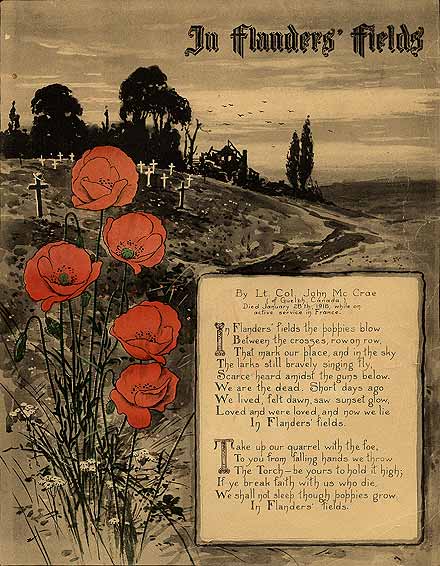
     

    A 1920s copy of the poem In Flanders Fields with on a page with sketches of a battlefield, crosses, and red poppies
    Photo Courtesy Canadian War Museum

    I asked a friend who has taught elementary school for decades about what she was seeing in the schools for Remembrance day and how it compared to what I remembered. She said that overall there is a lot less being done for a few different reasons. One is time. Teachers are strapped for time and researching Remembrance Day activities takes time. Another reason is curriculum tie-ins. This is why things like reading a poem aloud is done instead of teaching the background to the poem. One ticks the boxes for the language arts curriculum, the other doesn’t tick a grade appropriate box for history or civics at the primary level – so when combined with the first reason these mean that kids are learning the poem but not the history behind it. The third reason she gave made me incredibly frustrated though. She told me there’s a political reason – parents complain when they teach too much around Remembrance Day. It turns out, some parents feel that teaching about Remembrance Day and even celebrating it at all is promoting militarism.

    Remembrance day does NOT promote militarism. In fact it promotes exactly the opposite. When we celebrate valour and courage on the battlefield we are not rejoicing in it. I have yet to meet a veteran (and I’ve talked to hundreds personally) who thinks that war is a good thing. Some will tell you that World War II was a noble war – it needed to happen to stop evil from triumphing, but they still wish it hadn’t been necessary in the first place. The same is true of military historians. We don’t celebrate war. We celebrate people – people who fought in wars yes, but people nonetheless. War is always tragic. War always hurts the innocent. We need to understand war if we want to live in peace. So not teaching about war will, ironically, prevent peace.

    %{include image.html url=“/wp-content/uploads/2012/10/poppy22.jpg” alt=“A poppy on a white background” description=“Poppy”}

    On November 11th, please take a moment to remember those who have served in the name of peace. Right now, more than ever, we as a nation (and as part of the global community) need to remember that war is not the solution to our differences.  If you are able, attend a service at the cenotaph and thank those who served with valour.

    %{include image.html url=“/wp-content/uploads/2016/11/coollogo_com-54974031.png” alt=“Stylized word Valour” description=“Valour”}

    Valour ( val·our ) noun

    1. Boldness or determination in facing grave danger – particularly in battle
    2. Heroic courage
    3. Bravery
  • Poppies

    Poppies

    I have a thing for Poppies. I love them. I love what they symbolize, I love that I can grow them, and I think that they’re one of the prettiest flowers out there.  I also love how they blossom on the lapels of Canadians for 2 weeks before Remembrance Day.  With Remembrance day being less than 2 weeks away, I thought I’d post some fun facts and figures about our symbol of Remembrance (Source: Legion.ca)

    %{include image.html url=“/wp-content/uploads/2012/10/poppy21.jpg” alt=“A red poppy with a black centre” description=“2012 Poppy”}

    • As I mentioned in my post on Remembrance, 18 Million poppies are distributed annually.
    • There is NO COST for a Poppy.  They are freely given.  If you wish to make a donation towards the Poppy campaign, that is strongly encouraged.
    • There is no “set period” for when Poppies can be worn, though traditionally they are worn for the 2 weeks prior to Remembrance day and the official kick off to each year’s Poppy campaign is the last Friday in October.  Poppies are also traditionally worn at Commemorative Services such as National Peacekeepers’ Day, The Battle of the Atlantic, The Battle of Britain, and at funeral services for Veterans.
    • While you can attach your Poppy however you wish, the Legion does not promote using any other pin through the centre of the Poppy (even if it is a Canadian flag or the ceramic Poppy pin that you buy at the Legion) In the words of Legion Canadian Command though their FAQs: “It is the position of the Legion that the Poppy is the sacred symbol of Remembrance and should not be defaced in any way. No other pin, therefore, should be used to attach it to clothing.”  That said, if it’s a choice between wearing a Poppy with a pin through the centre or no Poppy at all; Wear the Poppy!
    • To keep your Poppy on your coat or shirt, use a plastic earring back (you can get a package of 50-100 at a dollar store) or a piece of eraser on the pin.  You can also double the pin back but then you risk stabbing yourself.
    • Poppies should be worn on the left side – closest to the heart.
    • Poppy centres in Canada were originally black, then changed to green to represent the fields where Poppies grow.  In 2002, the Legion changed the centre back to black as that is what a true poppy looks like.
    • Proceeds from the Poppy Campaign are held in trust (separate from Legion funds) to be used to help Veterans, their families and to help promote Remembrance.

    Please wear your Poppy with pride and remember the sacrifices made by our veterans. [please-wear-your-poppy-with-pride-and-remember-the-sacrifices-made-by-our-veterans.]

    A Remembrance Day Craft Idea: Poppies made with love [a-remembrance-day-craft-idea-poppies-made-with-love]

    Last, but not least, I have a craft that I’ve used with my Brownies, Guides, and Sunday School kids in the past to help promote Remembrance.  It’s a Poppy made out of love.  I was trying to figure out how to make an easy Poppy craft and thought that hearts looked a lot like the petals of a Poppy.  I also really liked the symbolism of the hearts and the Poppies together.

    Supplies:  Red paper, black paper (you can also use red and black foam either precut or not), scissors, glue (glue sticks work well if you are using paper, white glue if you use foam), safety pins

    Optional: heart punch, Cricut machine (Especially if you are trying to cut out enough hearts for 50 kids!)

    Step 1:  Cut 4 hearts out of red paper (If you’re one of those people who can plan things in advance, you can use foam hearts from the dollar store purchased around Valentine’s Day)

    If you are using a Circuit Machine, my poppies were made using the basic heart from the George and Basic Shapes cartridge on the 1 1/2 inch setting or the 1 inch setting and the circles are either the smallest circle on the smallest setting or the inside of the charm circle on the smallest setting.

    Step 2 Cut a small circle out of the black paper.  This will be the centre of the Poppy so adjust sizes according to the size of the hearts.

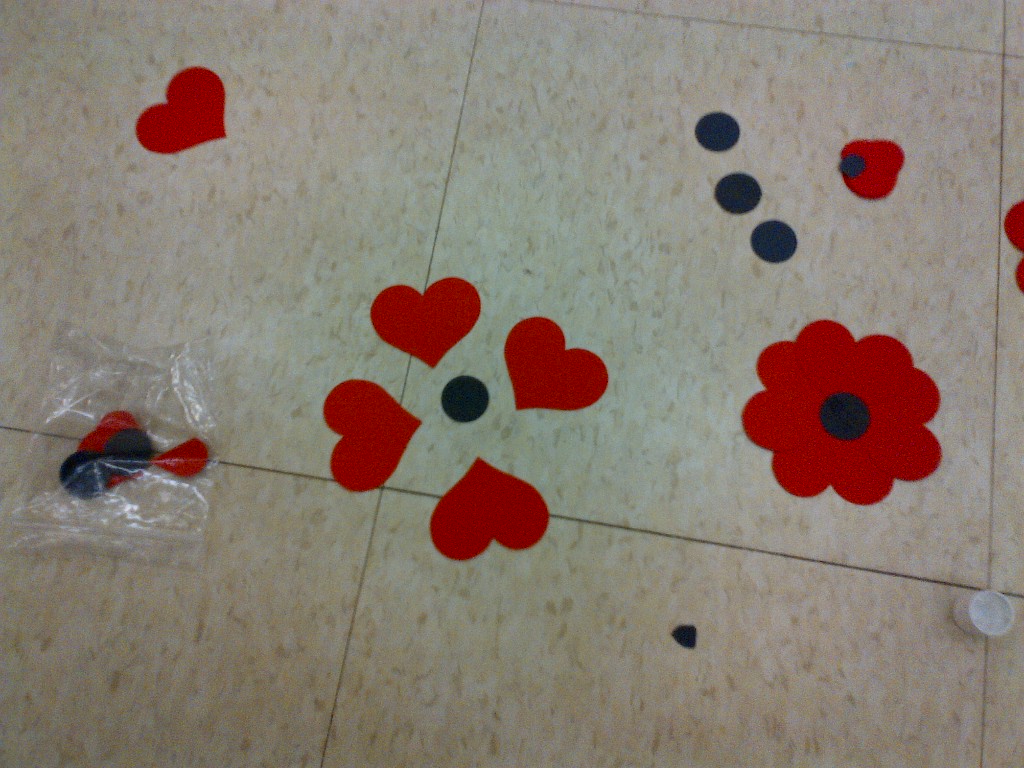
    a view of 2 hand made poppies, one put together and one with the 4 hearts spaced about 4 cm apart from each other and the black circle in the middle. There are extra pieces scattered on the floor around the 2 poppies.
    Exploded view of the process

    Step 3: Apply glue on the black circle.

    Step 4:  Attach hearts to the black circle The can either be touching or spread out a bit.  It’s really up to you.

    Step 5.  Allow to dry for at least 5 minutes.

    Step 6. Attach a safety pin to the Poppy.

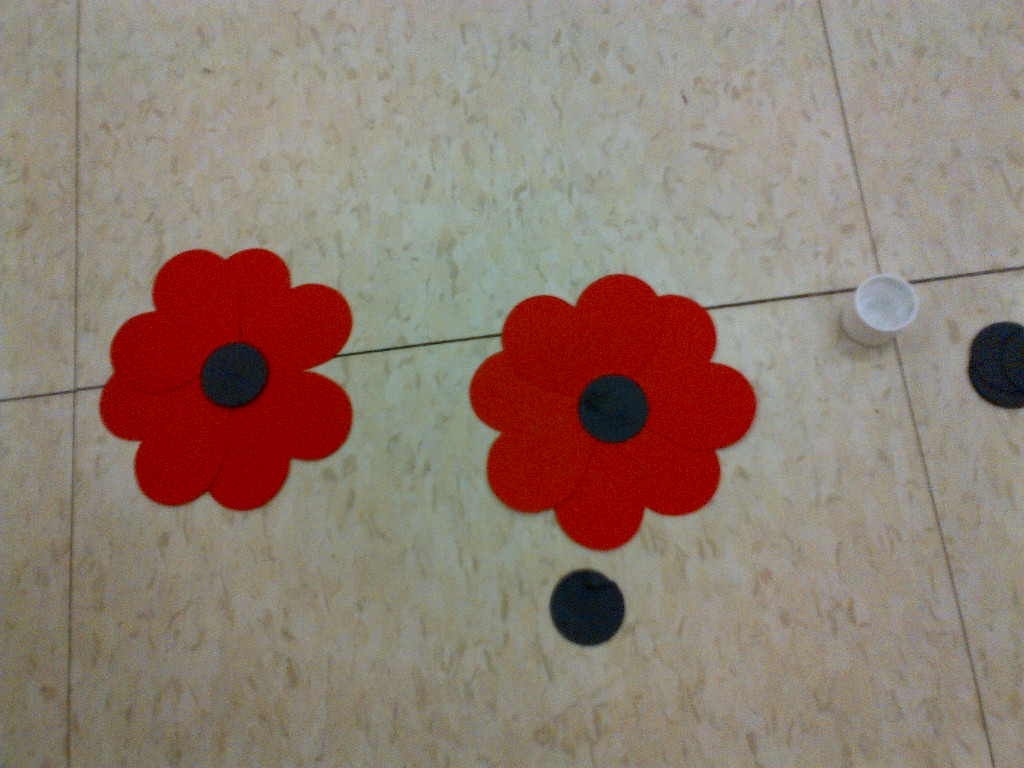
    Two completed construction paper poppies lay on a gym floor
    The Finished Product

    Voila you have a poppy made from love.  It’s a quick and easy craft – the hardest part is the prep work!