Tag: holidays

  • Word Wednesday Not Quite Feeling It (Yet)

    Word Wednesday Not Quite Feeling It (Yet)

    In case anyone hasn’t noticed, the holiday season is creeping up on us rather quickly. Here in Ontario, we’ve had our first snowfall and all of the requisite bad driving conditions that accompany it. It’s just over 2 weeks until Christmas and Hanukkah, because this is one of those magical years where both celebrations overlap.  I have several friends who celebrate both holidays and when they fall over the same period, their already crazy lives get even crazier.  My schedule is certainly filling up as the end of the year draws near – with babysitting gigs, dinners with friends, and a couple of holiday parties. I love the chance to get dressed up, put on some holiday themed jewelry (usually that I made myself) and celebrate with friends. As I wrote last week, I love picking out gifts for friends and family and seeing them smile when they open it. But unlike other years where I’m in full on Santa, Cheesy Romantic Comedies, and Christmas baking explosions, I’m feeling decidedly non-festive this year.

    I have felt like this before and it usually resolves itself long before we hit double digit dates in December. I’m not sure what is so different this year but there’s something missing for sure. I was briefly in the Christmas spirit a couple of weeks ago when I went with my friend Louise to see the Trans-Siberian Orchestra do their annual Christmas Show.  It was spectacular: he music was amazing even at the Air Canada Centre (a place not known for great acoustics), the set design was nothing short of magical, and the special effects and pyrotechnics were beyond what I expected. This was one of those shows I’d wanted to see for awhile but had never managed to attend the one or two nights they were in Toronto due to scheduling conflicts. This year I was gifted the tickets, and finally went and I regret not going sooner and making it a Christmas tradition long before now. If you like Christmas music with screaming guitars, fire, an awesome group of background singers, and joined with instrumentalists from the local symphony, go see the Trans-Siberian Orchestra if you possibly can. You won’t regret it. But you may want to bring ear plugs because it’s a pretty loud concert.

    %{include image.html url=“/wp-content/uploads/2016/12/IMG_20161123_215606_edit_edit.jpg” alt=“Four musicians play on a stage with fireworks going off behind them.” description=“Definitely one of the best concerts I’ve seen.”}

    I know it’s partly grief – I came by my love of all things Christmas quite honestly – Mum adored Christmas and would have the house decorated long before the Grey Cup participants were decided. This is the third Christmas without her, and things are getting a little easier but I still have moments when grief washes over me like waves washing away a sandcastle on the beach. One of those happened this past weekend as I was getting groceries after volunteering. I was in a good mood after volunteering and was enjoying walking the aisles of the supermarket in search of new things to cook in the pressure cooker. Then I rounded a corner and came face to face with a display of Mrs. Kipling’s Mince Pies. I cannot abide mince pies – I don’t like the taste or the texture. Dad’s firmly in my camp – not a fan of mincemeat nor fruitcake (unless it is positively swimming in brandy). Mum was another story and every year we would start hunting as early as mid-November for the coveted Mrs. Kipling’s Mince Pies. Seeing them on display made me smile and I had one of those grief-fog moments where I forgot mum isn’t here anymore. I grabbed the package and as I turned to put it in my cart the realization hit me like a ton of bricks. I felt sick – my head got all foggy and muffled, I was really really hot all of a sudden, and needed to go somewhere to regain my composure. Fortunately the grocery store in question has bathrooms that are pretty much impossible to find and are single family style washrooms instead of gendered multi-stall affairs. I beelined to the washrooms and had a good cry, emerging a few minutes later red-faced but able to continue shopping.

    I’m going through the motions – the tree is up and decorated, the Christmas stuffed animals that surround the stairs to the basement are being put out as we speak, the family and dining rooms look like an elf was let loose with every holiday decoration known to man. I even got the blasted Noma musical boxes (circa 1990 ) out and untangled the wires to set them up. The manger is set up, awaiting the arrival of the baby Jesus figurine on December 25th (assuming I haven’t forgotten where I put it). I even hung the stockings on the mantle. Dad never really liked filling stockings – I was in charge of mum’s stocking once I was old enough to be let loose in a store with $30 (Santa only filled kids stockings in our house). Since mum died, we haven’t done stockings and that makes me sad because I love opening the stocking to find some of the same things in there year after year – an Archie comic book, a lottery ticket, Ovation chocolates, and lip balm. There were other things in the stocking too, but those were in there without fail every year. Seeing the empty stockings hanging on the mantle makes me feel sad, but not having them hanging at all was upsetting too so it’s hard to choose.

    %{include image.html url=“/wp-content/uploads/2016/12/IMG_20161207_141253_edit.jpg” alt=“A mantel with 4 stockings hanging on it” description=“The family room mantel ready for Christmas”}

    I’ve got a couple of days ahead which will involve me playing Santa Jenn to a few of my friend’s kids and lots more gifts to be distributed next week. I’m also volunteering to help sort gifts for the local Santa fund so that should improve my Christmas spirit.  Have you ever had a year where you just didn’t get into the holiday spirit? What helped you?

    Spirit comes from Latin – which shouldn’t be a surprise at all – the root word is spirare – to breathe.

    %{include image.html url=“/wp-content/uploads/2016/12/coollogo_com-31270177.png” alt=“Stylized text of the word Spirit” description=“Spirit”}

    Spirit (spir·it) Noun

    1. Qualities regarded as forming the definitive or typical elements in the character of a person, nation, or group or in the thought and attitudes of a particular period.

    2. The real meaning or the intention behind something as opposed to its strict verbal interpretation.

    3. The attitude or intentions with which someone undertakes or regards something.

    4. The nonphysical part of a person that is the seat of emotions and character; the soul.

    5. Strong distilled liquor such as brandy, whiskey, gin, or rum.
  • Word Wednesday on Thankful Thursday

    Word Wednesday on Thankful Thursday

    I couldn’t quite make up my mind on whether or not this should be a Word Wednesday post or if I should call it Thankful Thursday so I decided to make it both. Now before anybody asks. I’m planning to tackle the US election results with a word next week. I need some time to think of a word that adequately describes what went on  other than one that rhymes with musterduck. This week, however is the week of Remembrance so I’m going to concentrate on that today.

    I’ve written about how important Remembrance Day is to me before, and there’s no doubt that it’s always going to be a special day in my household. Of late, I’ve been quite involved with the debate over whether or not Remembrance Day should be a statutory holiday in Ontario as it is in many other provinces. I’m of two minds on this. On the one hand, I like the idea of families being able to go to the cenotaph together to either remember family members who served or to thank veterans in person. I’ve seen the joy in an older veteran’s eyes when a small child comes up to thank them – it’s really special. Having Remembrance Day as a statutory holiday would allow this to happen more frequently. The banks and federal and provincial government offices are already closed so I’m not sure how much of a negative effect it would have on business to have the day off.

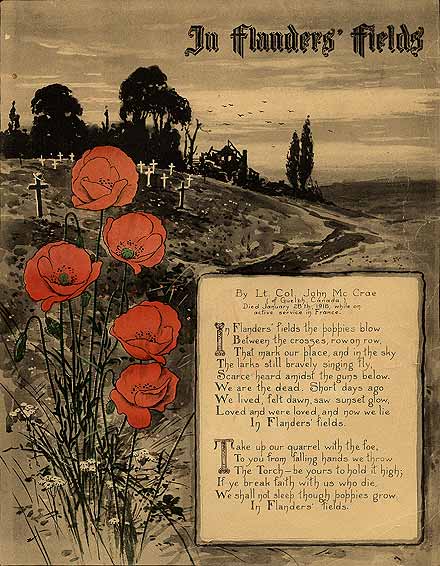
    On the other hand, I understand that not all parents will bring their kids to a cenotaph or watch the ceremony from Ottawa via television or the internet so those kids may end up seeing Remembrance Day as just another day off.  This argument is usually accompanied by statements such as “schools do so much for Remembrance Day”. Which used to be true but I’m not so sure anymore. I remember asking a friend’s grade 3 child who was dutifully practicing the words to “In Flanders’ Fields” why they were doing that poem. “For Remembrance Day” he said – which was a good start. I asked if they were doing anything other than memorizing a poem to recite. “No, the teacher says this is more than enough since we have the assembly too”.  I may have sighed audibly at that point. The kid was blindly memorizing words and there was no teaching about WHY the poem was important or even WHAT the poem was about. Of course I explained it but it bothers me that this wasn’t done in school – especially given that the child lived within an hour of Guelph, Ontario which is the birthplace of John McCrae, the author of In Flanders’ Fields.


    A 1920s copy of the poem In Flanders Fields with on a page with sketches of a battlefield, crosses, and red poppies
    Photo Courtesy Canadian War Museum

    I asked a friend who has taught elementary school for decades about what she was seeing in the schools for Remembrance day and how it compared to what I remembered. She said that overall there is a lot less being done for a few different reasons. One is time. Teachers are strapped for time and researching Remembrance Day activities takes time. Another reason is curriculum tie-ins. This is why things like reading a poem aloud is done instead of teaching the background to the poem. One ticks the boxes for the language arts curriculum, the other doesn’t tick a grade appropriate box for history or civics at the primary level – so when combined with the first reason these mean that kids are learning the poem but not the history behind it. The third reason she gave made me incredibly frustrated though. She told me there’s a political reason – parents complain when they teach too much around Remembrance Day. It turns out, some parents feel that teaching about Remembrance Day and even celebrating it at all is promoting militarism.

    Remembrance day does NOT promote militarism. In fact it promotes exactly the opposite. When we celebrate valour and courage on the battlefield we are not rejoicing in it. I have yet to meet a veteran (and I’ve talked to hundreds personally) who thinks that war is a good thing. Some will tell you that World War II was a noble war – it needed to happen to stop evil from triumphing, but they still wish it hadn’t been necessary in the first place. The same is true of military historians. We don’t celebrate war. We celebrate people – people who fought in wars yes, but people nonetheless. War is always tragic. War always hurts the innocent. We need to understand war if we want to live in peace. So not teaching about war will, ironically, prevent peace.

    %{include image.html url=“/wp-content/uploads/2012/10/poppy22.jpg” alt=“A poppy on a white background” description=“Poppy”}

    On November 11th, please take a moment to remember those who have served in the name of peace. Right now, more than ever, we as a nation (and as part of the global community) need to remember that war is not the solution to our differences.  If you are able, attend a service at the cenotaph and thank those who served with valour.

    %{include image.html url=“/wp-content/uploads/2016/11/coollogo_com-54974031.png” alt=“Stylized word Valour” description=“Valour”}

    Valour ( val·our ) noun

    1. Boldness or determination in facing grave danger – particularly in battle
    2. Heroic courage
    3. Bravery
  • Making the holidays manageable for kids on the spectrum

    Making the holidays manageable for kids on the spectrum

    The holidays are supposed to be full of fun and relaxation – but to many kids on the spectrum (and their parents), they are just the opposite. Between the increased social engagements, the lack of familiar routine, and the sensory overload happening everywhere – the holidays can be really tough. And that’s not even counting gift giving which I wrote about last week. I’ve rounded up some of my best tips for a happy and hopefully less stressful holiday season.


    • Don’t over-schedule yourself – tempting though it is, one event per day is probably enough. Most kids have exhausted their coping skills after the first event and need time to recharge before heading out to another event.
    • Headphones are a huge help at blocking out sensory distractions. You may need to do some advance work with family or friends who think it’s rude for your child to wear headphones in public or at a gathering. Simply explain how they help your child and leave it at that.
    • Have a safe place where your child can go if overwhelmed. Use an inexpensive bathmat as the “safe spot” and bring it with you when visiting – I practice this with the kids for a few days or weeks before the first event. These adorable round spots from Ikea are great for “safe spots”. There are also more intricate patterns available if that is soothing to your child.
    a red circular rug
    These are a great size for travelling – but you can also use a bathmat or small towel.
    • Bring along some toys / activities your child can use when overwhelmed. Even (or especially) if they will be getting new toys at the event, bring a toy or two that you *know* your child will enjoy playing with – just in case. The new toy may need batteries that aren’t included in order to work, or it may not be something your child is into. Having a backup will prevent frustration and upset for your child.

    • If the event is at your house and there will be other children present, work with your child in the days or weeks before the event to figure out which toys he is comfortable sharing and which ones need to be put away before the party. Ask him again on the day of the party if there is any toy he doesn’t want others to play with.

    • Make sure that your child still has somewhere to escape to at your house – try to leave her room untouched if at all possible, so that if she needs to escape, she can.

    • Role play potential situations that could come up at a party. One that takes many by surprise is what to do if the washroom is occupied. If you have multiple washrooms (or even better an ensuite one) designate one as the guest washroom and the other for family use. Some kids with autism have delayed signals that they need to use the bathroom so waiting in a line-up can lead to accidents.

    • Use a calendar or visual timetable to prepare for Christmas, for specific events, to highlight school days and home days, or the night when Nana is coming to sleep.

    • Set up a daily calendar using a white board to outline what will be happening each day. Visual schedule tools can also help.

    • Try using a visual schedule if you are celebrating the holidays on more than one day (e.g., Hanukah) to show when there will be parties/gifts and when there will not – otherwise the child may expect gifts every day.

    • Make sure you give plenty of advance warning for changes – “In 15 minutes, we are going to put on our coats and say good bye to Grandma” is a good cue before transitioning to another activity, repeat the warnings as needed so that your child isn’t surprised by the change of activity.

    • Be careful with “fun” traditions such as elf on the shelf. We may think it’s fun but for a child who is anxious about being watched, an elf that watches and reports back to Santa is highly stressful. (Same goes with some Christmas carols – the line in Santa Claus is coming to town “He sees you when you’re sleeping, he knows if you’re awake” can be very stressful for some children. Actually, the whole idea of a stranger coming into the home while they are sleeping can be very stressful for some children. If your child is showing signs of stress over the elf, it may be time to send it back to the North Pole or try an alternative tradition.

    • Consider decorating gradually – so the house doesn’t transform overnight. One day you could put the Christmas tree in position, decorate it the next day, then put up other decorations even later (if at all).

    • On the decoratios front, be aware of how your child reacts to different decorations. Flashing and noisy ones may upset some children. Motion activated ones (Like a Santa that says “Ho Ho Ho” as you walk by) can be very distressing to kids (and adults!) so those may have to either find a new home or be switched off until the child is ready.

    • Have “the talk” with your family members. If your child hates being hugged, and Great Aunt Sally is a hugger – you need to explain that to her. It may be uncomfortable, but you want both sides to have a good experience. Make them aware of your child’s self soothing behaviours and whether or not they should approach him if he’s in his “safe spot”. [If you’re part of the extended family of a child with autism, the best gift you could give the parents and the child is to listen to their cautions. They know what works and what won’t and a holiday is not the best time to suggest alternatives.]

    • Keep mealtimes as consistent as possible. (Also make sure your child eats). Offer to bring something you know your child will eat if she is a picky eater. You can also feed your child before an event if needed and provide them with a quiet activity to do while the meal is being served.

    • Model / practice buffet behaviour – washing hands before going to get food, not sticking hands in food / using utensils provided, what to do if you don’t like something, not going straight for the desserts – these are not common occurrences and your child may not know how to handle a buffet, so practice.

    • You may want to find a less busy place for your child to eat if they are easily distracted, the kids’ table is generally pandemonium, so see if there’s somewhere a little quieter where he could eat with maybe 1 or 2 helpful older cousins.

    • Don’t be surprised if your child doesn’t want to eat when everyone else is eating, then is ravenous once things are quieter. Set aside a plate for easy access later.

    A table full of different kinds of food at a holiday event
    Try to make meals as stress free as possible
    • Avoid shopping at peak times, or for extended periods of time. Malls are full of sensory stimuli – the carols being played over the speakers, the voices of other shoppers, the bells some charities use to collect donations, the over the top window displays, the smells of the food court, the feelings of fabrics – it all adds up to one seriously overstimulating experience. If you can manage it, try only taking your child to smaller free standing stores, and do it when there isn’t a crowd.
    • Santa can be scary for kids. Some malls do a sensory sensitive Santa (try saying that 5 times fast), or open early on a weekend so sensory sensitive kids can visit Santa with fewer people around. If not, ask one of Santa’s helpers if perhaps your child could visit right at opening or closing when Santa tends to be less busy.
    Photograph of Santa Claus
    Photo Courtesy Lyall Cousins. Devonshire Mall Santa 2013
    • Or, see Santa at a smaller event such as a pancake breakfast or a company holiday party and skip the mall Santa altogether.


    I hope these tips make the holiday season a little less stressful. If all else fails, remember that it’s about the spirit of the season and having fun with your family, not about everything being perfect. (Spoiler alert – it’s never perfect, which is what makes it awesome.)

  • Dos and Don’ts of Giving Gifts to Special Needs Children

    Dos and Don’ts of Giving Gifts to Special Needs Children

    With the holiday season fast approaching, I’ve had a few queries as to how best to alert friends and family members as to what the best gift for a special needs child is. Buying gifts for kids at Christmas is tough, and if the child has special needs, it can be hard to figure out what kind of gift the child (and parents) would like. While there are no universal one-size-fits-all recommendations, there are some best practices to follow.

    14 square presents wrapped in purple paper with gold ribbon.
    That’s a lot of wrapping!

    Do – Ask the child (or the parents) what the child’s interests are.

    Don’t – Buy a generic gift for every kid you know in the age range. (A good rule to use for all the kids in your life.)

    Do – Buy items tailored to the child’s interests, even if you think the toys are “too young”. So what if the 8 year old still loves Sesame Street?

    Don’t – Only buy things that are labelled ‘educational’. Any toy can be educational, and many of the ones promoted as educational are boring and expensive.

    Do – Keep safety in mind – if the child is a chewer, stay away from items with small pieces (like marble runs!) that could be swallowed. Or metal cars if the child is prone to throwing things – they hurt!

    Don’t – Buy therapy supplies – while they may be useful, they’re not fun and can make special needs children feel singled out.

    Do – Be aware of the child’s limitations and buy accordingly – if there are issues with fine-motor control, the 1000 piece Lego set may not be the right gift.

    Don’t – buy kits for projects that the parents have to do most of the work for.

    Do – Think outside the box – maybe tickets for an experience (like the zoo) would be better than a traditional gift.

     Don’t – Get the child the same thing you got them last year. Nobody needs 10 sets of stacking cups. Nobody.

    Do – Get a gift receipt.

    Don’t – Be insulted if the parent returns the gift or exchanges it – duplicates happen.

    Do – Get your child involved – if your child is friends with a special needs kid, they’ll probably have some great ideas!

    Don’t – Buy toys with no volume control or that don’t have an off switch. Again, don’t do this period – special needs or not.

    Do – Get games the family can play together.

    Don’t  – Get games that have complicated rules, or are completely random in the way the game works. (Uno Attack, Ker-plunk, Jenga)The randomness of the games can be a huge source of frustration for kids in general, but special needs kids can have a much harder time accepting the randomness. You can find my list of games for kids on the Autism Spectrum here.

    Above all, ask. I know quite a few special needs parents and none of them are insulted or upset about polite questions regarding their children’s likes, dislikes, and abilities. As more than one of my friends with kids who have special needs have pointed out – they LOVE to talk about their kids, so just get them started and they’ll supply you with the information you need (and adore you for being so thoughtful). Sometimes there’s an expensive item on the wish list, and multiple friends and family members can each contribute to it. Finding the right gift for a kid with special needs isn’t an impossible task, it just takes a little time and thought.