Tag: board games

  • Word Wednesday – Rocks and Hard Places

    Word Wednesday – Rocks and Hard Places

    Most of you already know that I have a slight  healthy obsession with board games. I love to play them with friends and I use them to teach social skills such as patience and turn taking when I work with kids and teens on the Autism spectrum. I remember spending a lot of rainy afternoons at the cottage as a kid playing games like the Hardy Boys Treasure Game,  Scrabble, Don’t Lose Your Head, and even Sorry! (which caused far more tears than smiles). I’ve since graduated to more strategic games that don’t rely purely on luck to win. I was taught to play chess when I was in grade three – mostly because I couldn’t keep my hands off the gorgeous chess set my parents had bought on vacation, and dad figured it was a good way to teach me to think a few steps ahead.
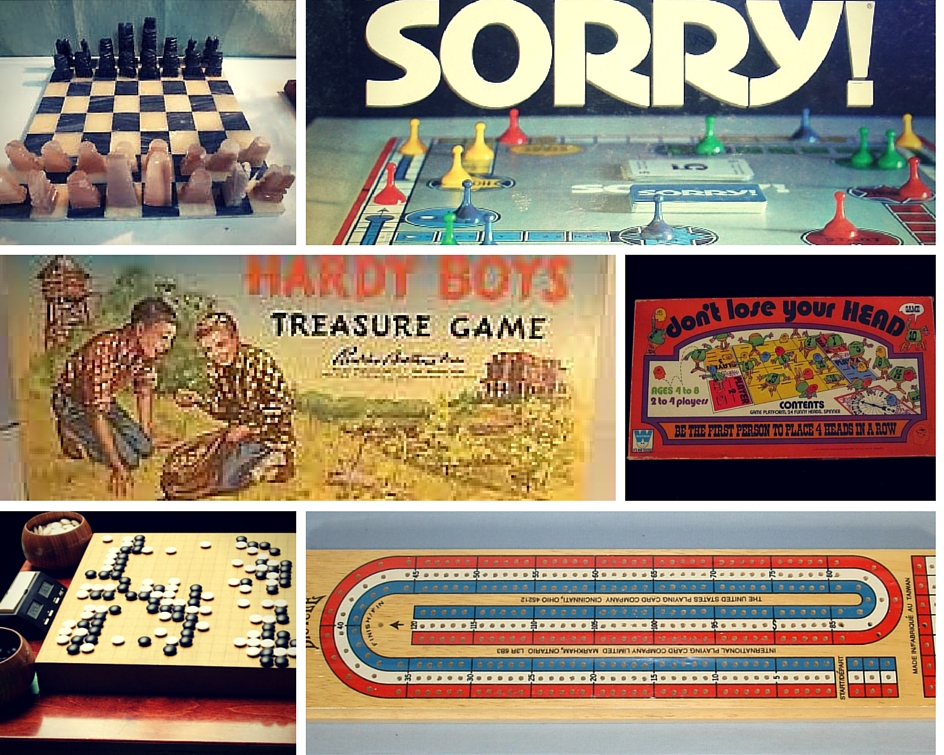
    Board games including chess, sorry, the hardy boys treasure game, don't lose your head, go, and cribbage.
    Some of my favourite childhood games

    I was by no means the next Bobby Fischer, but I got pretty good at the game throughout my childhood and teen years. Sure I had games where I got too cocky and underestimated my opponent and promptly had my rear end handed to me on a platter, but overall I was always learning and getting better. My grade six teacher introduced my class to the strategy game of Go – and for a few years I abandoned chess and played Go every chance I could, but by high school I was back to chess.

    There was a brief period of time where I didn’t play board games in early university – though my best friend is one heck of a cribbage player and we did play a lot of online cribbage. The crowd I hung out with didn’t really play board games and I was busy with school, football, and the newly discovered world of online gaming. Then I found friends who loved board games as much as I did, or even more and they introduced me to games I’d never heard of and some I’d heard of and never played. Sometimes there was a good reason for having not played them as I discovered when I lost an entire weekend to a mega game of Risk and another weekend to Axis and Allies. Those games take an amount of patience I just don’t possess most of the time.

    So I was launched into the world of strategy board games with offerings like Settlers of Catan, Carcassonne, Puerto Rico, Thurn and Taxis, and Ticket to Ride. My friends would often host board game afternoons or evenings and we’d start with a warm up game and move to the more pure strategy games afterwards. Every so often Jenga would come up and I’d be reminded of a word I first learned in the context of playing chess, but that is applicable to a lot of other games when you have to make a move even if it’s not in your best interest to do so: Zugzwang.

    %{include image.html url=“/wp-content/uploads/2016/06/coollogo_com-33313043.png” alt=“Stylized word Zugzwang” description=“Zugzwang”}

    The term zugzwang was first used in chess literature in Germany in the 1850s and was used in English referring to chess by the turn of the century. The concept, however, is far older than that having appeared in chess literature in the early 1600s. Zugzwang is a compound word, comprised of zug – meaning “move” and zwang – meaning “compulsion”. Zugzwang, then, is the compulsion to make a move even if it is to your detriment. Often the condition of zugzwang is such that the player will lose by making any of the possible moves. The word has escaped the chess world though, and can also be applied to those rock and a hard place scenarios where you’re damned if you do and damned if you don’t.

    What got me thinking of zugzwang this week wasn’t board gaming, but the situation at the Cincinnati Zoo where the Gorilla was killed by zookeepers after a young child got into the enclosure and the 400 lb gorilla was standing over him. The zookeepers were very much in a condition of zugzwang – no matter what they did they would have been wrong in the eyes of the public. Had the gorilla killed the boy, while zookeepers were waiting for tranquilizers to take effect they would have been criticized for taking too long. Had they attempted to rescue the boy and something gone wrong, they’d be criticized. If you’ve seen any of the coverage, you will know they are being criticized for shooting to kill. Total zugzwang. 

    Zugzwang (zug·zwang) noun

    A situation in which the obligation to make a move in one’s turn is a serious, often decisive, disadvantage.

     

  • Word Wednesday: Circular Logic

    Word Wednesday: Circular Logic

    It should come as no surprise that I subscribe to two different “word of the day” emails – I love language and jump at any chance I get to expand my vocabulary. Sometimes I already know the “word of the day”, and other times they’re so obscure I can’t find a use for it in my everyday life, but file it away in my brain for later use. Once in awhile a word comes into my inbox that is new to me and fits perfectly into my life – and today’s word is one of those.

    Being a word nerd from a very young age (I was reading chapter books in kindergarten and read the Hobbit for a grade 2 book report when the rest of my class chose Clifford or Franklin books) means that I have a pretty decent vocabulary, and the fact that I took Latin and French in high school helps me figure out words I haven’t come across before. I have a predilection for words that roll off the tongue nicely. Some words just feel right as you say them, and others just always feel awkward and no matter how much you try to make yourself like them, you find yourself using them less and less. I have tons of words that fall into this category – I still try to use them but they never feel right.

    %{include image.html url=“/wp-content/uploads/2016/03/coollogo_com-187152691.png”” alt=“Stylized word Lexical1” description=““}

    Words have a tendency of being tied up in their grammatical rules and losing favour because of that. I’ve often wished there was a way to look at words on their own, separated from all the grammatical constraints that can render them useless. It turns out there is a word for that. The fact that there’s a word specifically for the study of words and vocabulary of a language separate from grammatical aspects, means that I’m not the only one who wants this kind of information. We should start a club or something. There would have to be a ban on word games though, us word nerds can get super serious and uber competitive about Scrabble, Bananagrams, or Upwords, and that wouldn’t be much fun. Hrm. A word nerd club. I’m going to put that on my “great ideas” list that I never seem to manage to get to. How does one start a club anyway? Can anyone start a club? Related idea: a club for people who like to go off on tangents… or have ADHD… or both. I could totally be president of that club.

    A small brown squirrel sits in a tree
    Squirrel! Wait… what was I saying?

    Back to my word though. It’s a fairly recent word. though significantly older than grok was when I talked about it last month. Lexical dates from the mid 19th century, when I suppose people had time and the literacy skills to start thinking about words more. It comes from the Greek root  lexikos  which means “of or relating to words”. Not to be confused with the Latin root word Lex which relates to laws or ruling.

    Lexical (lex·i·cal) adjective

    Of or relating to the words or vocabulary of a language

  • Board games I like for kids on the Spectrum.

    Board games I like for kids on the Spectrum.

    Last week I blogged about how I use <a href=“https://jennannis.com/its-my-turn-the-challenges-of-turn-taking-with-kids-who-have-asd/” title=““It’s MY TURN” – The challenges of turn taking with kids who have ASD”>board games to help teach turn taking skills to kids with ASD. I’ve been asked what games I recommend and while I have some general guidelines and games that I always try out, not every game will be a hit with every kid.  I mentioned last time that Chutes and Ladders can be tricky as there is an element of chance in it, but it doesn’t have any text to read (a great thing in a kid’s game) and some kids really love the game. Some games come in character variant like Dora the Explorer or Transformers so that they engage kids’ interest. If you can find a game the child is interested in, that’s half the battle right there – they’ve bought in.  So, what games do I have in my stash for kids with ASD? It’s probably not what you’d expect.

    I love to start with Guess Who? for kids who already have verbal skills because it helps them learn to ask questions as well as being a very visually based game. As a bonus, the faces also have expressions on them so you can re-use the board for teaching emotions. The game is really easy to learn and if there are any issues with which questions to ask, you can provide a list or give them some suggestions. Guess Who isn’t noisy – the loudest noise it makes is when the “wrong” pictures are flipped down – and if you do it quietly, it mitigates that nicely. There are versions without the faces – with animals or Disney characters so depending on what you want you can get a different version, though I prefer the original with the faces.

    For kids whose verbal skills aren’t quite advanced enough, or for younger children, Lucky Ducks by Milton Bradley is a great beginner game. There are 12 ducks each with symbols on their undersides. The first person to find 3 ducks with matching symbols wins. It’s simple but still a lot of fun. Another great option for kids who can’t yet read is the ever-popular Candy Land. Candy Land is easy to play, requires no reading, just matching of colours and pictures. As a note, I recommend the “classic” version of the game over the newer “bookshelf” style as the game board is sturdier and the spinner works better.
    <

    A great introduction to basic strategy games is the ever popular Connect 4. I played this game a lot as a kid, it was fun and fairly quick but it taught some important lessons on strategy. Do you go for the win and leave yourself possibly exposed? It’s all a balancing act and Connect 4 does it well. The original game pieces (not so much the knock offs or travel versions) have textures around the edges that make them easier to pick up for kids with fine motor issues.  The game is a little noisy, especially at game end when all the plastic pieces are released but playing on a placemat or tablecloth dampens the sound considerably.

    My all time favourite games to start with though, are Co-operative games. There are dozens of games to choose from, so you can pick one that works with the interests of the child. They all have one thing in common – all players work as a team to win the game.  This is great for two reasons. Firstly, it eliminates some of the competitiveness of the game and helps kids focus on playing together instead of as opponents. Secondly, it helps encourage good turn taking skills because what other players do on their turn directly impacts your turn so there is incentive to pay attention even when it is not your turn to move. As an added bonus, many of these games teach extra skills – Harvest Time, for example teaches kids about the seasons and how crops grow through spring and summer and are harvested in fall before winter. These games are geared towards everybody winning, but be aware that everybody can lose as well. When that happens, I usually start a discussion about what we might have done differently to win the game and then test out the theory by re-playing the game. (The answer to “what could we have done differently to win the game?” is always “helped each other more” – another nice feature of the games.) The Co-operative games are great because they engage the kids but aren’t so annoying that adults don’t want to play them repeatedly.

    As a rule, I stay away from games like Perfection because when the timer goes off and the pieces are launched, it can be loud and frightening for some kids, also some of the pieces go flying and are hard to find! Hungry Hungry Hippos is very fast paced which is good, but it’s also really noisy with all the marbles on the plastic tray, which can be really hard on some sensory kiddos. The family favourite game Uno comes in many variants so you can pick a character variant that your kid is into. For beginners, there are different character editions of My First Uno, such as which feature larger cards and pictures to help with pattern recognition (for example, all 6s have the same character on them so the players can match the numbers OR the pictures). There are less cards so the deck has to be shuffled more with the My First Uno games, but they’re a good introduction to the game. My only warning with Uno as a whole, is that if you’re just introducing turn taking games, hold off on this one awhile. The reverse direction cards can throw newly minted turn takers for a loop. The skip a turn feature can also lead to some crankiness so it’s better to wait a bit before introducing Uno.

    For older kids who love to find patterns, you can’t beat the classic card game Set. Set was one of my favourite indoor recess games, and I own a copy now and still love playing it. To create a ‘set’, a player must locate three cards in which each of the four features is either all the same on each card or all different on each card, when looked at individually. The four features are, symbol (oval, squiggle or diamond), color (red, purple or green), number (one, two or three) or shading (solid, striped or open). You can play the game on your own, in turns, or competitively which makes it a great game to grow on. I usually recommend it for ages 10 and up but have played with younger kids who can understand the rules of how to make a set, and have enough of a tolerance for frustration that they can spend the time needed to look for the set in the cards laid out.

    These are my top go-to games when I’m working on turn taking or just enjoying the social aspect of games. I tend to stay away from noisy games, games that need batteries, and games with long turn times until the habit of gaming is firmly established. I don’t have any games specifically made for people with ASD, such as ones that directly teach social skills, mostly because I don’t think you always need to get specialized equipment, and it’s good to expose kids to games they may see in the classroom or at a friend’s house. Do you have any favourite family games at your house? I’d love to know what they are. I wrote about my favourite games right now in a post here.